

[Kakizome] Four-character idioms fit for the New Year: Introducing words that resonate with the heart and their meanings

Are you thinking about what words to write for your first calligraphy of the year? Four-character idioms, which are popular every year, pack deep meaning into just a few characters and are perfect for expressing New Year’s resolutions.
Still, many people may wonder, “Which idiom should I choose?” In this article, we’ll introduce four-character idioms that are well-suited for the first calligraphy of the year.
From bold, striking phrases to words that fit your New Year’s determination, find the expression that’s just right for you.
- Four-character idioms for New Year’s resolutions! A collection of motivational phrase ideas
- Become positive with four-character idioms that resonate with the heart! Common yet deeply meaningful words.
- [Elementary School Students] Perfect for Kakizome! A Collection of Four-Character Idiom Ideas
- General: Four-character idioms that encourage determination—powerful, heart-stirring words
- For Elementary School Students: Four-Character Idioms You Can Use for New Year’s Resolutions — How to Set Cool Goals!
- [Four-Character Idioms] Impressive and Cool Sound! A Collection of Famous Quotes Worth Knowing as General Knowledge
- Learn the meanings too! Cool four-character idioms that elementary school students will want to remember
- Four-character idioms that help you achieve goals! Phrases you can use in everyday situations
- Four-character idioms that pioneer the future: powerful words that express challenge and effort, perfect as personal mottos.
- Easy-to-remember, positive four-character idioms for elementary school kids! Words that brighten the heart
- Recommended for elementary school class goals! A collection of impactful ideas using four-character idioms
- Strive toward your goals! Four-character idiom ideas that resonate with elementary school students
- Four-character idiom slogans for groups! Words that convey a powerful message
[Kakizome] Four-character idioms suited for the New Year: Introducing words that resonate with the heart and their meanings (21–30)
Blue sky beyond the clouds
@34m0923 When you look up at the sky, what do you see? Clouds, or a blue sky? Kirari – Fujii Kaze (cover by Fugen @whogen_) ↑ You can listen to Fugen’s lovely singingBlue sky beyond the cloudstranslationcloudBlue skyHope#Kirari#FujiiKazeCover songWind StringsFugen FTW
Original song – Fugen (Fūgen) – whogen Fugen
Even when we go about our daily lives as usual, small mishaps can happen.
We may also encounter things we never expected.
Older people, having lived longer, have likely experienced even more.
Some may have faced problems, put in effort, and overcome hardship.
The idea is that beyond what we overcome—like the sky above us—there’s a wonderful blue sky spread out above the thick clouds.
It’s a metaphor.
Even when we face difficulties, it can fill us with energy and a roused, determined spirit.

majestic and dignified
It means approaching things calmly, confidently, and with a dignified bearing.
In sports, it describes the attitude of trusting your own ability and playing solidly.
For example, a runner who takes a deep breath and focuses before the start, a soccer player who handles the ball with composure, or a basketball player who sinks a shot coolly are examples of “ifu dodo.” In simpler words, it means “to act calmly and confidently, with dignity.” By keeping this in mind, you can perform to your potential even when nervous, and it helps stabilize the team’s atmosphere.
Ifu dodo is a cool phrase that expresses inner strength and poise, and it’s an important mindset for athletes.

diligent effort
@0qf_harvey_3005 diligent effort#shortstranslationProverb
♬ original sound – 0qf_harvey_3005 – 0qf_harvey_3005
Pronounced “funrei-doryoku,” this four-character idiom means to muster your spirit and devote yourself wholeheartedly to your goal.
When you want to succeed at something, you need energy, effort, and a strong will to see it through.
If you find it hard to stay positive or feel your motivation slipping, try recalling this phrase to draw out your inner strength.
Because it serves as a mental pillar, it also makes a great personal motto or New Year’s resolution.

turn over a new leaf

Simply put, it means “Correct what was wrong and move forward each day as a new you.” Some people brood endlessly over what’s past; others shrug off unpleasant things in no time—everyone has their own temperament.
You might think, “Ah, I wish I had a straightforward, no-nonsense personality like that,” but even those forthright people have their own worries.
You could call it a matter of mindset, and leave it at that, but I believe the phrase ‘kaika jishin’—amending past faults and renewing oneself—will give your slightly downcast heart a timely lift.
The characters are different, but renewing yourself (自新, jishin) also becomes self-confidence (自信, jishin)!
a clear and serene mind

It’s a four-character idiom that describes a state where the mind is bright like a polished mirror and calm like still water.
For example, before a competition you might feel your heart pounding.
If you take a deep breath and steady your mind at such times, you’ll feel refreshed, like a tranquil lake without a single ripple, and you can reach a state of meikyō-shisui.
With both your head and heart clear, it’s easier to perform at your best.
“Meikyō-shisui” is the perfect phrase for when you want to cleanse and calm your mind.
Whether you’re a child or an adult, if your heart feels unsettled, try remembering this phrase.
self-praise

This is a four-character idiom that describes praising or boasting about one’s own actions and thoughts.
It comes from the image of someone writing a poem or prose praising a picture they themselves painted.
People often confuse the characters for “painting” and “self,” so be careful.
Because it carries a strong negative nuance and is mainly used to criticize conceited people, you should use it with caution.
If you deliberately apply it to yourself, though, it can suggest that you’re moving forward in your own way and taking on challenges with confidence.

Wind, Forest, Fire, Mountain
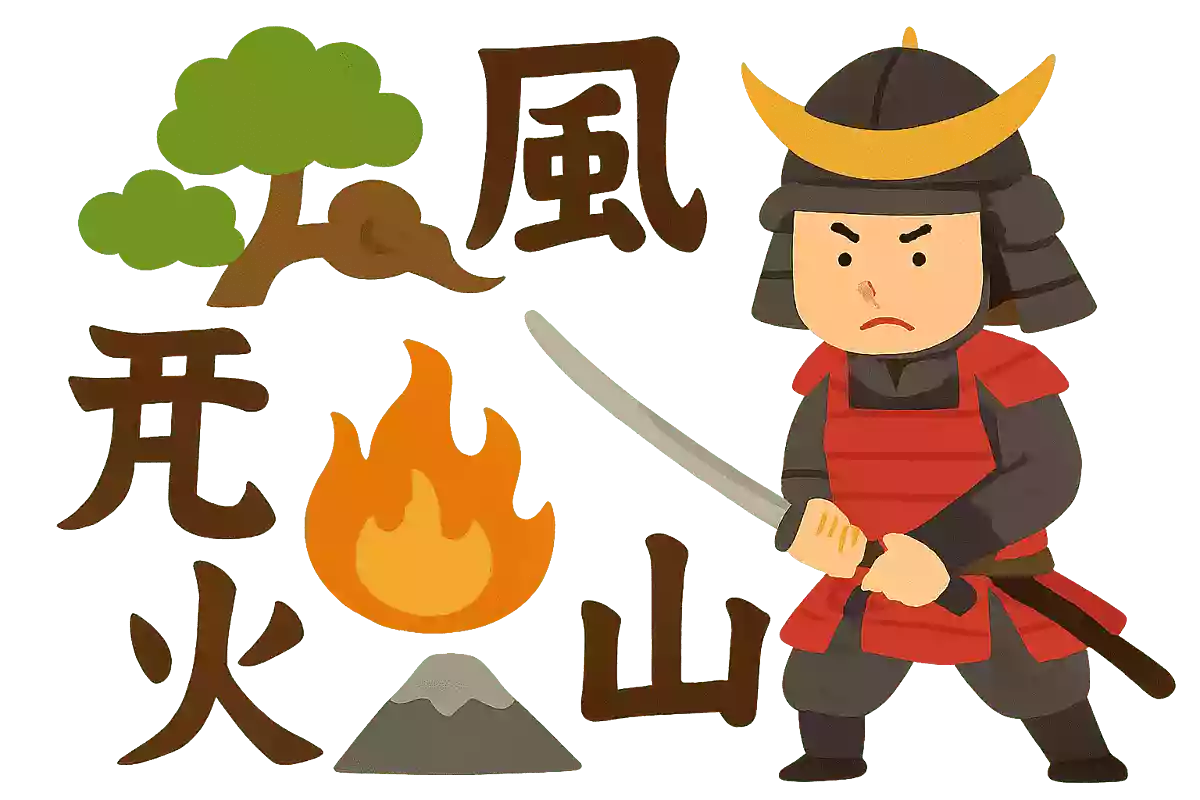
People say, “His life is like Fūrinkazan.” This sentence means that he responds flexibly to various situations and takes bold action as needed.
“Fūrinkazan” is a famous four-character idiom written on the war banner of the warlord Takeda Shingen.
When using the idiom “Fūrinkazan,” it’s clearer to the listener if you explain specifically how each element—wind, forest, fire, and mountain—maps to actions, behaviors, or states.
