

[Kakizome] Four-character idioms fit for the New Year: Introducing words that resonate with the heart and their meanings

Are you thinking about what words to write for your first calligraphy of the year? Four-character idioms, which are popular every year, pack deep meaning into just a few characters and are perfect for expressing New Year’s resolutions.
Still, many people may wonder, “Which idiom should I choose?” In this article, we’ll introduce four-character idioms that are well-suited for the first calligraphy of the year.
From bold, striking phrases to words that fit your New Year’s determination, find the expression that’s just right for you.
- Four-character idioms for New Year’s resolutions! A collection of motivational phrase ideas
- Become positive with four-character idioms that resonate with the heart! Common yet deeply meaningful words.
- [Elementary School Students] Perfect for Kakizome! A Collection of Four-Character Idiom Ideas
- General: Four-character idioms that encourage determination—powerful, heart-stirring words
- For Elementary School Students: Four-Character Idioms You Can Use for New Year’s Resolutions — How to Set Cool Goals!
- [Four-Character Idioms] Impressive and Cool Sound! A Collection of Famous Quotes Worth Knowing as General Knowledge
- Learn the meanings too! Cool four-character idioms that elementary school students will want to remember
- Four-character idioms that help you achieve goals! Phrases you can use in everyday situations
- Four-character idioms that pioneer the future: powerful words that express challenge and effort, perfect as personal mottos.
- Easy-to-remember, positive four-character idioms for elementary school kids! Words that brighten the heart
- Recommended for elementary school class goals! A collection of impactful ideas using four-character idioms
- Strive toward your goals! Four-character idiom ideas that resonate with elementary school students
- Four-character idiom slogans for groups! Words that convey a powerful message
[Kakizome] Four-character idioms fit for the New Year: Introducing words that resonate with the heart and their meanings (51–60)
ecstatic; overjoyed; beside oneself with joy

You might not hear ‘uchōtengai’ very often, but you’ve probably heard ‘uchōten,’ right? Uchōten refers to a state where things go so well that you become overjoyed to the point of losing sight of your surroundings.
In other words, uchōtengai describes being even more ecstatic than uchōten.
It’s natural to be happy when things go well, but if you don’t pay attention to your surroundings, you might get into an accident or get hurt.
If you’re going to be uchōtengai, make sure you’ve secured your safety first.
And if you can also think about how your display of joy looks to those around you, that would be wonderful.

to eat and drink like a horse; gluttony and heavy drinking

This four-character idiom describes gulping down food and drink in large quantities—like cows drinking water and horses eating fodder—and expresses a voracious appetite.
It’s similar to “binge eating and drinking,” and is often used with a negative nuance, but it can also convey positive feelings when simply highlighting hearty appetite.
Because animals eat as much as they want when they want, the phrase can also evoke an image of unrestrained desire, prompting us to reflect on our own approach to eating.
Since it can carry either a positive or negative meaning, it’s important to judge from context which sense is intended at the moment.

ecstatic frenzy

This four-character idiom expresses a state of intense joy so great that you can’t help but break into dance.
It conveys the utmost happiness, with each character carrying a positive nuance in its strength.
Even the “ecstatic joy” part alone communicates delight, but adding “wild dance” brings a comical feel, as if you might actually start dancing.
It’s less about everyday, casual happiness and more perfectly suited to special occasions—times when the joy feels especially big.
Where there’s a will, there’s a way.
Pronounced “seishin-ittō,” it carries the meaning that by focusing your mind, you can accomplish any difficult task, and that even challenging things can surely be achieved through sustained concentration and effort.
It’s an encouraging four-character idiom suggesting that if you stay focused and don’t give up on lessons, studies, or interests, you can reach your goals.
It may also be beneficial for parents to adopt the same mindset—watching over their children and boosting their spirits—as this can have a positive impact on the children as well.
Kakizome: Four-character idioms perfect for the New Year. Introducing words that resonate with the heart and their meanings (61–70)
to lie on firewood and taste gall (an idiom meaning to endure hardship and persevere for future revenge or success)
This four-character idiom, read as “gashin-shōtan,” means to endure hardship and persevere over a long period of time in order to achieve a goal.
As you keep working hard, there will be moments of failure or discouragement.
At such times, this idiom may support some children.
Even if they experience setbacks, it would be wonderful if they could use those experiences as a springboard to aim higher and ultimately accomplish their goals.
It is one of the expressions we especially want to pass on, as it helps cultivate the strong willpower and focus needed to keep striving without giving up.
stubborn to the core

This four-character idiom expresses sticking to a decision, idea, or belief to the very end without listening to other people’s opinions.
“Stubborn” can carry a negative impression of being inflexible, and the idiom is sometimes used with that nuance as well.
It’s interesting that it carries both a positive image of staying true to one’s convictions and a negative one.
It feels like a word that directly conveys the strength of will to charge ahead in your own way.
with all one’s might4
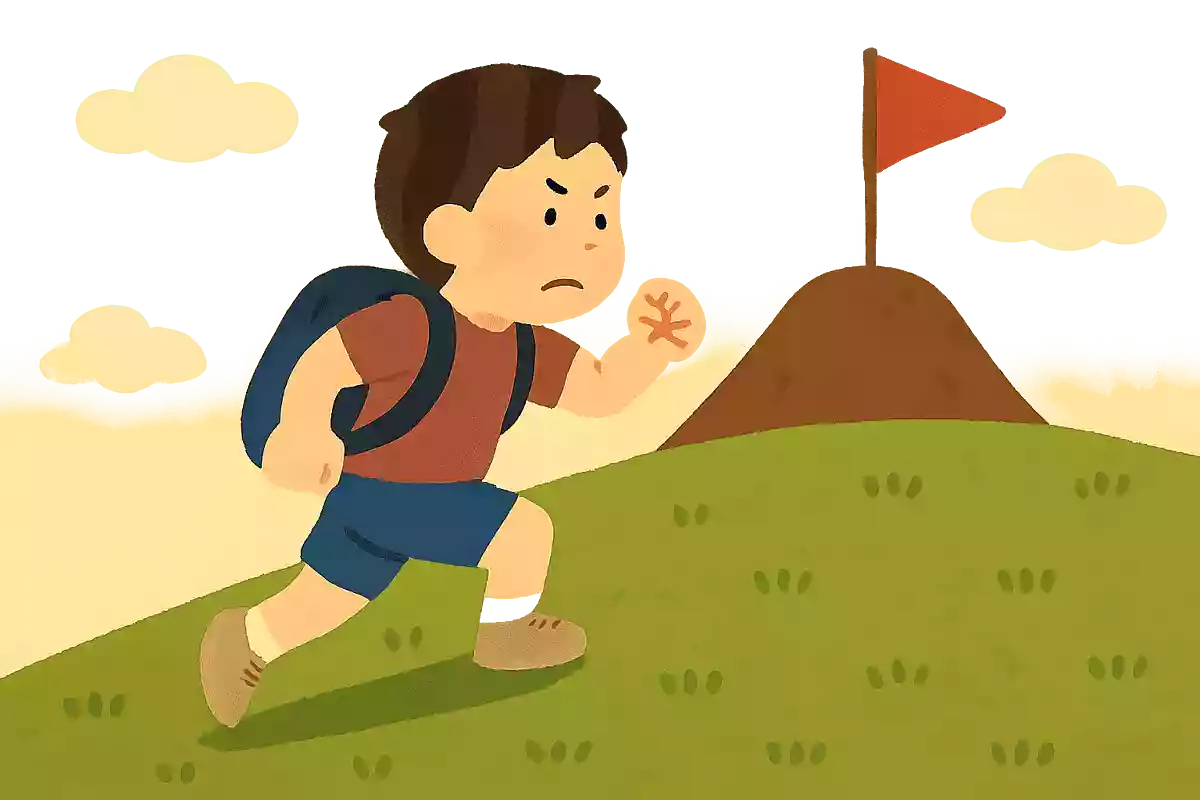
This is a four-character idiom you often hear in various contexts, expressing an attitude of tackling things with full effort.
Its origin is said to be “issho-kenmei,” which described the stance of medieval samurai; from the idea of defending a single place with all one’s might, the meaning evolved into “isshō-kenmei,” devoting one’s whole life.
The key to this word is the passion of being willing to stake one’s very life; if you show that you understand and use it with that meaning, you can demonstrate your determination as well.
It’s a phrase that reminds us that what matters first is to engage so earnestly that you can truly say you’re giving it your all.