Although his music belongs to the Romantic era, it respects the classical sense of form, allowing you to feel both Romantic expression and a majestic atmosphere.
Johannes Brahms Popular Songs Ranking [2026] (71–80)
Holy LullabyJohannes Brahms71rank/position
Brahms: 'Sacred Lullaby' from Two Songs
This is the second of the Two Songs composed by Johannes Brahms to celebrate the birth of Joseph Joachim’s son, setting music to a text by Emanuel Geibel, which is a reworking of a poem by Lope de Vega.
It is scored for alto (a female voice type), viola (a lower-voiced member of the violin family), and piano.
As with A German Requiem, the texts were selected by Brahms himself from the Bible.
Songs 1 and 2 are from Ecclesiastes in the Old Testament, Song 3 is from Sirach in the Old Testament, and Song 4 is from the First Epistle to the Corinthians in the New Testament.
Intermezzo in B minor, Op. 119 No. 1 (Four Pieces, No. 1)Johannes Brahms75rank/position
Brahms – 4 Klavierstücke, Op. 119
Among the masterpieces left by the German composer Johannes Brahms, the short pieces he wrote late in life have a special poignancy.
Composed in 1893, this work strongly reflects Brahms’s inner turmoil and sense of loneliness.
Beginning with slow, dark chords, its world of sound—woven from complex harmonies and delicate expression—awakens deep emotion in the listener.
In a letter to Clara Schumann, Brahms described the piece as “melancholy, with swirling dissonances,” and one can feel the composer’s quiet resolve as he contemplates the end of life.
It is a highly recommended piece for those who are drawn to introspective music.
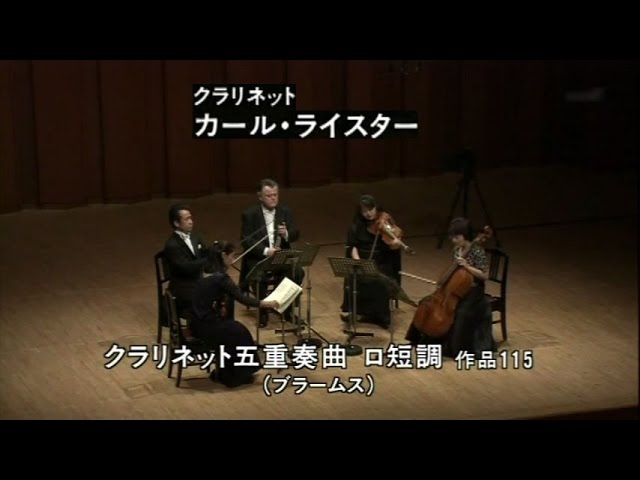
Clarinet Quintet in B minor, Op. 115Johannes Brahms77rank/position
Brahms Clarinet Quintet in B minor, Op.115
Brahms, a leading musician of the late 19th century, is known as a representative German composer, often mentioned alongside fellow Germans Bach and Beethoven.
The chamber work for clarinet and string quartet that he composed in his later years is a gem in which mature craftsmanship and deep emotion are beautifully fused.
Inspired by his encounter with a clarinetist, the piece embodies Brahms’s gentleness and a sense of resignation.
It’s a highly recommended work for those interested in classical music who aren’t sure where to begin.