

Johannes Brahms Popular Songs Ranking [2026]

Johannes Brahms, a German composer.
Although his music belongs to the Romantic era, it respects the classical sense of form, allowing you to feel both Romantic expression and a majestic atmosphere.
Here is a ranking of some of his popular pieces!
- Brahms's masterpieces. Popular classical music.
- [Masterpiece Classics] A special showcase of gem-like masterpieces so beautiful they’ll move you to tears
- Ludwig van Beethoven Popular Songs Ranking [2026]
- Anton Bruckner Popular Songs Ranking [2026]
- Johann Burgmüller Popular Song Rankings [2026]
- J.S. Bach Popular Songs Ranking [2026]
- Robert Schumann Popular Song Ranking [2026]
- Taro Hakase’s famous and popular songs
- A poignant classic masterpiece. Recommended classical music.
- Gustav Mahler Popular Songs Ranking [2026]
- Franz Liszt Popular Song Ranking [2026]
- Antonín Dvořák Popular Songs Ranking [2026]
- Johann Strauss II Popular Song Ranking [2026]
Johannes Brahms Popular Song Rankings [2026] (21–30)
Symphony No. 1 in C minor, Op. 68Johannes Brahms22rank/position

Brahms’s First Symphony, which he finally completed after the age of forty, came to fruition only after twenty-one years of deliberation from conception to completion in his effort to create a symphony worthy of succeeding Beethoven.
Crafted with fearsome care and burning passion, the work earned such high praise for its perfection that conductor Hans von Bülow called it “Beethoven’s Tenth Symphony.” Steeped in dramatic tension that seems to reflect Brahms’s own struggles, it embodies the trajectory “from suffering to victory.”

Symphony No. 1 in C minor, Op. 68 — I. MovementJohannes Brahms23rank/position

Conducted by Herbert von Karajan, the Berlin Philharmonic Orchestra.
In opposition to the program music of the Romantic era, Brahms argued that music should stand on its own as music, asserting “absolute music” in the tradition of the Viennese Classicists.
Symphony No. 1 in C minor, Op. 68 – Fourth MovementJohannes Brahms24rank/position

This work is Brahms’s first symphony, yet it took him 21 years from conception to completion.
He revered Beethoven’s symphonies and agonized over the question, “I want to write a symphony, but what kind of piece could I possibly write after Beethoven?” The result, completed after overcoming that dilemma, was a work so highly regarded that the conductor Hans von Bülow called it “Beethoven’s Tenth Symphony.” Driven by a beautifully uplifting melody and propulsive rhythms, the piece unfolds and concludes with a power befitting the climax of the entire work.
Symphony No. 3, Movement IIIJohannes Brahms25rank/position

The premiere performer described it as “Brahms’s ‘Hero,’” but the overall mood of the piece evokes melancholy and romance rather than struggle.
Over the timbre of the woodwinds, the cello sings a sorrowful melody.
This theme has also been used in films and, with lyrics added, has been sung as popular music.
Lullaby, Op. 49 No. 4Johannes Brahms26rank/position
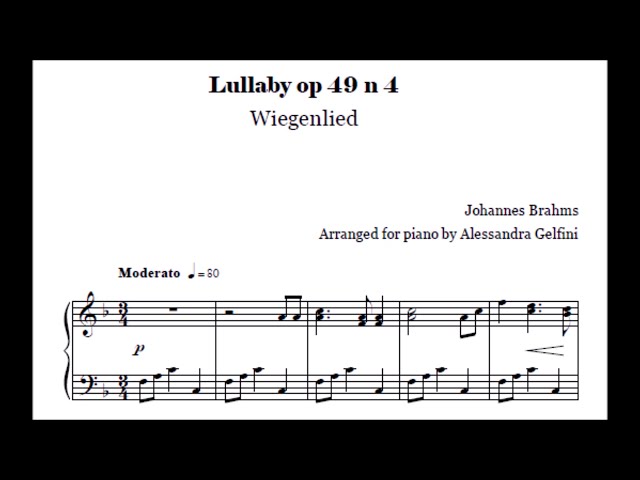
Among classical works, there are several pieces that bear the title “Lullaby.” Among them, alongside those by Schubert and Mozart, one of the most famous is Johannes Brahms’s “Lullaby, Op.
49 No.
4,” widely known as “Brahms’s Lullaby.” Its gentle, sparsely noted melody—typical of lullabies that lull children to sleep—is easy to play on the piano, making it perfect for beginners.
However, precisely because it is simple, the beauty of tone and flow becomes crucial.
Let’s aim for a soothing performance that helps listeners feel at ease and drift off to sleep.

Two Rhapsodies, Op. 79: No. 2 in G minorJohannes Brahms27rank/position

Johannes Brahms is one of the leading composers of the German Romantic school.
While honoring the formal beauty of Classicism, he left many works that also embody the lyricism characteristic of Romanticism.
The second piece of Two Rhapsodies, Op.
79, is striking for its grand main theme and its dark, surging triplet melody.
Within its passionate character, it preserves the framework of classical sonata form, and its performance demands advanced technique and deep musical understanding.
Though highly challenging both technically and expressively, it is a work I would strongly recommend to those who can dynamically convey a quiet, inner passion.
Three Intermezzi, Op. 117: No. 1 in E-flat majorJohannes Brahms28rank/position

The young Brahms created a masterpiece, Three Intermezzi.
Known for treating the piano as a member of the orchestra, this work is still performed by many pianists today.
Among them, I particularly recommend Three Intermezzi, Op.
117 No.
1.
While the set as a whole is technically demanding, No.
1 is structured in a way that makes it approachable even for beginners.
Please give it a try.
