The great master Beethoven, who is even rumored to have led a sad life.For many people, when you think of classical music, you think of Beethoven.We’ve compiled a ranking of his quintessential pieces.As you go through it, you might also catch a glimpse of changes in his mental state through the shifts in his musical style.
Ludwig van Beethoven Popular Songs Ranking [2026] (1–10)
Für EliseLudwig van Beethoven1rank/position
Für Elise / Beethoven / Für Elise (For Elise) / Beethoven / Piano / Tried playing / CANACANA
A famous work by Ludwig van Beethoven, the German master whom every pianist admires at least once.
Written in April 1810, this piece resonates in the heart with its wistful, beautiful melody.
It begins with a gentle, conversational, and calm theme that instantly captivates the listener.
However, the mood changes dramatically in the middle section, revealing a touch of mature passion and dramatic intensity.
It’s as if a straightforward heart crosses paths with the desire to act grown-up.
Perfect for elementary and middle school students who want to challenge themselves with rich emotional expression and play the piano as if spinning a story.
Imagine the changes in feeling from scene to scene, and perform with expressive nuance!
Piano Sonata No. 14 “Moonlight,” 3rd MovementLudwig van Beethoven2rank/position
Moonlight Sonata, 3rd Movement / Piano Sonata / Beethoven / Classic Piano / Classical / CANACANA
A piano work by Ludwig van Beethoven famous for its quiet, sorrowful melody.
But on Halloween night, the third movement—with a ferocity as if anger were exploding—is the perfect pick.
The opening figure that shoots upward like flying sparks is nothing short of breathtaking! Its relentless thrill feels like hurling the listener into the eye of a raging storm, leaving no time to catch one’s breath.
This chillingly intense melody is ideal for creating an eerie atmosphere as party background music.
Published in 1802, the piece continues to captivate across eras, even being quoted in the J-pop group °C-ute’s song “Mugen Climax.” Master it on the piano, and you’re sure to bring the house down with applause.
Beethoven, one of the most important composers in the history of music, is revered in Japan as the “Saint of Music,” and his monumental achievements are beyond words.
Among the many pieces familiar to everyone—from symphonies and orchestral works to rhapsodies and chamber music—we would like to introduce his highly popular Symphony No.
7, frequently featured in dramas and films.
Though classical in form, its rhythm-centered construction is strikingly innovative.
Wagner praised it as the “apotheosis of the dance,” while some other composers criticized it.
It’s accessible even to classical music beginners and highly recommended.
By the way, while some of his other symphonies bear titles like “Fate” and “Pastoral,” the Seventh is untitled—which is interesting in its own right.
Piano Sonata No. 14 in C-sharp minor, Op. 27 No. 2 “Moonlight,” I. AllegrettoLudwig van Beethoven4rank/position
Moonlight Sonata 1st Movement Piano Sonata / Beethoven / Moonlight Sonata (1st Movement) / Classic Piano / Classical / CANACANA
Ludwig van Beethoven’s masterpiece, Piano Sonata No.
14 in C-sharp minor, Op.
27 No.
2 “Moonlight,” opens with an achingly beautiful melody suffused with poignancy.
The first movement, marked by its gently repeating triplets, is known as a piece approachable even for beginner pianists.
Although the score is easy to read and the writing falls naturally under the hands, sustaining an even, accurate pulse while allowing the melody line to sing demands strong concentration and acute awareness in the fingertips.
Listen closely to the harmonic changes and immerse yourself in the piece’s world as you perform.
Ludwig van Beethoven was a composer who stood at the turning point from the Classical era to a new age of music.
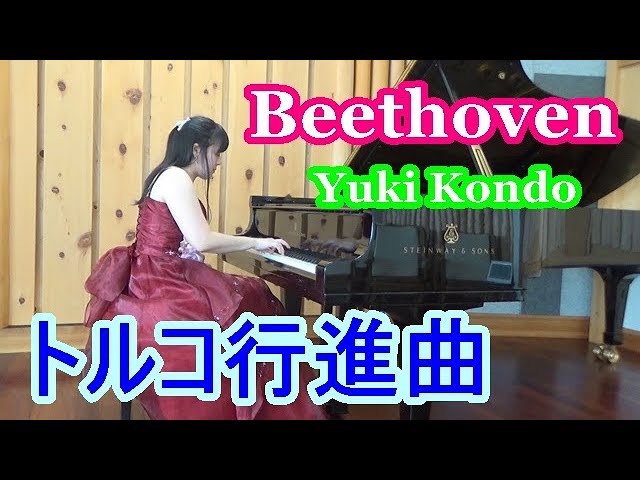
The “Turkish March,” a section from The Ruins of Athens composed between 1811 and 1812, was influenced by the Ottoman military band, the Mehter, and is known as a representative example of a work that incorporates Turkish elements into Western music.
In addition to the orchestral version, the Turkish March has been arranged for solo piano and has long been beloved in arrangements by Anton Rubinstein and Franz Liszt.
Characterized by its bright and lively character, it’s a staple often performed at piano recitals.
If you keep a steady rhythm in the left hand while playing the bold, march-like melody in the right, it’s a piece that brings a smile to both listeners and performers alike.
Piano Sonata No. 23, Op. 57 “Appassionata,” Third MovementLudwig van Beethoven6rank/position
[FAZIOLI] Beethoven “Appassionata” – 3rd movement / Piano Sonata No. 23 “Appassionata,” 3rd movement by Beethoven
Ludwig van Beethoven’s masterpiece, Piano Sonata No.
23, Op.
57 “Appassionata,” Third Movement.
Alongside the “Pathétique” and “Moonlight,” it is one of his most famous works and a representative piece by Beethoven.
This work can be considered a prototype of the celebrated “Fate” Symphony—one of the most widely known pieces in classical music—and it features many of his hallmark emotionally charged expressions.
Naturally, the performance difficulty rises in proportion to the richness of expression, but that very quality makes it a highly compelling piece to listen to, so be sure to check it out.
Piano Sonata No. 8 in C minor, Op. 13 “Pathétique,” 1st movementLudwig van Beethoven7rank/position
[First Steinway Recording] Beethoven – Piano Sonata No. 8 “Pathétique” First Movement - Classical - Beethoven - Pathetique Piano Sonata No. 8 Op. 13 - CANACANA
Ludwig van Beethoven’s Piano Sonata No.
8 in C minor, Op.
13 “Pathétique,” composed in 1798, is a work that gives voice to his suffering and the sorrows of youth.
Among its movements, the first is marked by dramatic emotional shifts and demands profound expressiveness.
Beginning with a grave introduction, it unfolds into a powerful, passionate main section, then returns to a closing section that draws out a quiet, tender emotion.
Performing this piece is a major challenge for middle school students, but the sense of accomplishment upon mastering it will be exceptional.
In practice, start by thoroughly grasping the structure and understanding the emotional character of each section.
Also, pay close attention to dynamics and articulation so you can properly convey both intense passion and quiet melancholy.


![Ludwig van Beethoven Popular Songs Ranking [2026]](https://i.ytimg.com/vi_webp/BSXV1crkcKc/maxresdefault.webp)