

Franz Liszt Popular Song Ranking [2026]

Franz Liszt, a pianist and composer born in Hungary who was active in Europe in the 19th century.
He possessed extraordinarily advanced piano skills, earning him the nickname “the Wizard of the Piano.”
This time, we’ve selected the most popular pieces from his catalog of masterpieces.
Please enjoy them with a cup of tea!
- A masterpiece by Franz Liszt. Popular classical music.
- [Lower Difficulty] Recommended Piano Pieces by Franz Liszt [Intermediate]
- Johannes Brahms Popular Songs Ranking [2026]
- Frederic Chopin Popular Songs Ranking [2026]
- [Piano Recital] Recommended for Middle Schoolers! A Comprehensive Introduction to Classical Masterpieces
- Franz Schubert Popular Songs Ranking [2026]
- Franz Joseph Haydn Popular Song Rankings [2026]
- François Couperin Popular Songs Ranking [2026]
- [Highest Difficulty] A selection of challenging pieces crafted by Liszt, the magician of the piano
- César Franck Popular Songs Ranking [2026]
- Sergei Rachmaninov Popular Songs Ranking [2026]
- Richard Wagner Popular Songs Ranking [2026]
- Johann Burgmüller Popular Song Rankings [2026]
Franz Liszt Popular Songs Ranking [2026] (31–40)
F major – Allegro sempre legato, No. 3 from 48 Etudes for the Practice of All Major and Minor KeysFranz Liszt36rank/position

A beautiful étude in F major with a bright, gentle resonance, published in 1826.
It is included in the album Étude en douze exercices, S.136, a set of twelve pieces that would later develop into the Transcendental Études.
For a work by Franz Liszt, its performance time is relatively short at about two minutes and thirty seconds, but it is a miniature rich in lyricism that goes far beyond mere finger exercises.
Rather than sharp attacks or flashy leaps, it calls for continuous, singing phrasing that keeps the melody connected.
It’s the perfect piece for those who want to refine their sense of smooth legato before tackling works that demand dazzling technique.
Try to keep the tone soft while maintaining finger independence as you play.
E-flat major – Allegro grazioso, No. 9 from 48 Exercises for the Practice of All Major and Minor KeysFranz Liszt37rank/position
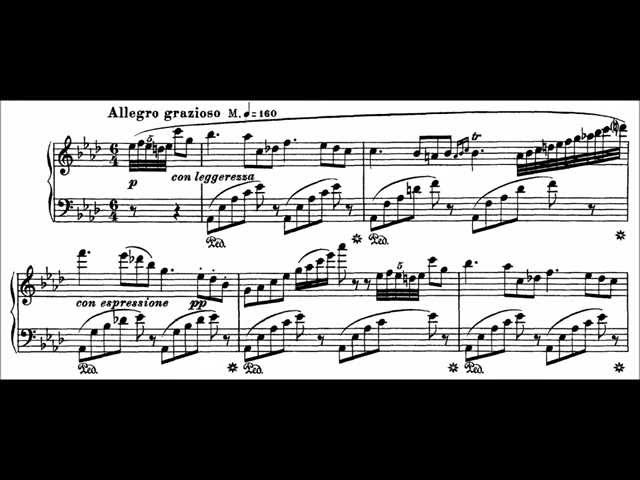
Etude No.
9 from Franz Liszt’s early set composed in 1826 is a significant milestone that foreshadows his later masterpieces.
Marked by flowing, graceful melodies and an improvisatory sense of timing, its warm sonority in A-flat major creates a romantic atmosphere.
Rich with elements for refining expression—such as delicate right-hand ornamentation and flexible tempo—it offers deep musicality that goes far beyond mere finger exercise.
It’s an ideal piece for those who wish to let a singing melody shine rather than showcase flashy technique.
Be mindful of pedal usage and the shifting harmonies as you savor the dreamlike world painted by the young genius.
“Whispers of the Forest,” No. 1 from Two Concert Études, S.145/R.6Franz Liszt38rank/position

A collection of piano pieces composed around the time Liszt moved to Rome and dedicated to his beloved pupil, Dionys Pruckner.
It consists of two pieces; the first, “Whispers of the Forest,” is notable for its graceful, airy melody reminiscent of leaves being carried off by the wind.
Grandes études de Paganini No. 3 in G-sharp minor “La Campanella,” S.141/3, R.3bFranz Liszt39rank/position
Completed in 1851, this piece is based on the third movement of Paganini’s Violin Concerto No.
2.
Franz Liszt, a leading composer of the Romantic era, was inspired by Paganini’s performances and resolved to become “the Paganini of the piano.” The result was this very work.
Its bell-like high-register sonorities leave a strong impression, and it pushes piano virtuosity to the extreme.
With leaps spanning as much as a fifteenth, it is a formidable piece that tests a performer’s skill.
It’s recommended not only for classical music enthusiasts but also for those interested in the possibilities of piano performance.
Each listening reveals something new—an exhilarating piece that sets the heart dancing.
From “Two Legends”: 1. Saint Francis of Assisi Preaching to the Birds, S.175 / R.17Franz Liszt40rank/position

It is a masterpiece whose graceful melodies resonate in the ear.
Composed by the Hungarian composer Franz Liszt between 1862 and 1863 and premiered in Budapest in 1865, this piece is based on the story of Saint Francis of Assisi preaching to the birds, expressing the beauty and sanctity of nature through music.
With the piano’s delicate timbre, it skillfully imitates birdsong and the sound of flowing water, and the scenes where the saint’s voice seems to speak gently are particularly striking.
Reflecting Liszt’s religious sensibility, this work is recommended for those who wish to connect with nature and faith.
Please enjoy this moving masterpiece by the composer known as the “magician of the piano.”
Franz Liszt Popular Songs Ranking [2026] (41–50)
Fountains of the Villa d’Este, No. 4 from Années de pèlerinage, Third Year, S.163/R.10eFranz Liszt41rank/position

This is a work composed in the late years of Franz Liszt, renowned as a master of the Romantic era.
It takes as its subject the fountains of the Villa d’Este in Italy, expressing the flow of water and the play of reflected light through delicate arpeggios.
Written shortly before his death in 1886, the piece showcases Liszt’s consummate artistry and is said to have influenced later Impressionist music.
With a performance time of about 7 minutes and 30 seconds, its tranquil yet richly expressive character makes it ideal for moments when you wish to calm the mind.
Although technically demanding, its beautiful melodies that evoke the movement of water are sure to captivate not only classical music enthusiasts but a broader audience as well.
Poetic and Religious Harmonies No. 7 “Funérailles,” S.173/R.14Franz Liszt42rank/position

This is a collection of ten piano pieces, composed under the inspiration of the poetry of Alphonse de Lamartine, a French poet with whom the composer had a close friendship.
Among them, the famous “Funérailles” is regarded as a memorial piece dedicated to Liszt’s acquaintances who were executed during the Hungarian Revolution.