

A masterpiece by Richard Strauss. Popular classical music.
Richard Strauss is a composer who represents the German late Romantic period.
Strauss’s representative work, the symphonic poem Thus Spoke Zarathustra, is known as the theme music for the film 2001: A Space Odyssey.
His symphonic poems Macbeth and Till Eulenspiegel’s Merry Pranks are also frequently performed by wind ensembles, making him a familiar composer to many wind band musicians.
In his early period, under the influence of his father, Strauss wrote many works that adhered to classical styles like those of Mozart and Schumann.
After meeting Alexander Ritter—who married one of Wagner’s nieces—he began composing more innovative works.
Here, I will introduce pieces that let you enjoy both Strauss’s classical side and his transformation into a master of the symphonic poem.
Listening in chronological order makes it easier to appreciate the changes in his style, so I hope you’ll keep the period of composition in mind as you listen.
Playlist
| A masterpiece by Richard Strauss. Popular classical music. | |||
|---|---|---|---|
| show_chart | Title | Playlist | Review |
| 1east | Symphonic Poem ‘Thus Spoke Zarathustra’Fritz Reiner/The Chicago Symphony Orchestra |  play_arrow play_arrow | Let's get to know the whole picture of Strauss's masterpiece, Also sprach Zarathustra |
| 2east | Don JuanRihyarto Shutorausu |  play_arrow play_arrow | Introduction to Strauss's Don Juan |
| 3east | Till Eulenspiegel’s Merry PranksDeividdo Jinman/Chūritto Tōnhare Kangen Gakudan |  play_arrow play_arrow | Strauss masterpiece: depicting a prank by an eccentric in a symphonic poem |
| 4east | A Hero’s LifeOzawa Seiji & Baiherun Hoso Koyogakudan |  play_arrow play_arrow | Strauss's final symphonic poem |
| 5east | Serenade for 13 Wind InstrumentsHirokami Jun’ichi shiki Kyōto-shi Kōkyō Gakudan | 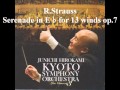 play_arrow play_arrow | Strauss’s breakout work, a classical and beautiful piece for wind instruments |
| 6east | SerenadeRihyarto Shutorausu |  play_arrow play_arrow | Serenade by Strauss: A Sweet Song of Love |
| 7east | An Alpine SymphonyBernard Haitink/Vienna Philharmonic Orchestra |  play_arrow play_arrow | Strauss's Alpine Mountaineering Piece |
| 8east | Horn Concerto No. 1 in E-flat majorRihyarto Shutorausu |  play_arrow play_arrow | Horn Concerto No. 1 by Strauss |
| 9east | Suite ‘Der Rosenkavalier’Rihyarto Shutorausu |  play_arrow play_arrow | Introduction to Strauss's Opera Suite |
| 10east | Suite ‘The Bourgeois Gentlemen’Rihyarto Shutorausu |  play_arrow play_arrow | A suite based on Molière, satirizing a townsman with aristocratic aspirations |
| 11east | Violin Concerto in D minor, Op. 8, TrV 110Vaiorin: Urufu Herushā/Kangenraku: Shutātsukapere Doresuden/Shiki: Rudorufu Kempe |  play_arrow play_arrow | Strauss’s only violin concerto |
| 12east | MacbethKenpe shiki, Shutātsikapere Doresuden |  play_arrow play_arrow | Strauss composed a symphonic poem. |
| 13east | SalomeRihyarto Shutorausu |  play_arrow play_arrow | The allure and impact of the opera Salome |
| 14east | Death and TransfigurationSā Georugu Shoruti shiki/Shikago Kōkyō Gakudan |  play_arrow play_arrow | Strauss’s masterful tone poem “Death and Transfiguration” |
| 15east | Oboe Concerto in D majorShutefan Shīri |  play_arrow play_arrow | Strauss’s late-period work, Oboe Concerto |
| 16east | ElektraRihyarto Shutorausu |  play_arrow play_arrow | Introduction to Strauss's operas based on Greek tragedies |
| 17east | Ariadne of NaxosRihyarto Shutorausu |  play_arrow play_arrow | A myth-themed operatic masterpiece by Strauss |
| 18east | Metamorphosen: Étude for 23 Solo String InstrumentsRihyarto Shutorausu |  play_arrow play_arrow | A string variation imbued with the sorrow of war |
| 19east | Symphonic Fantasia “From Italy,” Op. 16Zdenek Kosler/Slovak Philharmonic Orchestra |  play_arrow play_arrow | Explain Strauss’s first programmatic music work |
| 20east | Burlesque in D minor (for Piano and Orchestra)Maruta Arugeritchi |  play_arrow play_arrow | Characteristics of Strauss's piano concerto Burleske |
| 21east | Four Last SongsJōji Seru shiki / Berurin Hōsō Kōkyō Gakudan |  play_arrow play_arrow | A late work by Strauss, a large-scale song with orchestral accompaniment. |
| 22east | Double Little Concerto in F major, TrV 293, for Clarinet and Bassoon with String Orchestra and HarpRihyarto Shutorausu |  play_arrow play_arrow | Double Concerto work from Strauss’s late years |
| 23east | All Souls’ DayBarbara Bonney |  play_arrow play_arrow | Strauss’s song, a beautiful masterpiece in remembrance of the departed |
| 24east | Don QuixoteJōji Seru shiki, Kurīburando Kangengakudan |  play_arrow play_arrow | A symphonic poem based on Don Quixote |
| 25east | Suite for 13 Wind InstrumentsRihyarto Shutorausu |  play_arrow play_arrow | A masterpiece of a wind-ensemble suite composed by Strauss |
| 26east | Horn Concerto No. 2 in E-flat majorRihyarto Shutorausu |  play_arrow play_arrow | Strauss’s Horn Concerto |
| 27east | Violin SonataRihyarto Shutorausu |  play_arrow play_arrow | Violin Sonata composed by Strauss in 1887 |
| 28east | Domestic SymphonyRihyarto Shutorausu |  play_arrow play_arrow | A program symphony depicting Strauss's family life |
| 29east | Symphony No. 2Tanaka Ken shiki, ISP |  play_arrow play_arrow | Strauss Symphony No. 2 |
| 30east | Symphonic Fantasy after ‘Die Frau ohne Schatten’Tīreman shiki Uīn Firu |  play_arrow play_arrow | An aesthetic song arranged from an opera |