

Children’s songs, school songs, and nursery rhymes with a river theme. Beloved classics about nostalgic watersides.

Children’s songs and school songs that entrust the babbling and flow of rivers to music are filled with a unique sentiment that deeply resonates with the Japanese heart.
From nostalgic tunes hummed in childhood to memorable songs learned at school, many people still remember river-themed pieces even as adults.
In this article, we introduce works that sing of the river’s beauty as it changes with the seasons and of the creatures that live in and around it.
Please enjoy as you bask in fond memories.
- Children’s songs, school songs, and nursery rhymes with a river theme. Beloved classics about nostalgic watersides.
- [Elementary School Music] List of Popular and Nostalgic Songs That Have Appeared in Textbooks
- [February Songs] Introducing children's songs, folk songs, nursery rhymes, and hand-play songs about Setsubun and winter!
- March nursery rhymes & hand play songs! Spring songs you can enjoy with your kids
- Spring songs from the early Showa era: a collection of kayōkyoku and shōka that evoke spring
- Lullabies: children's songs, folk songs, and nursery rhymes. Nostalgic songs for putting children to sleep.
- Nostalgic Children’s Songs, Folk Songs, and Nursery Rhymes: The Heart of Japan Passed Down Through Song
- [Warabe-uta] Beloved Classic Songs Passed Down Through Generations
- [Sea Nursery Rhymes] Fun children's songs themed around the sea
- Lullabies of the World: Beloved and Popular International Songs That Soothe Children
- Ranking of Popular Folk Songs
- Japanese Shoka, Children's Songs, and Nursery Rhymes | Timeless masterpieces that resonate in the heart, passed down across generations
- Nursery rhymes to sing in spring: a collection of classic songs you'll want to sing with your children
Children’s songs, school songs, and nursery rhymes themed around rivers: Beloved waterside classics (21–30)
Spring StreamNihon Gasshō Kyōkai

It is said to be a Ministry of Education school song published in 1912, with lyrics by Tatsuyuki Takano and music by Teiichi Okano.
Its first appearance was in “Elementary School Songs for the Fourth Grade,” and although the lyrics have undergone changes, it has been sung continuously up to the present day.
There are theories that the river in the song was modeled on the Kobokegawa, a tributary of the Udagawa, and theories that it refers to a river in Nagano Prefecture, where Takano was from.
Let’s play by the riverSuzuki Tsubasa & Roketto Kureyon

This song was created mainly by Rocket Crayon (Takashi Yamaguchi and Satoshi Takada), who are active while working at a daycare center as childcare workers.
Yamaguchi composed the music, and in addition to the two members of Rocket Crayon, Hirotaka Nakagawa and Tsubasa Suzuki—both also involved in children’s songs—participated as lyricists.
Song of Leaving My HometownMineko Ando

It was first introduced in the 1913 publication Shin-saku Shōka, Volume 5.
The original melody is the German folk song/art song Der letzte Abend (The Last Evening), with lyrics written by Yoshimaru Kazumasa, the lyricist known for Early Spring Song (Sōshunfu).
The lyrics describe a farewell to the grasses and trees, the mountains, and the river of one’s hometown.
The Valley of the Red RiverTōkyō Maisutā Jingā
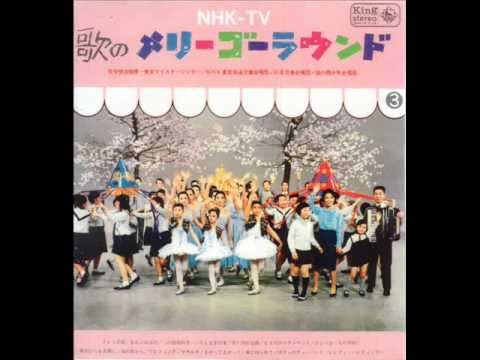
The Red River refers to the Red River in Texas, USA, and this folk song tells of a romance between a white settler and a Native American woman during the Westward Expansion era.
With Japanese lyrics by Kanji Kobayashi, the version sung by Mieko Hirota and the Tokyo Broadcasting Children’s Choir was broadcast on NHK’s “Minna no Uta” in 1963.
Waterwheel on the riverbankharayama katsue

It’s a traditional children’s song.
You can play it in various ways, like forming a circle and switching directions at “gurutto mawatte,” or changing “futarizure” (a pair) to three or four people.
Other children’s songs that mention a waterwheel include “Yodo no kawase no” and “Ido no kawase no.”
rivertsukumi kashi no mi shounen shoujo gasshoudan

This is a two-part choral piece with lyrics by the poet Genma Senke and music by Kunihiko Hashimoto, known for works such as “Radio Kouta” and wartime songs.
Be careful not to confuse it with other pieces titled “River,” such as “River” from the choral suite Mizu no Inochi (lyrics by Kikuo Takano, music by Saburo Takata), or the four-part choral work “River” with lyrics by Tamiko Hirai and music by Fuyuki Ishigeta.
Rasa SayangDick Lee

This is a folk song well known in countries such as Indonesia, Malaysia, and Singapore, to which Mikiharu Kobayashi added Japanese lyrics praising nature.
In September 1962, a version sung by the Tokyo Broadcasting Children’s Choir was aired on NHK’s “Minna no Uta.”