

Recommended for elementary school class goals! A collection of impactful ideas using four-character idioms

A key to building a bright, positive class is how you choose the four-character idioms that serve as your goals.
Time-honored phrases carry deep meanings—for example, “Nisshin-geppo” (steady daily and monthly progress) expresses the wish for children’s growth, and “Ichigo-ichie” (treasuring each unique encounter) emphasizes valuing every meeting.
By incorporating four-character idioms, your class goals can be transformed into something wonderful that highlights the class’s individuality.
In this article, we introduce four-character idioms that are perfect for elementary school class goals.
We also explain each phrase’s meaning, origin, and usage in an easy-to-understand way, so please use it as a reference.
- Learn the meanings too! Cool four-character idioms that elementary school students will want to remember
- Easy-to-remember, positive four-character idioms for elementary school kids! Words that brighten the heart
- Strive toward your goals! Four-character idiom ideas that resonate with elementary school students
- For Elementary School Students: Four-Character Idioms You Can Use for New Year’s Resolutions — How to Set Cool Goals!
- Perfect for elementary school slogans! A collection of four-character idiom ideas you'll want to use
- [For Elementary Students] A Collection of Beautiful Four-Character Idioms to Know
- [Elementary School Students] Perfect for Kakizome! A Collection of Four-Character Idiom Ideas
- Interesting four-character idioms for elementary schoolers! Words you'll want to use once you understand their meanings
- [For Elementary School Students] Four-character idioms you can use in sports! Words that are helpful for cheering and goal setting
- Popular even among elementary school students! Stylish and easy-to-remember four-character idioms
- Easy for elementary school students to remember! A four-character idiom that expresses the feeling of trying your best
- [For Elementary School Students] Inspiring Four-Character Idioms for Shaping the Future at a Glance! Words that Spark Courage
- Four-character idioms that wish for happiness! Words that will warm the hearts of elementary school children
Recommended for elementary school class goals! A collection of inspiring four-character idioms (1–10)
Harmony and united cooperation

This four-character idiom expresses joining hearts as one, cooperating, and tackling things together.
Setting it as a class goal makes it easier for students to be mindful of kindness and a cooperative attitude toward their friends.
When everyone faces the same direction and acts together during group activities or choir practice, better results follow.
It isn’t enough for just one person to work hard; when everyone contributes their strength, a sense of unity grows throughout the class.
The experience of respecting and helping one another becomes an important ability that remains useful even as students move up a grade.
It’s a warm expression that helps students feel the joy of cooperation.

joy, anger, sorrow, and pleasure

This four-character idiom expresses the wide range of human emotions and teaches that joy, anger, sorrow, and fun are all important movements of the heart.
Incorporating it as a class goal can provide an opportunity to learn how to express feelings honestly while being considerate of others.
Sharing joy deepens friendship, calmly conveying anger reduces misunderstandings, understanding sorrow nurtures kindness, and sharing fun strengthens a sense of unity.
Facing emotions during the elementary school years enriches relationships with others and fosters the ability to value one’s own feelings.
It is a phrase that resonates in the heart, showing that expressing oneself honestly is the first step toward building trust.
Learning new things by revisiting the old
This is a four-character idiom that means learning from the past to gain new ideas and wisdom.
Used as a classroom goal for elementary school students, it can foster an attitude of learning from history and past experiences.
Students can reflect on the previous year to build a better class, and recall school events they shared—like sports days or field trips—to inspire new challenges.
By not only looking back at the past but also applying it to the future, growth accelerates.
It is a phrase that deepens learning and helps children feel the joy of gaining knowledge and the fun of continuing to learn.
Recommended for elementary school class goals! A collection of impactful four-character idioms (11–20)
Forge ahead with courage
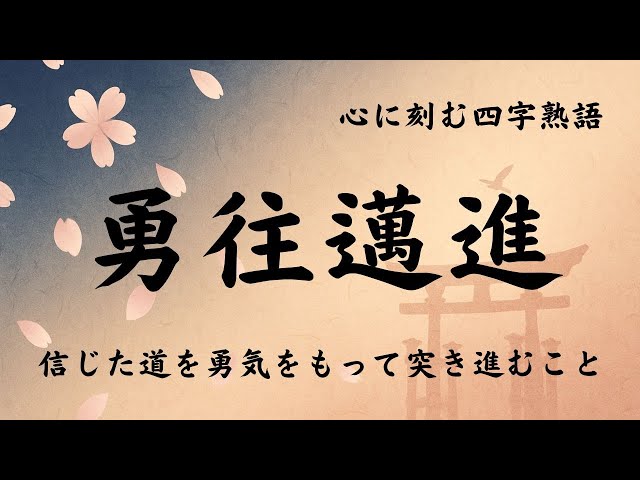
It’s a four-character idiom that shows the attitude of fearlessly moving forward.
For elementary school students, continuing to have the courage to take on challenges is an important lesson.
When tackling something they’re not good at or starting something new, this phrase will give them a push.
By making it a class goal, the whole class will develop a positive atmosphere and grow together while encouraging one another.
The experience of continuing to try without stopping even after failing becomes a great source of confidence.
It’s a courageous phrase that gives the strength to keep going without giving up.
Fall down seven times, get up eight.
This four-character idiom expresses an attitude of not being discouraged by repeated failures, but standing up and trying again.
It’s perfect as a class goal for elementary school students to foster a mindset of taking on challenges without fearing failure.
Even when studies, sports, or performances don’t go well, standing up and saying “Let’s try again” leads to growth.
It will also create an environment where friends and classmates watch over one another’s failures with warmth and encourage each other.
By accumulating small successes, children build confidence and perseverance.
It’s a phrase that teaches the courage to keep challenging oneself and a positive outlook.
Single-minded focus spanning a vast distance
@az0202za Banri-ikkuu (boundless and single-minded focus) #banri ikkuu #four-character idiom #learning
♬ Original Song – 0202civo – az0202za
It’s a four-character idiom that expresses uniting hearts toward the same goal, no matter how far apart we may be.
Displaying it as a class motto fosters an atmosphere where everyone works toward a shared purpose.
During practices for events like sports festivals or choir competitions, picturing the same finish line together heightens the sense of unity.
Even when spirits start to drift, recalling this phrase helps you return to your original intentions.
It’s an inspiring phrase that fills you with courage and lets you feel the joy of cooperating toward a big dream.
Once-in-a-lifetime encounter

The four-character idiom “ichigo ichie” carries the meaning of cherishing the special, once-in-a-lifetime moment at hand, and is rooted in the teachings of the tea master Sen no Rikyū.
Through the words of Rikyū’s disciple Yamanoue Sōji, the phrase spread in the Edo period when the tea master Ii Naosuke recorded it as “ichigo ichie” in his collection Tea Gatherings: Once-in-a-Lifetime Meetings.
“Ichigo” means “a lifetime,” and “ichie” means “a single tea gathering.” It’s a beautiful saying that encourages both the host and the guests of a tea gathering to approach the occasion with wholehearted sincerity, as if it were a once-in-a-lifetime moment.
