

Four-character idioms that wish for happiness! Words that will warm the hearts of elementary school children

Have you ever wanted to give someone a four-character idiom as a way to celebrate or cheer them on? Four-character idioms might feel a little difficult for elementary school students, but if they carry wishes for happiness, they’re sure to become special words that stay in the heart.
In this article, we’ve gathered four-character idioms that are easy for elementary school students to understand and perfect for wishing someone happiness.
These are phrases you can use in many situations—messages to friends, first calligraphy of the year, graduation celebrations, and more.
Once you know their meanings, you’ll surely want to share them with someone!
- Four-character idioms wishing happiness: a collection of heartwarming expressions for everyday use
- Easy-to-remember, positive four-character idioms for elementary school kids! Words that brighten the heart
- [Elementary School Students] Perfect for Kakizome! A Collection of Four-Character Idiom Ideas
- Learn the meanings too! Cool four-character idioms that elementary school students will want to remember
- For Elementary School Students: Four-Character Idioms You Can Use for New Year’s Resolutions — How to Set Cool Goals!
- [For Elementary School Students] Four-character idioms you can use in sports! Words that are helpful for cheering and goal setting
- Recommended for elementary school class goals! A collection of impactful ideas using four-character idioms
- [For Elementary Students] A Collection of Beautiful Four-Character Idioms to Know
- Perfect for elementary school slogans! A collection of four-character idiom ideas you'll want to use
- Popular even among elementary school students! Stylish and easy-to-remember four-character idioms
- Interesting four-character idioms for elementary schoolers! Words you'll want to use once you understand their meanings
- [For Elementary School Students] Inspiring Four-Character Idioms for Shaping the Future at a Glance! Words that Spark Courage
- Four-character idioms that help elementary schoolers not give up: words that spark the power to keep trying
Four-character idioms that wish for happiness! Words that warm the hearts of elementary school kids (1–10)
giving it your all

This four-character idiom teaches the importance of facing what’s right in front of you with all your strength.
Even if studying or sports don’t go as you’d like, if you keep challenging yourself without giving up, your abilities will gradually grow.
Even when the results aren’t ideal, the experience of giving your all becomes confidence and gives you the courage to take the next step.
Putting your whole heart into something moves the hearts of those around you—friends at school, family, and others.
It’s an encouraging phrase that conveys the value of persevering and giving your best effort in any situation.

A fresh start

The phrase “shinki-itten” conveys the importance of resetting your mindset and trying once more to look forward and move ahead.
Even on days of failure or when things don’t go as planned, that’s not the end.
The moment a new morning arrives, or when a new term begins, is a good opportunity to realign your heart.
By shifting your perspective just a little, the same scenery can look brighter.
A positive attitude becomes courage and helps you take the next step.
It’s a word that carries the hope that you can start over as many times as you need, pointing you toward the future.
sound health and safety (free from illness and calamity)

Mubyō-sokusai expresses the wish that being able to live each day in good health is the greatest happiness of all.
Even without major successes or special events, the everyday life of waking up, going to school, laughing with friends, and enjoying your meals is truly precious.
When your body is well, your mind becomes more positive, and the strength to take on new challenges arises naturally.
Having your family and those around you in good health also brings you peace of mind.
It is a gentle phrase that reminds us to cherish the seemingly ordinary days.
Four-character idioms that wish for happiness! Heartwarming words for elementary school children (11–20)
smooth sailing

Like a ship cheerfully sailing with a tailwind, this phrase describes when things go smoothly.
In school life, there are times when studying or sports feel enjoyable and when friendships go well.
That is proof that your past efforts and your kindness toward others are giving you strength.
Precisely when things are going well, it’s important not to forget gratitude and to prepare for the next challenge.
There will be days when failure makes it feel as if the wind has died, but if you keep going without giving up, a new tailwind will surely rise.
It’s a bright, hope-filled four-character idiom that gives you the courage to keep moving forward with a positive mindset.
Long life in good health

Sokusai-enmei expresses the wish for robust health and a long life.
Even without any special events, the everyday routine of waking up, going to school, talking with friends, eating meals, and sleeping is a very precious time.
When the body is healthy, the mind becomes positive, and the energy to take on new challenges wells up.
Valuing your own body and caring about the health of your family and those around you leads to a sense of security.
This four-character idiom reminds us of the importance of the ordinary days we spend—on the way to and from school, during recess, and with friends and family.
triumphant; elated; full of high spirits
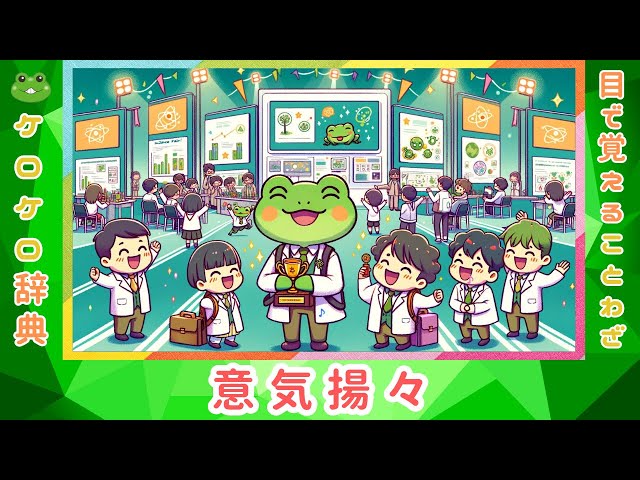
This four-character idiom is often used in positive situations where someone’s expression is radiant because things are going well.
It’s commonly used when someone feels proud after achieving a goal or returns victorious from a competition.
“Iki” refers to one’s frame of mind, while “yōyō” conveys a sense of pride or triumph.
Try using it in moments filled with joy and confidence, such as: “He won the contest and came back in high spirits,” “He was brimming with confidence after being entrusted with a new job,” or “She won the lottery and returned in a triumphant mood.”

a clear and serene mind

It’s not a phrase you hear often in everyday life, but it’s used at decisive moments—whether in a crucial contest or when making a major life decision.
Pronounced “meikyō shisui,” 明鏡 (meikyō) means a “polished mirror without a speck of cloudiness,” and 止水 (shisui) means “still, unmoving water.” For example: “Even against a strong team, his mind was as clear as meikyō shisui,” or “After long deliberation, I’ve made my decision, and my mind is meikyō shisui.” Try using it in situations involving important decisions or pivotal challenges.