


Loosen up your mind! Boost creativity with lateral thinking quizzes for elementary school students

A lateral thinking quiz that lets kids build logical thinking skills while having fun by asking questions repeatedly! Even problems that look simple at first require unexpected ideas and shifts in perspective, so both adults and children will be hooked.
In this article, we introduce lateral thinking quizzes for elementary school students.
It’s a great way to exercise your brain in a playful way—thinking together noisily with the whole family or taking turns quizzing each other with friends.
Take this opportunity to try these lateral thinking quizzes that help you develop unique creativity!
Flex your brain! Boost creativity with lateral thinking quizzes for elementary school kids (1–10)
I went to a sushi restaurant, drank only tea, and left, but the staff didn’t get angry. Why do you think that is?

See the answer
I bought some takeout sushi to bring home.
At sushi restaurants, they not only serve food to eat on the spot but also make sushi for takeout. Even if it looks like someone only had tea and left, the staff won’t be upset if that person bought sushi to take home. Many elementary school students today might arrive at this answer based on their own experiences using takeout or delivery services. This is a quiz where you can find the answer by carefully thinking through the situation, using familiar everyday scenes as hints.

Two babies were born to the same mother on the same day of the same year. However, they were not twins. Why is that?

See the answer
Answer: Because they were triplets.
At first glance it may seem contradictory, but if you loosen your thinking a bit, it makes sense. The two babies were indeed born to the same mother on the same day, but because there was actually another sibling, they were born as a set of three. Therefore, you can’t call just these two twins. This puzzle helps you practice thinking from multiple angles without being bound by fixed ideas. It’s a perfect quiz for funly developing children’s creativity and flexible thinking.
I got something I really wanted to get, but I threw it away right away. Why was that?

See the answer
Because it was a booger.
The thing I absolutely wanted to pick was “boogers.” They’re in your nose and you can’t stop noticing them, but once you pick them, you don’t need them, so you just throw them away. These boogers are formed when dust in the air and oils from the skin collect in the nostrils. There’s even a theory that people who live where the air is clean have shorter nose hair and fewer boogers! I wonder if that’s true.
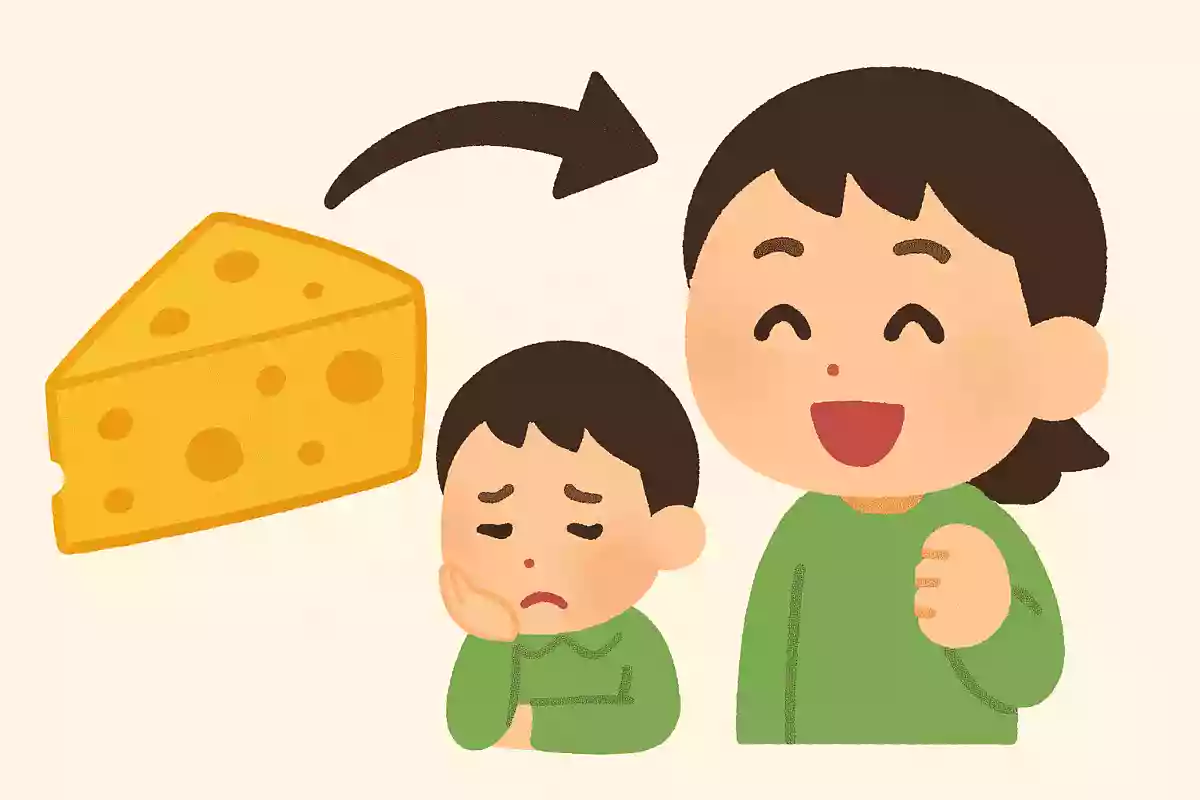
A child who dislikes cheese smiled when they heard “cheese.” Why is that?
See the answer
Because they said “cheese” when taking a photo.
When someone says “Say cheese!” when taking a photo, everyone smiles, right? Even kids who don’t like eating cheese do, too. There are various theories, but one says the phrase spread because saying “cheese” lifts the corners of your mouth into a smile. By the way, in neighboring South Korea they say “Say kimchi!”.
I handed the DVD to the clerk and paid 2,000 yen, but I couldn’t take the DVD home. Why is that?

See the answer
Because I got the DVD bought back at the store
Actually, this person had gone to a used DVD shop to sell DVDs. They handed the DVDs to the clerk, received 2,000 yen, and left the DVDs at the store, so they didn’t take them home. In other words, it was the clerk, not the person themselves, who paid the 2,000 yen. As for rental DVD stores, we used to call them “rental video stores” back in the day.
I went outside and got stung. However, I didn’t call an ambulance and headed straight to my destination. Why is that?

See the answer
Because I got bitten by an insect.
Going outside and getting “stung” doesn’t mean being attacked by someone; it refers to being bitten or stung by insects like mosquitoes or bees. It wasn’t life-threatening, so there was no need to call an ambulance, and we headed straight to our destination. Depending on the species of mosquito, it’s usually the females that suck blood. When they can’t get blood, they feed on things like flower nectar.
Even though I didn’t say I liked someone, my friends found out I do. Why is that?

See the answer
Because I reacted when the name of the person I like came up.
When my friend listed a bunch of names one after another, the moment my crush’s name came up I couldn’t help making a surprised, happy face—and that’s how I got found out. A similar trick is used in detective and police dramas, too. They’ll deliberately mention words like the gun or knife that serve as evidence right in front of the culprit. We can’t help reacting to the people and things we’re preoccupied with, right?