

A collection of trivia and fun facts about space, brimming with dreams and romance

The universe, full of mysteries, is brimming with dreams and romance, and it has always made people around the world feel a thrill of excitement.
Because so much of it is shrouded in mystery—what’s out there, what’s happening—our imaginations run wild, and sometimes it even inspires a sense of fear.
In this article, we’ll share trivia and fun facts about the universe, which still has countless enigmatic aspects.
Reading this might make you even more excited about space! Precisely because we can’t easily go there, you’ll want to know its secrets—so be sure to check them out!
A collection of trivia and fun facts about the dream- and romance-filled universe (1–10)
There is a person buried on the Moon.

There’s a person who’s buried on the Moon.
It’s the renowned American astronomer Eugene Shoemaker.
When he passed away, those close to him wanted to fulfill his dream of going to the Moon and asked NASA for help.
NASA gladly agreed, placed his cremated remains in a capsule, and sent it to the lunar surface.
So even now, he rests on the Moon.
As an aside, it’s said that NASA covered most of the cost of the space burial, and the family only paid for the capsule itself.

The moon is gradually moving away from the Earth.

The Moon we always gaze at—did you know there’s a possibility it could one day disappear from view? That’s because the Moon is gradually moving away from the Earth.
This is due to its gravitational influence, known as tidal forces.
Incidentally, the Moon’s gravity also acts like a brake on Earth’s rotation, so if it were to drift too far, it could trigger drastic environmental changes.
That said, by the time the Moon has moved away that much, the Earth will have been swallowed by the Sun, so there’s no need to worry.
Earthquakes also occur on the Moon.

Earthquakes are disasters that have repeatedly afflicted humanity.
You might think they’re unique to Earth, but in fact, the Moon has quakes too.
They were detected by a seismometer installed by Apollo 11, and the cause is believed to be the Moon losing heat, contracting, and its interior grinding against itself.
As a result, the Moon is said to be constantly changing shape.
That said, much about the mechanism of moonquakes remains unknown, and there may be factors—or even solutions—we haven’t discovered yet.
Let’s look forward to future research.
There is a mysterious hexagonal vortex on Saturn.

The farther a celestial body is from Earth, the harder it is for our instruments to reach and observe it, and the more mysteries it seems to hold.
One such mystery is the hexagonal vortex on Saturn.
The entire spherical planet is covered by clouds, and for some reason a hexagon forms around its apex, the North Pole.
Since its discovery during the Voyager mission in 1981, various hypotheses have been proposed—such as explanations involving wind speeds in the atmosphere—but it remains a fascinating phenomenon shrouded in mystery.

Artificial satellites can be seen with the naked eye from Earth.
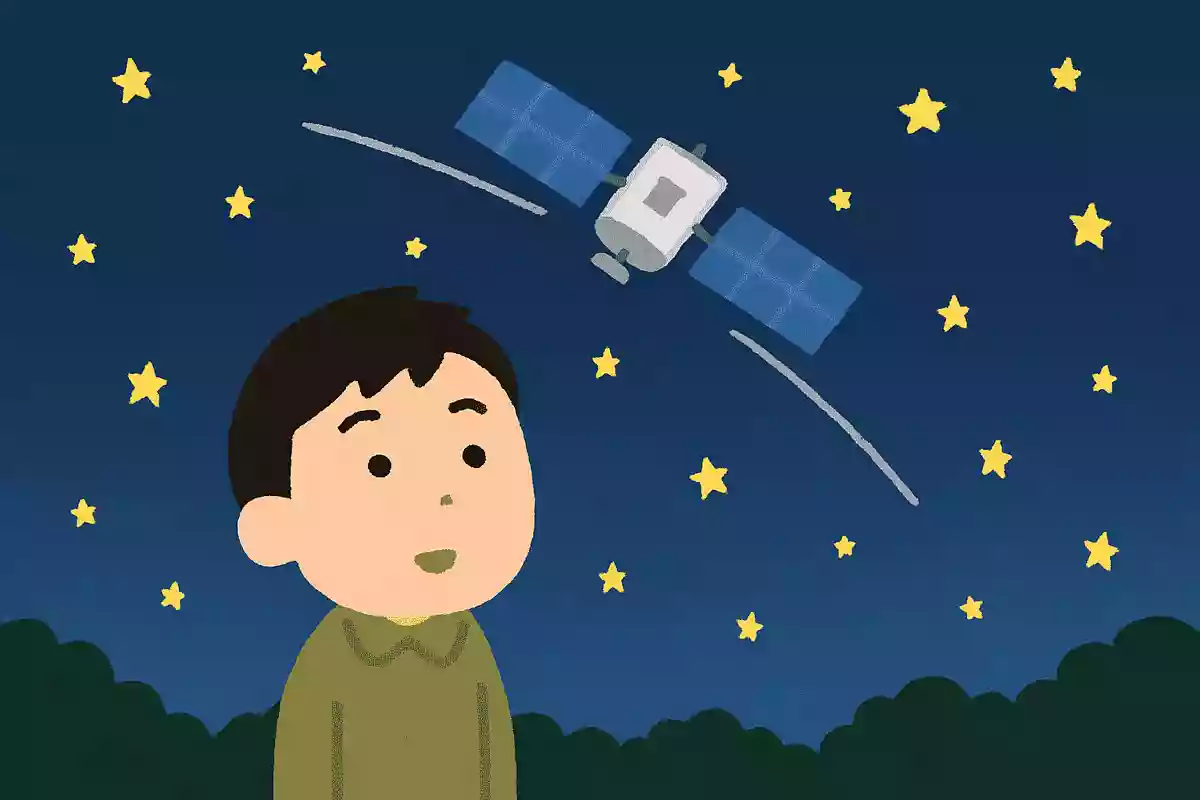
Artificial satellites flying through space.
While we often imagine them far, far away, you can actually see them with the naked eye.
The best time is around sunrise or sunset when it’s getting dark.
If a satellite is below 1,000 km in altitude at that time and reflects sunlight, it can be visible to the naked eye.
The conditions are a bit strict, but if you’re interested, give it a try.
If you have an astronomical telescope, aim for satellites at higher altitudes.
Since they’re constantly illuminated by the Sun, you should be able to see them even in the middle of the night.
Black holes are born from a massive explosion.
Black holes that swallow everything around them are often treated as symbols of danger in science fiction, aren’t they? These black holes, from which even light cannot escape, are celestial objects born at the end of a star’s life through a supernova explosion.
They are thought to form when a very massive star—at least 30 times the mass of the Sun—reaches the end of its life, and if the core cannot withstand its own gravity during the explosion, it collapses to an extreme density, creating a black hole.
Because their gravity is so strong that not even light can escape, we can only observe them as if a hole had opened in space, and they remain phenomena and celestial bodies full of many mysteries.
Space is silent.
In works like movies and anime, space is often portrayed as full of sound—spaceships zooming around, explosions, and constant noise.
But in reality, outer space is considered a silent, soundless environment.
Sound travels through vibrations in air, so in the vacuum of space, where there’s no air, it can’t propagate—hence the silence.
That said, while space itself is silent, the inside of a spacesuit isn’t: for safety monitoring and continuous communication, there’s always audio from radios and other systems.