



The Sun plays an important role for most forms of life on Earth, including humans.
Alongside the Moon, it’s a celestial body known by everyone, regardless of age, gender, or nationality.
However, despite its strong presence, there may not be many people who can explain exactly what the Sun is.
So this time, we’ve put together a quiz about the Sun.
We hope you’ll enjoy the quiz and learn a little more about the Sun.
Now then, let’s give it a try!
- Surprisingly unknown? Trivia Quiz [Multiple Choice: 3 Options]
- Space trivia quiz: Multiple-choice questions about the planets of the solar system and astronauts
- Fun facts about the Moon. A rapid-fire quiz!
- A compilation of unsettling trivia and fun facts about Earth
- Fun to Know! A Collection of Space Trivia [Rec]
- [Easy] Quiz for Middle School Students
- A quiz to learn what kind of celestial body Mercury—the planet closest to the Sun—is!
- [Space] Did you know? Saturn Trivia Quiz
- [Trivia] Did You Know? A Collection of Weather Proverb Quizzes!
- Trivia you think you know but surprisingly don’t? August trivia and fun facts quiz!
- [For Kids] November Trivia Quiz & Fun Facts: Let’s Learn While Having Fun!
- Hard to get right on the first try! A quiz you’re guaranteed to get tripped up by.
- Make weather forecasts more fun! Trivia and fun facts about the weather
Think you know the Sun? A surprisingly tricky trivia quiz about it! (1–10)
How many times larger than Earth is the Sun?

- 3,270 times
- 1,090,000 times
- 1.3 million times
See the answer
1.3 million times
The Sun’s diameter is about 109 times that of Earth, but since volume scales with the cube of the diameter, it works out to roughly 1.3 million times Earth’s volume. This means the Sun is large enough to fit about 1,300,000 Earths inside.

How long is the Sun’s lifespan from its birth?

- about 5 billion years
- about 10 billion years
- about 15 billion years
See the answer
about 10 billion years
The Sun was born about 4.6 billion years ago, and its lifespan as a main-sequence star is estimated to be about 10 billion years. Therefore, the Sun has spent roughly half of its total lifetime and is estimated to have about 5 billion years remaining. After this period, the Sun will evolve into a red giant and is ultimately predicted to become a white dwarf.
What do we call the explosive phenomenon that occurs on the surface of the Sun?

- Solar flare
- Aurora
- corona discharge
See the answer
Solar flare
The explosive phenomena that occur on the Sun’s surface are called solar flares. They arise when magnetic reconnection releases enormous amounts of energy and are observed as plasma ejections and intense radiation. Solar flares occur frequently during periods of heightened solar activity and can, in some cases, affect Earth’s communication networks.
How long does it take for sunlight to reach the Earth?

- About 8 minutes and 20 seconds
- About 1 hour 45 minutes
- about 24 hours
See the answer
About 8 minutes and 20 seconds
It takes about 8 minutes and 20 seconds for sunlight to reach Earth. Since the speed of light is approximately 300,000 kilometers per second and the average distance between the Sun and Earth is about 150 million kilometers, light needs roughly 500 seconds—about 8 minutes and 20 seconds—to travel that distance.
What is the approximate surface temperature of the Sun in degrees Celsius?

- 1,500℃
- 5,500℃
- 15,000℃
See the answer
Option 2
The surface temperature of the Sun is estimated to be about 5,500°C. This value is calculated based on the assumption that the Sun emits blackbody radiation and refers to the temperature of the outermost layer called the photosphere. The core of the Sun is much hotter, estimated to reach around 16 million°C.
What is the Sun primarily composed of?
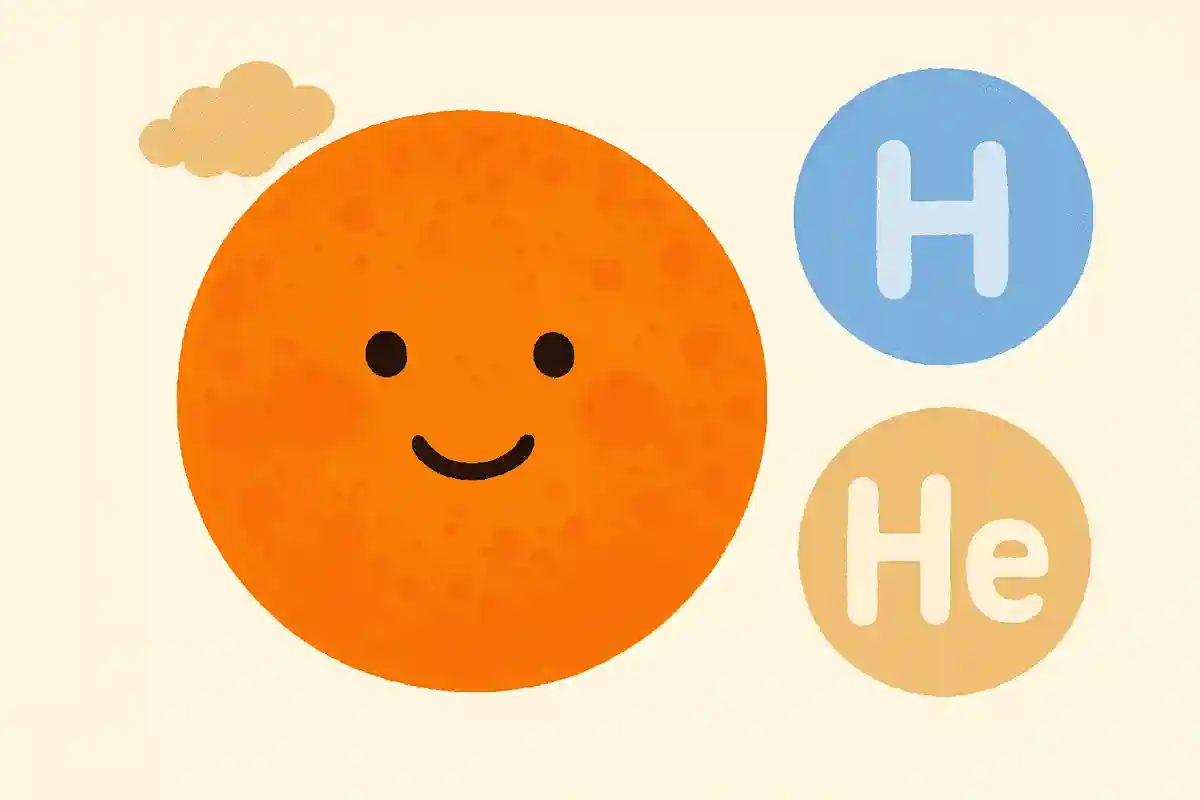
- oxygen
- hydrogen
- iron
See the answer
hydrogen
The Sun is composed of about 75% hydrogen by mass and about 25% helium. All other elements together account for less than 1%. Inside the Sun, hydrogen undergoes nuclear fusion, releasing energy as it is converted into helium.
How much time has passed since the Sun was born?

- about 4.6 million years
- about 4.6 billion years
- About 46 billion years
See the answer
about 4.6 billion years
The solar system and the Sun were formed about 4.6 billion years ago. This estimate is inferred from data collected from the Sun and nearby celestial bodies, as well as theoretical insights into star and planet formation. Therefore, the correct answer is “about 4.6 billion years.”