

Get hyped! Tongue twisters that sound cool if you can say them—wordplay that makes you want to take on the challenge

Tongue twisters can be enjoyed in many situations—from practicing enunciation to playing with friends.
But do you ever feel that the classic phrases you often hear just aren’t enough? In this article, we’ve carefully selected tongue twisters that sound cool if you can say them! We’ll share a variety you can use for vocal warm-ups before a talk or speech, or as conversation starters at parties.
Enjoy discovering fun tongue twisters that will get everyone excited and make you want to jump in and give them a try!
- Challenging tongue twisters: Introducing high-difficulty phrases and sentences!
- [Diction Training] A Collection of Tongue Twisters to Improve Articulation
- Tongue Twisters So Fun and Cute You’ll Want to Say Them Out Loud!
- Take on the world’s hardest tongue twisters! A roundup of ultra-tough prompts that’ll tie your tongue
- Perfect for pronunciation practice! A collection of English tongue twisters.
- Tongue twisters that will make you laugh out loud! Super funny
- A collection of long tongue twisters. Also recommended for practicing announcements and narration.
- [Recreation] Challenge! A roundup of tongue twisters recommended for elementary school students
- Irresistibly tempting to try! Have fun practicing pronunciation with Korean tongue twisters
- Kenta Otani’s original tongue twisters: a collection that’ll have you tripping over words and bursting into laughter
- Chinese tongue twisters: A collection of rao kou ling helpful for learning Chinese
- Funny palindromes. A masterpiece collection that makes you burst out laughing when you imagine them.
- Nagoya dialect tongue twisters are exquisite! A fun collection where your tongue gets tied in knots with regional dialects
Get hyped! Tongue twisters that sound cool if you can say them—wordplay you'll want to try (1–10)
I leaned bamboo against this bamboo fence because I wanted to lean bamboo against it.

This one is well known as a classic tongue twister, and if you can say it clearly, it will definitely impress the people around you! “Take” and “tate” aren’t difficult to pronounce on their own, but when you put them together, the difficulty rises.
“Take,” “tate,” and the “kake” that follows are all made up of the same vowel sounds, so reading them in sequence gets tricky, causing your tongue to stumble and your brain to get confused.
At first, practice slowly to keep each word from blending into the others.

An elderly man of sixty-six wanders anxiously down the broad corridor of a Roman prison, carrying a candle.

Since so many instances of ‘ro’ appear, it’s easy to get confused about which word’s ‘ro’ you’re on! Also, the heavy use of the conjunctive particle ‘no’ in the first half might be another tricky point.
For tongue twisters like this, where many words appear and various situations are described all at once, it’s best to say them while picturing the scene written in the text.
This one is quite tricky and might conjure up a slightly scary image, but if you can deliver it cleanly as a tongue twister, you’re sure to grab everyone’s attention!
The Director of the Tokyo Patent Approval Bureau suddenly refused to grant leave today.

Even just the first part, “Tokyo Patent Approval Bureau,” is often used as a tongue-twister prompt.
It’s already challenging on its own, and then even more difficult words follow.
For many people, the sticking point is the “kyoka” (approval) portion.
Saying it as a single word isn’t too hard, but when it’s preceded by sounds like “ka,” “kyu,” or “kyo,” your tongue mysteriously stops cooperating.
Try breaking it into individual words and start by reading it slowly.
Get hyped! Tongue twisters that sound cool if you can say them. Wordplay you'll want to try (11–20)
The melon seller came to sell melons, left some unsold, and went home selling, the voice of the melon seller.

It looks simple at first glance, but you may unexpectedly get tripped up by the repeated word “uri-uri.” Because words with the same sound—“uri” as in “gourd” and “uri” as in “selling”—are repeated, you might start to lose track and think, “How many times did I say ‘uri’ just now?” To make it clear which “uri” you’re saying at any given moment, it helps to picture each one in kanji as you speak.
It’s also a good idea to start by breaking it into words or phrases when you practice.
Try practicing until you can pronounce it clearly enough that the situation comes across vividly.
Frogs go pyoko-pyoko, three pyoko-pyoko; together pyoko-pyoko, six pyoko-pyoko.
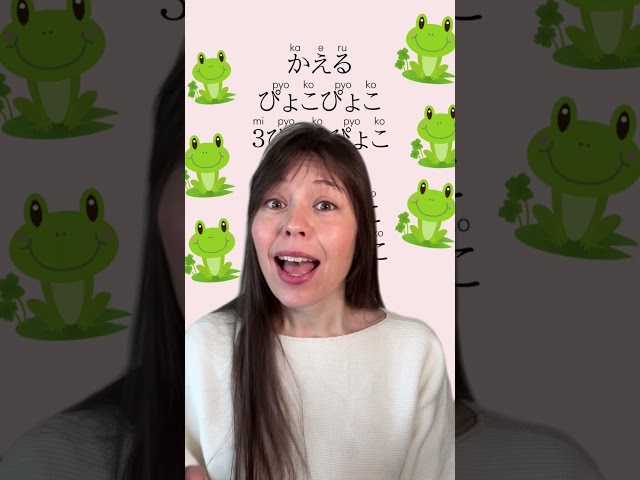
If you can say it clearly, it sounds cool—this is one of the classic tongue twisters.
“Pyoko-pyoko” is just so hard to say! Quite a few people end up turning “pyo” into “po.” To deliver this one quickly and stylishly, start by pronouncing it slowly and make sure “pyo” doesn’t become “po.” Even after you can say it slowly, don’t speed up all at once—gradually pick up the pace.
Practice until you can say it well enough to show off with confidence.
Whose naginata is that long naginata on the long shelf?

We tend to read 「長押」 as nagao-shi, like the long press on a button, but in fact it’s pronounced “nageshi,” and 「薙刀」 is pronounced “naginata.” 「誰が」 should be read “taga,” which is the classical reading.
Many of you probably learned this in classical literature classes at school.
For the “長薙刀” part, you pronounce it without ever closing your lips.
If you can get through that smoothly and connect it to the latter “who,” you should be able to say the whole phrase well.
Give it a try and practice!
When a pig hit a pig, the pig that got hit hit back the pig that had hit it, so the pig that hit and the pig that got hit both collapsed.

Who would have thought that just the presence or absence of the little sokuon “っ” would make it this hard to say—between ‘buta’ (pig) and ‘butta’ (hit)! Next time, you’ll have to think as you speak: is it ‘buta,’ or is it the situation of ‘butta’ or ‘butareta’? Even while you’re thinking, it’s a tongue twister, so keeping up the speed matters.
The scenario is that two pigs are hitting and getting hit—basically a rather rough scuffle.
If you can get through this ultra-complicated one, people around you will definitely think you’re cool!