

Take on the world’s hardest tongue twisters! A roundup of ultra-tough prompts that’ll tie your tongue

Have you ever tried the “world’s hardest tongue twister”? Even well-known ones like “Tōkyō Tokkyo Kyoka-kyoku” and “Kaeru pyoko-pyoko” are tough enough, but there’s always something harder.
From fiendish Japanese challenges that cleverly use palatalized and geminate sounds to English tongue twisters recognized by Guinness, there are plenty of ultra-difficult lines guaranteed to tie your tongue.
In this article, we introduce the world’s hardest tongue twisters that you’ll want to try again and again.
Give them a go with your family and friends!
Challenge the world's hardest tongue twisters! A roundup of super-tough prompts that will tie your tongue in knots (1–10)
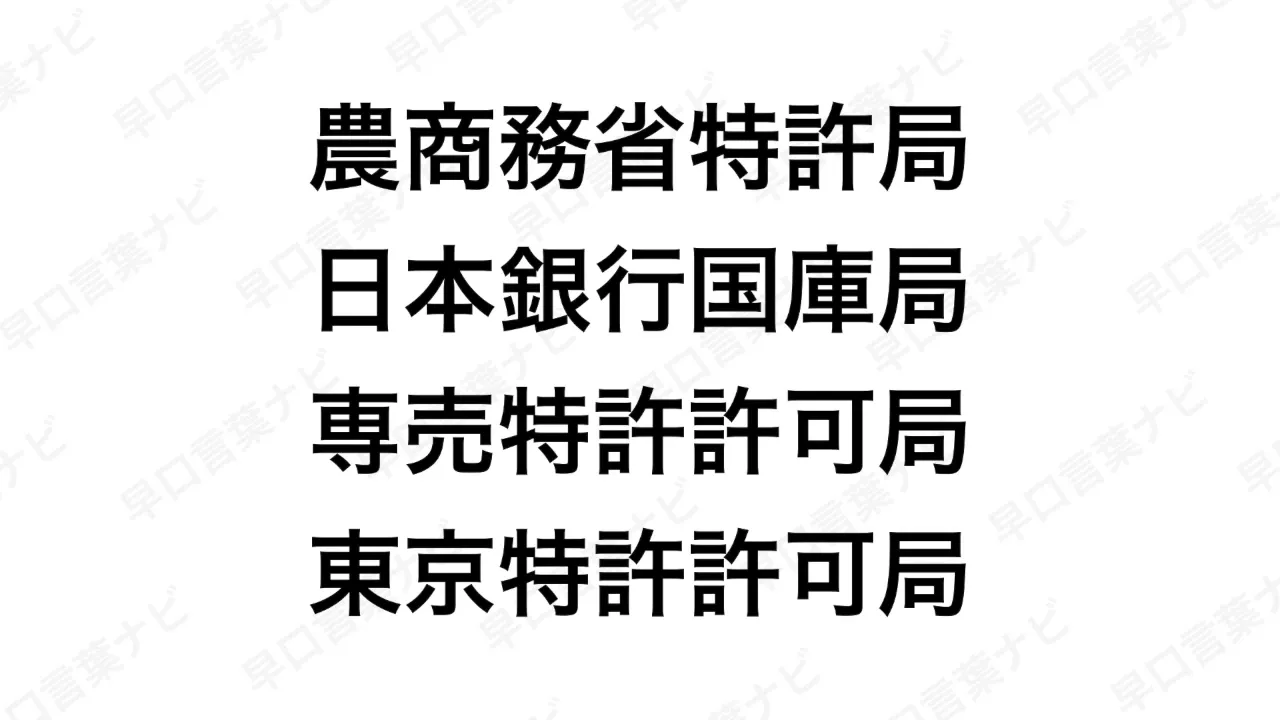
Ministry of Agriculture and Commerce Patent Bureau, Bank of Japan Treasury Bureau, Monopoly Patent Authorization Bureau, Tokyo Patent Authorization Bureau
It’s a classic tongue twister that’s long and easy to trip over.
Because a string of names of government offices and bureaus with long titles comes one after another, you can’t help but lose the rhythm and laugh when you say it out loud.
Both kids and adults can enjoy taking on the challenge while getting into the rhythm.
Words with similar sounds like “tokkyo” (patent), “kyoka” (permission), and “kyoku” (bureau) appear repeatedly, so each repetition naturally trains your mouth movements and sense of rhythm.
Every time you read it, the tempo and timing change, letting you enjoy both the fun of speaking out and a good laugh—there’s plenty of challenge to it, isn’t there?

Red Myakumyaku, Blue Myakumyaku, Yellow Myakumyaku

A tongue-twister so fiendishly hard it’ll tie your tongue in knots, bursting with playful rhythms of color and sound.
Because the repeated “Myaku-Myaku” appears over and over, saying it aloud naturally tangles your mouth and sparks laughter.
The key is that both kids and adults can enjoy it like a game.
Images of red, blue, and yellow pop into your head, letting you imagine a little story just by reading, which makes speaking it out loud even more fun.
Each repetition shifts the rhythm and timing, so every attempt brings new laughs and fresh discoveries.
Try it once and you’ll be hooked—this is a notoriously tricky tongue-twister.
When a pig hit a pig, the pig that got hit hit back the pig that hit it, so the pig that hit and the pig that got hit both collapsed.

This passage describes a scene where two pigs are fighting.
Because the small pause “っ” creates a tricky contrast between words like 'buta' (pig) and 'butta' (hit), practice while clearly visualizing which pig is doing what as the action keeps moving along.
Also, ‘bu’ is produced by briefly closing the lips before voicing, and when that sound appears repeatedly between other words, it becomes harder to say.
It’s recommended to start practicing slowly, perhaps adding a light rhythm.

Kiku kiri kiku kiri three kiku kiri, together make six kiku kiri.
The plant names “chrysanthemum” (kiku) and “paulownia” (kiri) appear alternately, and you might get your tongue twisted as you say them over and over! Saying “kiku-kiri” three times makes “three kiku-kiri,” and combining two of those makes “six kiku-kiri”—a playful word game with a fun rhythm.
This tongue twister will captivate not only children but adults too.
Try it with family or friends and see who can say it the best.
As you repeat it, you might get faster and more accurate.
Give this slightly mysterious and amusing tongue twister a try—you’ll laugh, have fun, and pick up the rhythm of Japanese along the way!
I leaned bamboo against the bamboo fence because I wanted to lean bamboo, so I leaned bamboo.

This is a classic tongue-twister phrase that goes on to explain why bamboo was leaned against a bamboo fence.
It gives the impression of declaring the will to do what one wants to do, and it’s also interesting that such free-spirited action is expressed in light, sprightly words.
The key lies first in the interplay of the “t” and “k” sounds in ‘take’ (bamboo), and the difficulty of mouth shape and articulation creates the overall tongue-twisting effect.
It’s recommended to start by consciously shaping your mouth and pronouncing each word slowly and separately, then gradually filling the gaps between words and increasing the overall speed.

Today’s kyōgen performer came today from the capital, performs kyōgen today, and today returns to his hometown in the capital.

This is a tongue twister rich with rhythm, where the words “today,” “Kyō” (Kyoto), and “kyōgen” are repeated over and over.
When you try to read it, your mouth gets tangled, and you can’t help but laugh.
Children can enjoy challenging it aloud as a playful activity, and adults can use it for tongue and mouth exercises or pronunciation training.
It blends the everyday word “today” with story elements like “kyōgenshi” (kyōgen performer) and “the old hometown in Kyoto,” letting you imagine a little story just by reading it—that’s part of the charm.
Each repetition shifts the rhythm and timing, letting you enjoy both the fun of speaking it out loud and the laughter it brings.
It’s a tongue twister that’s truly worth the challenge.
Parent turtle, child turtle, descendant turtle; parent duck, child duck, descendant duck

This is a charming tongue twister that rhythmically expresses the bond between parent and child in turtles and ducks.
Because the same sounds for “parent,” “child,” and “grandchild” repeat, reading it aloud naturally tangles your tongue and brings out laughter.
Children can take it on playfully while imagining the animals, and adults can enjoy it as an exercise for the tongue and mouth, as well as for pronunciation practice.
With turtles and ducks appearing alternately, the sense of rhythm and vocal tempo change, revealing something new each time you read it.
Through repetition, you develop a sense of rhythm and can enjoy both the fun of speaking out and a good laugh—so give it a try!