

Take on the world’s hardest tongue twisters! A roundup of ultra-tough prompts that’ll tie your tongue

Have you ever tried the “world’s hardest tongue twister”? Even well-known ones like “Tōkyō Tokkyo Kyoka-kyoku” and “Kaeru pyoko-pyoko” are tough enough, but there’s always something harder.
From fiendish Japanese challenges that cleverly use palatalized and geminate sounds to English tongue twisters recognized by Guinness, there are plenty of ultra-difficult lines guaranteed to tie your tongue.
In this article, we introduce the world’s hardest tongue twisters that you’ll want to try again and again.
Give them a go with your family and friends!
- Challenging tongue twisters: Introducing high-difficulty phrases and sentences!
- Perfect for pronunciation practice! A collection of English tongue twisters.
- Get hyped! Tongue twisters that sound cool if you can say them—wordplay that makes you want to take on the challenge
- [Recreation] Challenge! A roundup of tongue twisters recommended for elementary school students
- [Diction Training] A Collection of Tongue Twisters to Improve Articulation
- A collection of long tongue twisters. Also recommended for practicing announcements and narration.
- Tongue Twisters So Fun and Cute You’ll Want to Say Them Out Loud!
- Tongue twisters that will make you laugh out loud! Super funny
- Kenta Otani’s original tongue twisters: a collection that’ll have you tripping over words and bursting into laughter
- Chinese tongue twisters: A collection of rao kou ling helpful for learning Chinese
- Irresistibly tempting to try! Have fun practicing pronunciation with Korean tongue twisters
- Nagoya dialect tongue twisters are exquisite! A fun collection where your tongue gets tied in knots with regional dialects
- Bursting into laughter! A roundup of Hakata dialect tongue twisters
Challenge the world’s hardest tongue twisters! A roundup of super-tough prompts that will tie your tongue (21–30)
During magic, martial arts pain, surgery 2

Because the same “-jutsu” sound repeats, it’s amusing to say aloud—it makes your mouth feel like it’s spinning.
Both kids and adults can enjoy trying it together to the rhythm.
If you picture things like “the strangeness of magic,” “the pain of martial arts,” and “the tension of surgery” as you read, it can feel a bit like a mini story, and might even make you chuckle.
With repetition, the rhythm and pace of your voice change, letting you enjoy the fun of speaking and laughing at the same time—this tongue twister is addictive after just one read.

I told you to take it, so why didn’t you take it? I thought you were taking it.

A slightly chuckle-worthy tongue twister where the sounds “chi” and “to” pop up again and again.
Its charm is that when you try to read it, your mouth gets tangled and you can’t help but laugh.
For children, it becomes practice in moving the tongue while playing, and for adults, it can be enjoyed as a tongue exercise.
There’s even a story-like exchange of “I told you to do it but you didn’t… or so I thought, but actually you did,” so when you read it aloud, it feels like a little conversation.
Each repetition changes the rhythm and timing, so you discover new fun every time you read it.
Totetchiteta tote chite tote chite tote chiteta—oops, I danced. Tontsutsu ton tsutsu toton tsutsu—let’s dance the Dontaku dance.

Because sounds like “totechite” and “tontsutsu,” which resemble onomatopoeia, appear repeatedly, your mouth naturally tangles when you say them aloud, making you laugh without meaning to.
Both children and adults can take it on playfully, imagining the rhythm of the sounds and the dancing.
If you read while picturing the scene of dancing the “Dontaku Dance,” that’s the key to enjoying it as a story that’s more fun than a simple tongue twister.
With each repetition, the rhythm and timing shift, letting you savor both the joy of speaking out and the urge to challenge yourself.
Once you read it, it becomes addictive—so try enjoying it in all sorts of situations!
Since I couldn’t tell whether it was a mule or a donkey, I compared the mule and the donkey, but I still couldn’t tell whether it was a donkey or a mule.
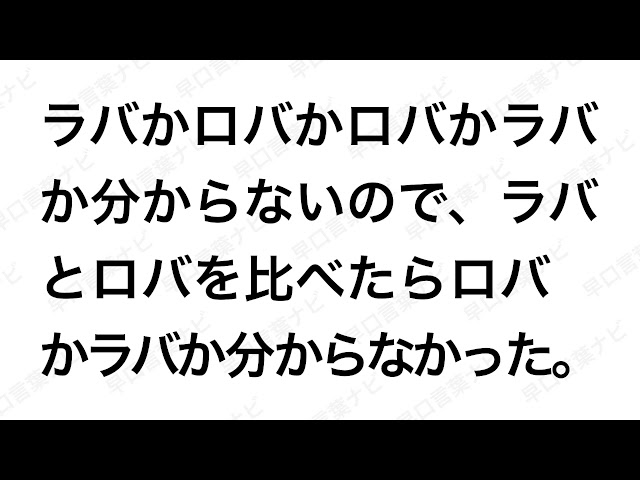
Here’s a tongue-twister that will tie your tongue in knots.
Because “mule” and “donkey” appear alternately, you’ll soon trip over your words and burst out laughing when you say it aloud.
The key is that both children and adults can tackle it playfully while picturing horses and mules.
It’s also fun as a mouth exercise and for pronunciation practice.
Since the word order is a bit confusing, your rhythm and timing change each time you read it, which adds to the fun of speaking it out loud and fuels your sense of challenge.
By reading while focusing on the differences between similar sounds, why not enjoy the pleasure of speaking and a good laugh at the same time?
Questioning conducted at the water intake site regarding distilled water upstream

This is a tongue twister with amusing sound rhythms and word links.
Because of similar sounds like “jōryū,” “jōryū,” and “shūryō,” and tricky combinations such as “shusui-jō” (water intake station) and “jijō chōshu” (questioning about circumstances), your mouth tangles when you say it aloud, which leads to laughter.
Children can enjoy taking on the challenge while playing to the rhythm, and adults can use it for tongue and mouth exercises or pronunciation practice.
Each time you read it, the rhythm and timing of your voice change, so the more you repeat it, the more fun it becomes to speak out loud; it’s also enjoyable to imagine a little story as you read.
Even though it’s short, the sequence of catchy sounds makes it an addictive and rewarding tongue twister to try.
A noble enemy’s shoulder-tapping machine, devoted to a vertically written letter dashed off with its mane bristling; to drawing shadows that locked a key on a half-scorched bamboo fence of a horsehair crab set out with a detective to a cliff and a surgeon; and to writing a radical opera, chipped a bamboo stand propped up halfway.

A tongue twister packed with continuous sounds that tangle your tongue—perfect for a real challenge.
In this long phrase, similar sounds like “ka,” “ke,” “ta,” and “ki” appear over and over, so when you speak it aloud your mouth quickly can’t keep up.
Kids can tackle it playfully while imagining a story, and adults can enjoy it as an exercise for the tongue and mouth or for pronunciation practice.
Each reading changes the rhythm and pacing, letting you savor both the joy of voicing it and a good laugh at the same time.
By repeating complex sounds, it offers both a sense of challenge and accomplishment—an ultra-advanced tongue twister!
Art room, technology room, operating room, art preparation room, technology preparation room, operating preparation room

Because the words for “room” and “preparation room” keep popping up, the moment you read it aloud your mouth can’t keep up and you can’t help but laugh.
Both kids and adults can enjoy it playfully while picturing familiar school classrooms and hospital rooms.
Each time you read it, the rhythm and the timing of your pauses shifts a little, so the more you repeat it, the more fun it becomes to use your voice.
If you read while conjuring different images for “art,” “technology,” and “surgery,” it feels like more than mere diction practice—you can savor a sense of story, too.
Once you read it, it’s addictive, so definitely give it a try.