

Take on the world’s hardest tongue twisters! A roundup of ultra-tough prompts that’ll tie your tongue

Have you ever tried the “world’s hardest tongue twister”? Even well-known ones like “Tōkyō Tokkyo Kyoka-kyoku” and “Kaeru pyoko-pyoko” are tough enough, but there’s always something harder.
From fiendish Japanese challenges that cleverly use palatalized and geminate sounds to English tongue twisters recognized by Guinness, there are plenty of ultra-difficult lines guaranteed to tie your tongue.
In this article, we introduce the world’s hardest tongue twisters that you’ll want to try again and again.
Give them a go with your family and friends!
- Challenging tongue twisters: Introducing high-difficulty phrases and sentences!
- Perfect for pronunciation practice! A collection of English tongue twisters.
- Get hyped! Tongue twisters that sound cool if you can say them—wordplay that makes you want to take on the challenge
- [Recreation] Challenge! A roundup of tongue twisters recommended for elementary school students
- [Diction Training] A Collection of Tongue Twisters to Improve Articulation
- A collection of long tongue twisters. Also recommended for practicing announcements and narration.
- Tongue Twisters So Fun and Cute You’ll Want to Say Them Out Loud!
- Tongue twisters that will make you laugh out loud! Super funny
- Kenta Otani’s original tongue twisters: a collection that’ll have you tripping over words and bursting into laughter
- Chinese tongue twisters: A collection of rao kou ling helpful for learning Chinese
- Irresistibly tempting to try! Have fun practicing pronunciation with Korean tongue twisters
- Nagoya dialect tongue twisters are exquisite! A fun collection where your tongue gets tied in knots with regional dialects
- Bursting into laughter! A roundup of Hakata dialect tongue twisters
Challenge the world's hardest tongue twisters! A roundup of super-tough prompts that will tie your tongue in knots (1–10)
A singer came and told me to sing, but I would sing if I could sing like a singer; since I cannot sing like a singer, I will not sing.
@otokowaturaiyo Ballad of the Singer#ShibuyaRanmaru#Fuwatchi#BaldStreamer#Date NoboruRehabilitationDepopulation
♪ Original song – Greed = Date Noboru – Date Noboru
It’s about someone who sings coming over and saying, “Go on, try singing,” but you don’t sing because you can’t sing as well as they can.
Still, the same words keep appearing over and over, and the forms change a little each time, so you just keep tripping over them! But once you can say it, it feels amazing.
Practice a lot and have fun giving it a try! You’ll find yourself getting competitive.
It’s also great to compete with family or friends, or record yourself and listen back.
Even if you can’t say it, it’ll make you laugh—it’s a fun word game.
Try it like a game and see who can say it the best!

Pad kid poured curd pulled cold

Because similar sounds like “poured,” “curd,” “pulled,” and “cold” come in succession, your tongue quickly gets tied when you say it out loud.
Both children and adults can practice pronunciation and exercise their tongues by repeating it to a rhythm, making it feel like a game.
Each time you read it, the speed and timing change, which sparks a bit of challenge and laughter—that’s the key point.
By consciously focusing on the sounds of the words as you try it, you can enjoy both the fun of speaking out loud and a sense of accomplishment at the same time.
It’s a difficult English tongue twister.
The melon seller came to sell melons but had leftovers, and the voice of the melon seller returning, selling as he goes.

The gist is a slightly whimsical, humorous story: a melon seller goes to another melon seller to sell melons, but ends up with leftovers and heads home calling out, “Melons for sale!” The repeated “uri-uri” rhythm is fun to say and makes both kids and adults laugh.
Start slowly, then speed up as you get used to it and give it a try.
It feels like you can say it, but you can’t; like you’ll stumble, but you don’t… It’s also fun to compete with family and friends to see who can say it the best.
Give it a try!
Challenge the world's hardest tongue twisters! A roundup of insanely tough prompts that’ll tie your tongue (11–20)
On the large plate, a big mugwort rice cake; on the small plate, a small mugwort rice cake.

It’s a tongue twister with a peaceful feel: a big mugwort rice cake sits on a big plate, and a small mugwort rice cake sits on a small plate.
The humor you sense from the words may change depending on how large you imagine them to be.
What’s important here is the “m” sounds in yomogi mochi; you’re tested on how smoothly you can close your lips and then pronounce them.
When it becomes koyomogi mochi, the “k” sounds are added, making the switch in mouth shape even more important.

As a result of consultations among the instructors for each subject this semester in the Mechanical Department of the Naval Engineering School, the following have been finalized: science, geometry, mechanics, national language, foreign languages, drawing, civics.

With so many K-sound words, your speech might start to get choppy.
Even the first half is filled with words that could break your spirit, and the second half offers no mercy with its difficulty either.
Since it’s hard to tell where one word ends and the next begins when they’re just strung together, I recommend first separating and writing them out word by word.
Because there are so many words using the K consonant, once you can say them clearly, your overall K-sound pronunciation should improve as well.
The difficulty is high, but it’s a perfect prompt for articulation practice, so be sure to make use of it!

Director of the Tokyo Patent Approval Bureau suddenly had his leave request denied today.

This is a more difficult version of the classic tongue twister “Tokyo Patent Approval Office.” Even just the commonly played first half is quite challenging, but after that, many words using kya, kyu, and kyo appear, making it harder and harder to keep your tongue moving.
To avoid getting tripped up by these palatalized sounds, try emphasizing the words that don’t contain them.
It’s also recommended to practice by breaking the passage into a few parts.
Once you can pronounce each word cleanly, try saying the whole thing quickly.
The Sixth Sick Sheik’s Sixth Sick Sheep
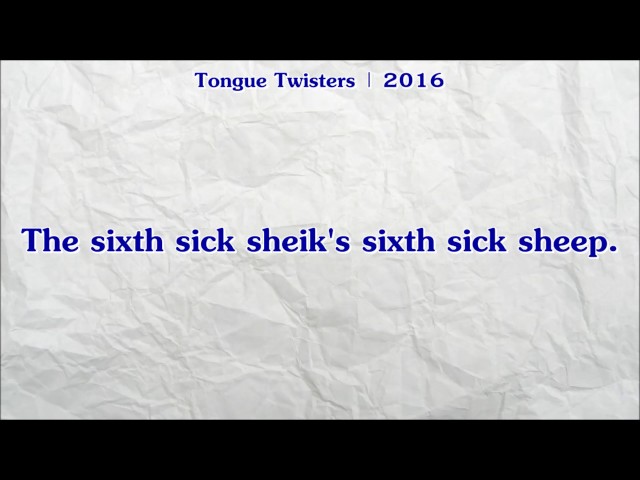
This one is even recognized by Guinness as the world’s most difficult tongue twister.
It means that the sixth elder, who has fallen ill, owns a sixth sheep that is also sick—a rather unfortunate situation.
It might seem easy if you read it in a katakana-like way, but it becomes very challenging when you try to pronounce it properly in English.
That’s because words like “sixth” and “sick” can end up sounding alike, as can “sheik’s” and “sheep,” and the sentence alternates between these similar-sounding words.
Give it a try while paying close attention to your pronunciation so it comes across clearly to native speakers!