

Get hyped! Tongue twisters that sound cool if you can say them—wordplay that makes you want to take on the challenge

Tongue twisters can be enjoyed in many situations—from practicing enunciation to playing with friends.
But do you ever feel that the classic phrases you often hear just aren’t enough? In this article, we’ve carefully selected tongue twisters that sound cool if you can say them! We’ll share a variety you can use for vocal warm-ups before a talk or speech, or as conversation starters at parties.
Enjoy discovering fun tongue twisters that will get everyone excited and make you want to jump in and give them a try!
- Challenging tongue twisters: Introducing high-difficulty phrases and sentences!
- [Diction Training] A Collection of Tongue Twisters to Improve Articulation
- Tongue Twisters So Fun and Cute You’ll Want to Say Them Out Loud!
- Take on the world’s hardest tongue twisters! A roundup of ultra-tough prompts that’ll tie your tongue
- Perfect for pronunciation practice! A collection of English tongue twisters.
- Tongue twisters that will make you laugh out loud! Super funny
- A collection of long tongue twisters. Also recommended for practicing announcements and narration.
- [Recreation] Challenge! A roundup of tongue twisters recommended for elementary school students
- Irresistibly tempting to try! Have fun practicing pronunciation with Korean tongue twisters
- Kenta Otani’s original tongue twisters: a collection that’ll have you tripping over words and bursting into laughter
- Chinese tongue twisters: A collection of rao kou ling helpful for learning Chinese
- Funny palindromes. A masterpiece collection that makes you burst out laughing when you imagine them.
- Nagoya dialect tongue twisters are exquisite! A fun collection where your tongue gets tied in knots with regional dialects
Get hyped! Tongue twisters that sound cool if you can say them. Wordplay you'll want to try (11–20)
Questioning conducted at the upstream distilled water intake site.

The first part, “distilled water upstream,” is relatively easy, but the second part, “questioning at the water intake station,” seems quite difficult.
The reading is ‘jōryū no jōryūsui, shusui-jō de jijō chōshu.’ I think the initial ‘shusui’ in the second half is hard to say, so be mindful of your mouth shape as you pronounce it.
If you can say it, it’ll sound cool, and the parts where the meaning of the sentence isn’t very clear might be especially fun.
Start practicing slowly, and once you get used to it, gradually increase your speed.

Infirmity Prevention Hospital, Preventive Ward, Infirmity Prevention Act
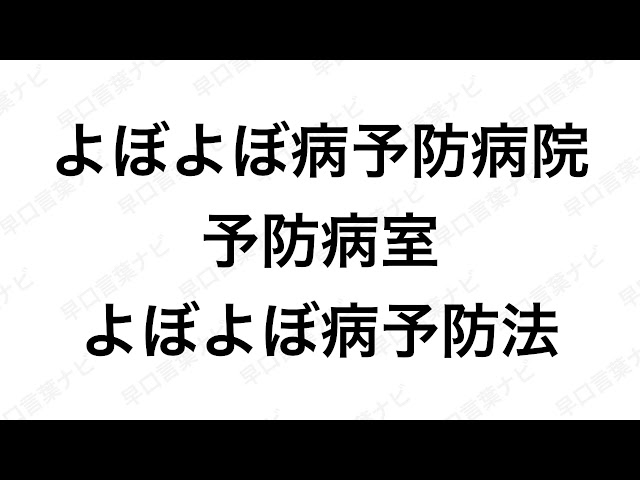
What exactly is this “yoboyobo disease” that appears in the tongue twister? It’s made up as a curious illness, and the tricky part is the connection between the second “bo” in “yoboyobo” and the following “byo.” The fact that this combo shows up repeatedly makes the tongue twister even harder.
Thoroughly practicing the plosive part where you forcefully release the air for “bo” and “byo” might be the first step to mastering it.
The final “yobōhō” (prevention method) is an easier section, so try slowing down a bit there.
A Kyō kyōgen performer came from Kyō today, performed kyōgen today, and will return to Kyō today.

Let’s try a tongue twister about a kyogen performer—something you don’t often encounter in everyday life.
The sentence also includes the word “Kyo” (Kyoto), giving the whole thing an elegant, courtly feel.
The key to nailing this tongue twister is likely to place the accent on kyo.
However, there’s one exception: the word for “hometown” (furusato).
If you also accent the “-go” part in “furusato no go,” it makes the following “kyo” in “today” harder to say, so be careful.
Try saying it while also paying attention to the natural breaks in the sentence.
Oh yeah, I split my bike and ended up messing it up, so I had to hurry and go kick the bike.
“Speaking of which, my bike ended up breaking, so I had to hurry to the bike shop” is a dialect phrase used around Nagoya and Mikawa, and it’s also known as a tongue twister.
It means, “Come to think of it, my bicycle broke, so I had to quickly go to the bike shop.” “Sou iya” corresponds to the standard “sou ieba” (“speaking of which”), “ketta” means “bicycle” and is commonly used in Aichi Prefecture, “kowakete matta” means “ended up breaking,” “chatto” means “quickly” or “in a flash,” and “ikanakankatta” means “had to go.” Because similar sounds repeat, it becomes a bit tricky to say quickly, making it a fun sentence.

Pad kid poured curd pulled cold

Because similar sounds like “poured,” “curd,” “pulled,” and “cold” come in succession, your tongue quickly gets tied when you say it out loud.
Both children and adults can practice pronunciation and exercise their tongues by repeating it to a rhythm, making it feel like a game.
Each time you read it, the speed and timing change, which sparks a bit of challenge and laughter—that’s the key point.
By consciously focusing on the sounds of the words as you try it, you can enjoy both the fun of speaking out loud and a sense of accomplishment at the same time.
It’s a difficult English tongue twister.
I told you to take it, so why didn’t you take it? I thought you were taking it.

A slightly chuckle-worthy tongue twister where the sounds “chi” and “to” pop up again and again.
Its charm is that when you try to read it, your mouth gets tangled and you can’t help but laugh.
For children, it becomes practice in moving the tongue while playing, and for adults, it can be enjoyed as a tongue exercise.
There’s even a story-like exchange of “I told you to do it but you didn’t… or so I thought, but actually you did,” so when you read it aloud, it feels like a little conversation.
Each repetition changes the rhythm and timing, so you discover new fun every time you read it.
Gets everyone hyped! Tongue twisters that sound cool if you can say them. Wordplay you'll want to try (21–30)
Today’s kyōgen performer came today from the capital, performs kyōgen today, and today returns to his hometown in the capital.

This is a tongue twister rich with rhythm, where the words “today,” “Kyō” (Kyoto), and “kyōgen” are repeated over and over.
When you try to read it, your mouth gets tangled, and you can’t help but laugh.
Children can enjoy challenging it aloud as a playful activity, and adults can use it for tongue and mouth exercises or pronunciation training.
It blends the everyday word “today” with story elements like “kyōgenshi” (kyōgen performer) and “the old hometown in Kyoto,” letting you imagine a little story just by reading it—that’s part of the charm.
Each repetition shifts the rhythm and timing, letting you enjoy both the fun of speaking it out loud and the laughter it brings.
It’s a tongue twister that’s truly worth the challenge.