

A collection of long tongue twisters. Also recommended for practicing announcements and narration.

Among tongue twisters that test articulation and smooth delivery, we’ll highlight and introduce longer ones.
The connections between words and the rhythm of the sentences add a level of difficulty unique to longer passages.
By repeatedly challenging yourself with hard-to-read text, your articulation will gradually improve, leading to clearer speech and smoother everyday conversation.
The key is to aim for clear, easy-to-understand pronunciation—like a news announcer reading the news.
- [Diction Training] A Collection of Tongue Twisters to Improve Articulation
- Tongue twisters that will make you laugh out loud! Super funny
- Challenging tongue twisters: Introducing high-difficulty phrases and sentences!
- Bursting into laughter! A roundup of Hakata dialect tongue twisters
- “Chau chau, anta” — a Kansai-dialect tongue twister. A phrase only Kansai folks can say.
- [Recreation] Challenge! A roundup of tongue twisters recommended for elementary school students
- Nagoya dialect tongue twisters are exquisite! A fun collection where your tongue gets tied in knots with regional dialects
- Perfect for pronunciation practice! A collection of English tongue twisters.
- Chinese tongue twisters: A collection of rao kou ling helpful for learning Chinese
- Challenge together! A roundup of word games for adults
- [For Seniors] Boost Oral Function with Tongue Twisters! Recommended Picks to Try
- For exam-takers! A collection of quotes that become profound and interesting once you understand their meaning
- Powerful words give you a push! Words that help you try even harder than before.
Collection of long tongue twisters. Also recommended for practicing announcements and narration. (11–20)
Boar soup, boar hotpot, boar rice bowl, boar stew — all of the above have been taste-tested by boar dish judges. Four of the seven new boar dishes.
This is a tongue twister made up of words starting with the S sounds.
While clear articulation is important for tongue twisters, I recommend focusing on the rhythm rather than articulation for this one.
It gets harder to read toward the end, so try saying it out loud multiple times.
Another notable point is that many words start with “shi,” so it’s helpful to practice by breaking it into words or short phrases.
It’s also great for learners of Japanese, so please use it as a reference!

Oh yeah, I split my bike and ended up messing it up, so I had to hurry and go kick the bike.
“Speaking of which, my bike ended up breaking, so I had to hurry to the bike shop” is a dialect phrase used around Nagoya and Mikawa, and it’s also known as a tongue twister.
It means, “Come to think of it, my bicycle broke, so I had to quickly go to the bike shop.” “Sou iya” corresponds to the standard “sou ieba” (“speaking of which”), “ketta” means “bicycle” and is commonly used in Aichi Prefecture, “kowakete matta” means “ended up breaking,” “chatto” means “quickly” or “in a flash,” and “ikanakankatta” means “had to go.” Because similar sounds repeat, it becomes a bit tricky to say quickly, making it a fun sentence.

A noble enemy’s shoulder-tapping machine, devoted to a vertically written letter dashed off with its mane bristling; to drawing shadows that locked a key on a half-scorched bamboo fence of a horsehair crab set out with a detective to a cliff and a surgeon; and to writing a radical opera, chipped a bamboo stand propped up halfway.

A tongue twister packed with continuous sounds that tangle your tongue—perfect for a real challenge.
In this long phrase, similar sounds like “ka,” “ke,” “ta,” and “ki” appear over and over, so when you speak it aloud your mouth quickly can’t keep up.
Kids can tackle it playfully while imagining a story, and adults can enjoy it as an exercise for the tongue and mouth or for pronunciation practice.
Each reading changes the rhythm and pacing, letting you savor both the joy of voicing it and a good laugh at the same time.
By repeating complex sounds, it offers both a sense of challenge and accomplishment—an ultra-advanced tongue twister!
Ministry of Agriculture and Commerce Patent Bureau, Bank of Japan Treasury Bureau, Monopoly Patent Authorization Bureau, Tokyo Patent Authorization Bureau
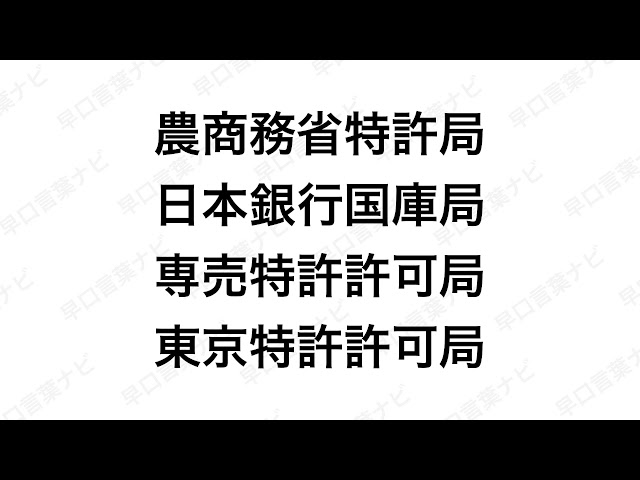
It’s a classic tongue twister that’s long and easy to trip over.
Because a string of names of government offices and bureaus with long titles comes one after another, you can’t help but lose the rhythm and laugh when you say it out loud.
Both kids and adults can enjoy taking on the challenge while getting into the rhythm.
Words with similar sounds like “tokkyo” (patent), “kyoka” (permission), and “kyoku” (bureau) appear repeatedly, so each repetition naturally trains your mouth movements and sense of rhythm.
Every time you read it, the tempo and timing change, letting you enjoy both the fun of speaking out and a good laugh—there’s plenty of challenge to it, isn’t there?
Art room, technology room, operating room, art preparation room, technology preparation room, operating preparation room

Because the words for “room” and “preparation room” keep popping up, the moment you read it aloud your mouth can’t keep up and you can’t help but laugh.
Both kids and adults can enjoy it playfully while picturing familiar school classrooms and hospital rooms.
Each time you read it, the rhythm and the timing of your pauses shifts a little, so the more you repeat it, the more fun it becomes to use your voice.
If you read while conjuring different images for “art,” “technology,” and “surgery,” it feels like more than mere diction practice—you can savor a sense of story, too.
Once you read it, it’s addictive, so definitely give it a try.
You keep calling me “you, you,” but I don’t go around calling you “you, you,” so stop calling me “you, you,” you!

The fun part is how your tongue gets twisted by repeating “anta” and “atashi” over and over.
It’s great practice for rhythm and pronunciation when read aloud by both kids and adults.
It feels like a humorous exchange—“Don’t say anta or atashi!”—almost like a real conversation.
The key is to savor the words and laugh as you take on the challenge.
Each read creates slightly different rhythms and pauses, so repeating it makes it even more enjoyable.
It’s a playful way to cultivate a feel for language—and once you read it, you might find it irresistibly catchy.
A collection of long tongue twisters. Also recommended for practicing announcements and narration. (21–30)
Totetchiteta tote chite tote chite tote chiteta—oops, I danced. Tontsutsu ton tsutsu toton tsutsu—let’s dance the Dontaku dance.

Because sounds like “totechite” and “tontsutsu,” which resemble onomatopoeia, appear repeatedly, your mouth naturally tangles when you say them aloud, making you laugh without meaning to.
Both children and adults can take it on playfully, imagining the rhythm of the sounds and the dancing.
If you read while picturing the scene of dancing the “Dontaku Dance,” that’s the key to enjoying it as a story that’s more fun than a simple tongue twister.
With each repetition, the rhythm and timing shift, letting you savor both the joy of speaking out and the urge to challenge yourself.
Once you read it, it becomes addictive—so try enjoying it in all sorts of situations!