

A collection of long tongue twisters. Also recommended for practicing announcements and narration.

Among tongue twisters that test articulation and smooth delivery, we’ll highlight and introduce longer ones.
The connections between words and the rhythm of the sentences add a level of difficulty unique to longer passages.
By repeatedly challenging yourself with hard-to-read text, your articulation will gradually improve, leading to clearer speech and smoother everyday conversation.
The key is to aim for clear, easy-to-understand pronunciation—like a news announcer reading the news.
- [Diction Training] A Collection of Tongue Twisters to Improve Articulation
- Tongue twisters that will make you laugh out loud! Super funny
- Challenging tongue twisters: Introducing high-difficulty phrases and sentences!
- Bursting into laughter! A roundup of Hakata dialect tongue twisters
- “Chau chau, anta” — a Kansai-dialect tongue twister. A phrase only Kansai folks can say.
- [Recreation] Challenge! A roundup of tongue twisters recommended for elementary school students
- Nagoya dialect tongue twisters are exquisite! A fun collection where your tongue gets tied in knots with regional dialects
- Perfect for pronunciation practice! A collection of English tongue twisters.
- Chinese tongue twisters: A collection of rao kou ling helpful for learning Chinese
- Challenge together! A roundup of word games for adults
- [For Seniors] Boost Oral Function with Tongue Twisters! Recommended Picks to Try
- For exam-takers! A collection of quotes that become profound and interesting once you understand their meaning
- Powerful words give you a push! Words that help you try even harder than before.
A collection of long tongue twisters. Also recommended for practicing announcements and narration. (21–30)
Ministry of Agriculture and Commerce Patent Bureau, Bank of Japan Treasury Bureau, Monopoly Patent Authorization Bureau, Tokyo Patent Authorization Bureau
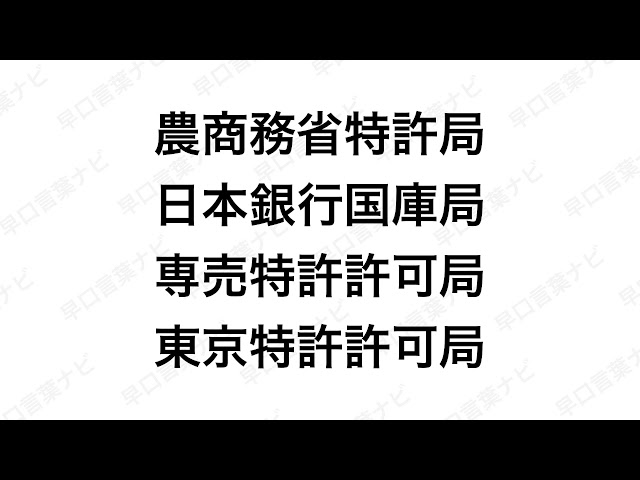
It’s a classic tongue twister that’s long and easy to trip over.
Because a string of names of government offices and bureaus with long titles comes one after another, you can’t help but lose the rhythm and laugh when you say it out loud.
Both kids and adults can enjoy taking on the challenge while getting into the rhythm.
Words with similar sounds like “tokkyo” (patent), “kyoka” (permission), and “kyoku” (bureau) appear repeatedly, so each repetition naturally trains your mouth movements and sense of rhythm.
Every time you read it, the tempo and timing change, letting you enjoy both the fun of speaking out and a good laugh—there’s plenty of challenge to it, isn’t there?

As a result of consultations among the instructors for each subject this semester in the Mechanical Department of the Naval Engineering School, the following have been finalized: science, geometry, mechanics, national language, foreign languages, drawing, civics.

With so many K-sound words, your speech might start to get choppy.
Even the first half is filled with words that could break your spirit, and the second half offers no mercy with its difficulty either.
Since it’s hard to tell where one word ends and the next begins when they’re just strung together, I recommend first separating and writing them out word by word.
Because there are so many words using the K consonant, once you can say them clearly, your overall K-sound pronunciation should improve as well.
The difficulty is high, but it’s a perfect prompt for articulation practice, so be sure to make use of it!

Kyary Pamyu Pamyu three Pamyu Pamyu, together Pamyu Pamyu six Pamyu Pamyu.
@winkawauchi♪ Original Song – Demon Monkey Kawachi Denrai – Demon Monkey Kawachi Denrai
“Pamyu-pamyu” starts rampaging in your mouth! This tongue twister—“Kyary Pamyu Pamyu, three pamyu-pamyus.
Altogether, pamyu-pamyu, six pamyu-pamyus.”—is a delightfully tricky classic whose clever rhythm and confusing sound make you burst out laughing.
The phrase “pamyu pamyu” is hard to pronounce to begin with, and repeating it while mixing in numbers scrambles your brain even more.
People inevitably lose track of how many pamyu-pamyus they’ve said—an amusing maze of pronunciation you can truly enjoy.
It’s perfect for parties and icebreakers, precisely because you’ll trip over it even if you try seriously.
If you can rattle it off in good tempo, you’re a bona fide Pamyu-Pamyu master!

On a gas-spraying bus, 100 passengers who often eat persimmons from 100 passenger planes in Massachusetts caused the gas bus to explode.

A tongue-twister so insanely hard that nailing it deserves a standing ovation! This one-liner—“In Massachusetts, 100 passenger planes each carrying 100 persimmon-loving passengers cause a gas-bus explosion”—is a chaotic masterpiece that tests your diction, focus, and sense of humor all at once.
It kicks off with the foreign place name “Massachusetts,” piles on numbers and tricky phrases, and caps it with the classic “gas-bus explosion.” You have to fire through it in one breath, and even if you mess up, it’s guaranteed laughs.
Whether you nail it or fail it, it kills either way—truly top-tier tongue-twister material.
Try it with friends or coworkers and watch the room explode with energy.
In conclusion
We introduced long tongue twisters where smooth pronunciation is difficult because of sequences with different word connections and sounds. If you want to try more challenging tongue twisters, we recommend combining hard-to-pronounce words from the ones listed here to build longer sentences. The reasons certain sounds are difficult vary by theme—such as the k- and s- sound series—so start by pronouncing them slowly while checking your mouth shape and tongue movements, then gradually increase your speed. By broadly mastering smooth pronunciation, you may also find it helps you read scripts more effectively.