

Can you solve it if you’re flexible-minded? Brain training with a math quiz

“I’m not good at math…” Don’t you hear that a lot? In fact, there are plenty of math quizzes you can enjoy like puzzles and games.
From addition and subtraction to 3D shapes and unit conversions, a full lineup of fun problems will tickle your brain.
You can take on calculations while adventuring through Mario’s world, or fill in numbers like a crossword puzzle…
The world of math is surprisingly fun! Try challenging yourself—together with your child, or even among adults.
- How many can you solve? Brain-flexing math riddle quiz
- A math quiz for adults. Can you solve it?
- [Get Friendly with Games] Math Games, Apps, and Activities
- Math quiz for elementary school students
- [Interesting] Collection of Math Quiz Problems
- From familiar topics to niche ones! A quiz you can enjoy even if you don't like math!
- A game where you can learn the multiplication table while playing
- [Interesting] A collection of brain teaser quiz questions. Let's train your brain!
- Loosen up your mind! Boost creativity with lateral thinking quizzes for elementary school students
- Take on the challenge like a puzzle! A collection of logic quizzes that also work as brain teasers.
- [Logic Quiz] Flexible Thinking and Creativity Are Key! From Classics to Tough Challenges, All in One Go
- [Satisfying When Solved] Challenging Quizzes Recommended for Elementary School Students!
- [For Elementary School Students] Great for Brain Training! Try These Addictive Matchstick Puzzles
Can you solve it if you’re quick-witted? Brain training with arithmetic quizzes (1–10)
Grade Check Quiz

Not just in arithmetic—every subject gets harder with each grade.
Let’s check what level of arithmetic problems you can solve using grade-appropriate quizzes.
In 1st grade, you’ll see addition and subtraction with one- to two-digit numbers; in 2nd grade, calculations with two or more digits; in 3rd grade, multiplication and division with remainders appear; and in 4th grade, you start calculating with decimals.
In 5th grade, decimal calculations become more advanced, and in 6th grade, fractions are introduced.
Even if you think you understand decimals and fractions, it’s easy to have misconceptions or make calculation errors, so keep practicing with a variety of problems to build familiarity!

Use symbols to make four numbers equal 10.
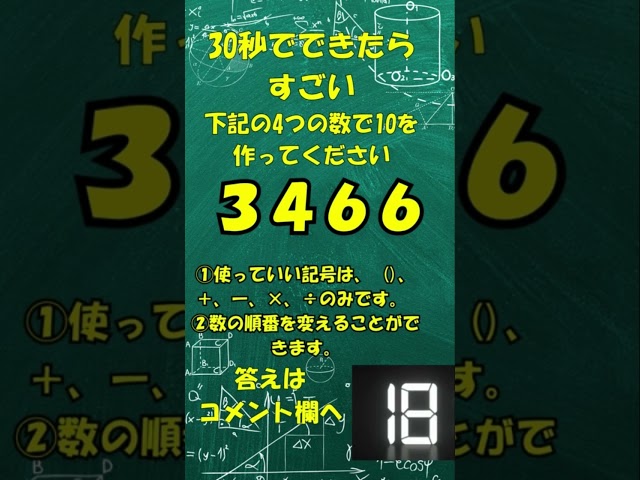
Insert one of the symbols +, −, ×, or ÷ between four randomly arranged numbers to make the final result 10—this makes a perfect brain-training activity! If you use parentheses, you can freely change the order of operations, so children who have learned parentheses should actively incorporate them.
Also remember that multiplication and division are performed before addition and subtraction, so keep that in mind as you complete your expressions.
Once you get used to it, it might be fun for parents and friends to take turns making problems for each other!
Three arithmetic puzzles

It’s a puzzle quiz where you fill numbers into blanks like a crossword.
The equations themselves are simple enough that even elementary school students could solve them, but the problems all require flashes of insight—only those good at arithmetic or with flexible thinking will be able to find the answers.
Can people with flexible minds solve these? Brain training with arithmetic quizzes (11–20)
Number fill-in-the-blank puzzle

Let’s try creating equations that lead to a predetermined answer! For example, suppose we have an equation like ○ + ○ + ○ = 20.
What numbers should we put in the circles to make the answer 20? You can provide a few choices of numbers to pick from, or leave it open and let people fill in any numbers they like.
In this problem of creating equations, it’s also recommended to adjust the difficulty—for instance, by changing the arithmetic operators in between, increasing the number of circles, or using decimals and fractions.
Which is the correct answer? A two-choice quiz on calculations
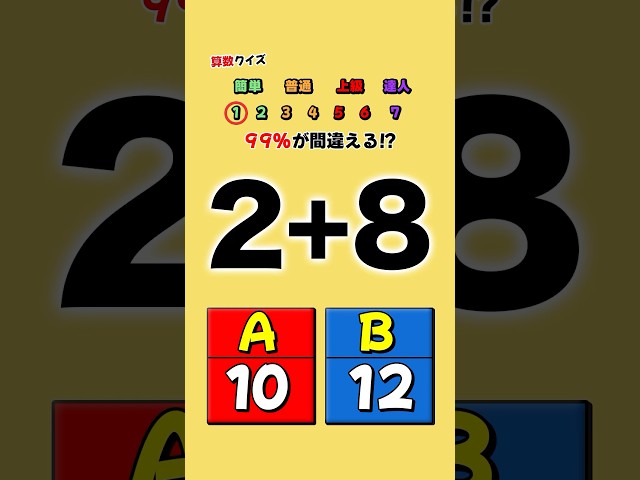
This is a math quiz with four levels: Easy, Normal, Advanced, and Master.
It features calculation problems in addition, subtraction, and multiplication.
Each question has two choices for the answer, so pick one within the time limit.
As the level increases, the numbers get larger, but it’s not too difficult.
However, because the answer is revealed after a 3-count, the time to think is short.
Stay calm and calculate carefully.
Elementary school students can have fun, and adults are encouraged to aim for a perfect score.

A problem that seems simple but is difficult

This calculation of 30,000 × 80,000 looks very simple at first glance, but it’s easy to fall into a trap and end up with the wrong answer.
To avoid being tricked, you need to pay attention.
First, start with a slightly easier calculation: 30,000 + 80,000.
After that, present the calculation of 30,000 × 80,000.
If you get tripped up, you might answer “240,000,” but unlike addition, this isn’t a problem you can solve by simply multiplying the numbers as they look.
If you take your time and think about how many zeros are in “man” (ten-thousand), you’ll arrive at the correct answer! Try changing the numbers or the place values and give it a go.
A math quiz that tests 3D spatial recognition skills

It’s a problem where diagrams of a certain solid are shown from various angles—top, left, front, and so on—and you’re asked to find its volume.
It can be quite challenging because it tests your ability to visualize the solid in your head.
I’ve heard that people who are good at these kinds of problems also tend to be good with maps.
