

Tongue Twisters So Fun and Cute You’ll Want to Say Them Out Loud!

Tongue twisters are loved as play and as practice for clear enunciation.
Since you’re giving them a try, how about tackling some cute tongue twisters that are sure to make you smile? In this article, we introduce tongue twisters that are cute either in their word order or in the things that appear in them.
From strings of animal and character names to rhythmic phrases that just beg to be spoken aloud, each one will lift your spirits just by pronouncing it.
They’re perfect for playing with kids or for a quick pastime with friends, so be sure to say them out loud and have fun!
- Tongue twisters that will make you laugh out loud! Super funny
- Get hyped! Tongue twisters that sound cool if you can say them—wordplay that makes you want to take on the challenge
- [Recreation] Challenge! A roundup of tongue twisters recommended for elementary school students
- [Diction Training] A Collection of Tongue Twisters to Improve Articulation
- Challenging tongue twisters: Introducing high-difficulty phrases and sentences!
- Perfect for pronunciation practice! A collection of English tongue twisters.
- Irresistibly tempting to try! Have fun practicing pronunciation with Korean tongue twisters
- Chinese tongue twisters: A collection of rao kou ling helpful for learning Chinese
- A collection of long tongue twisters. Also recommended for practicing announcements and narration.
- Take on the world’s hardest tongue twisters! A roundup of ultra-tough prompts that’ll tie your tongue
- Let’s have fun making them! Kid-friendly palindromes. Great as a reference for creating your own.
- Kenta Otani’s original tongue twisters: a collection that’ll have you tripping over words and bursting into laughter
- Nagoya dialect tongue twisters are exquisite! A fun collection where your tongue gets tied in knots with regional dialects
A collection of fun and cute tongue twisters (1–10) that make you want to say them out loud!
Banana Bavarois

Just from the words, they sound tasty and you can imagine a cute look, but the moment you try to say them out loud, they suddenly bare their fangs.
Most people can manage saying it once.
However, when you keep going, “banana” can get dragged by “bavarois” and come out as “babana.” It might help to keep “banana” firmly in mind at the start.
It’s also fun to gamify it—challenge yourself with the rule that if you say it correctly, you get to eat banana bavarois!

The mystery of the banana is still a mystery.

It sounds like a line from a story that unravels the mystery hidden in a banana.
“Banana” is a fairly familiar word, but when said quickly, the “nana” part can be hard to pronounce clearly.
On top of that, the similar sound of “nazo” (mystery) follows, which makes it even trickier.
And then there’s the final “nano da zo.” Since we don’t often use that kind of sentence ending, it tends to be both hard to say and hard to catch.
It’s a tongue-twister, so keeping a sense of speed matters, but try pronouncing it gently without rushing too much!
Frogs hop-hoppity, three hop-hoppity; together hop-hoppity, six hop-hoppity.
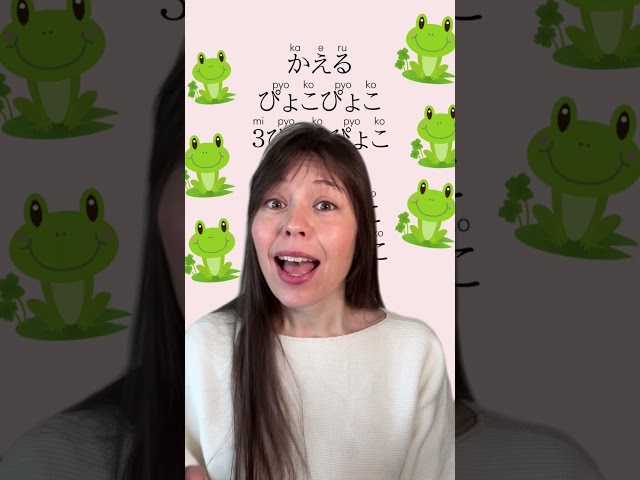
It’s a classic tongue twister phrase that depicts the number of frogs gradually increasing.
If you only look at the text, it can be hard to tell which number comes next, so picturing the scene might help.
The tricky parts as a tongue twister are the pronunciation of “pyo” and its connections with “mi” and “mu”; it’s important to pay attention to your mouth shape as you go.
The link between “pyo” and “ko” also requires a different articulation, so precisely because they come in succession, don’t let your guard down there either.

Tongue twisters so fun and cute you’ll want to say them out loud! A collection of tongue twisters (11–20)
I’m Bob, I’m Bob, I’m Bob

It’s a simple yet tongue-twisting phrase that depicts Bob repeatedly hyping up his own name.
The unusual situation of saying your own name over and over—something you wouldn’t normally do in everyday life—creates a subtly funny effect.
Since the sounds “bo” and “bu” are produced by closing the lips and then releasing them, the challenge is how smoothly you can connect them.
However, if you focus too much on those voiced consonants, you may get tripped up by the “ku” in between, so watch out.
Kit Kat cut cuntNEW!
It’s a tongue twister that goes, “I had to make sure to buy ‘KitKat’”—the product name.
KitKat is a famous chocolate snack, and many people love it.
Maybe the person who came up with this tongue twister wanted to eat one but forgot to buy it and was shocked.
For those used to speaking Hakata dialect, it might be easy, but for those who aren’t, it can be hard to say.
Since there are repeated small ‘tsu’ sounds, be careful not to bite your tongue and give it a try.

Red capybara, blue capybara, yellow capybara

This is a classic tongue-twister pattern: take a word that’s already hard to say and make it even trickier by adding color words.
Here, the focus is on “capybara,” and the addition of words like “red,” “blue,” and “yellow” highlights how awkward it becomes to pronounce.
The tricky point is the connection between the “pi” and “ba” sounds in “capybara.” Because those popping consonants mix with softer vowel sounds like “a” and “o,” be mindful of switching between them.
Since a colorful capybara doesn’t exist in reality, it might be fun to imagine the scenario on purpose while you practice the pronunciation.
raw banana

Saying it just once probably isn’t that difficult.
However, when you have to repeat it multiple times, the difficulty suddenly increases.
You start to feel challenged by almost the entire phrase—like the connection between the “ma” and “ba” in “nama-ba,” or the “nana” in “banana.” Both “ma” and “ba” are sounds pronounced with the lips closed, and to say them in succession you have to close your lips quickly twice, which makes it harder to pronounce smoothly.
By opening your mouth properly and moving it actively, you should be able to handle repeated pronunciation more clearly.