

Tongue Twisters So Fun and Cute You’ll Want to Say Them Out Loud!

Tongue twisters are loved as play and as practice for clear enunciation.
Since you’re giving them a try, how about tackling some cute tongue twisters that are sure to make you smile? In this article, we introduce tongue twisters that are cute either in their word order or in the things that appear in them.
From strings of animal and character names to rhythmic phrases that just beg to be spoken aloud, each one will lift your spirits just by pronouncing it.
They’re perfect for playing with kids or for a quick pastime with friends, so be sure to say them out loud and have fun!
- Tongue twisters that will make you laugh out loud! Super funny
- Get hyped! Tongue twisters that sound cool if you can say them—wordplay that makes you want to take on the challenge
- [Recreation] Challenge! A roundup of tongue twisters recommended for elementary school students
- [Diction Training] A Collection of Tongue Twisters to Improve Articulation
- Challenging tongue twisters: Introducing high-difficulty phrases and sentences!
- Perfect for pronunciation practice! A collection of English tongue twisters.
- Irresistibly tempting to try! Have fun practicing pronunciation with Korean tongue twisters
- Chinese tongue twisters: A collection of rao kou ling helpful for learning Chinese
- A collection of long tongue twisters. Also recommended for practicing announcements and narration.
- Take on the world’s hardest tongue twisters! A roundup of ultra-tough prompts that’ll tie your tongue
- Let’s have fun making them! Kid-friendly palindromes. Great as a reference for creating your own.
- Kenta Otani’s original tongue twisters: a collection that’ll have you tripping over words and bursting into laughter
- Nagoya dialect tongue twisters are exquisite! A fun collection where your tongue gets tied in knots with regional dialects
Tongue twisters so fun and cute you'll want to say them out loud! A collection of tongue twisters (21–30)
Red pajamas, yellow pajamas, brown pajamas

It’s the classic format of a tongue twister that evokes rows of pajamas in various colors.
Depending on which color you put before “pajamas,” both the imagined image and the difficulty of saying it will change.
Here, we use three colors: red, yellow, and brown.
Another factor that adds to the difficulty is that “aka” (red) has two mora, while “ki” (yellow) and “cha” (brown) have one.
For the popping “pa” sound, the shape of your mouth is crucial, so it’s important to pronounce it smoothly within the flow of the surrounding sounds.

Seven bananas, Nanana’s banana

This is a tongue twister full of rhythm, where the sound of the number “7” and “nanana” is fun.
The trick is that when you try to say “banana” and “nanana” alternately, your mouth inevitably trips up.
Children can learn a feel for language as they play along with the rhythm, and adults can enjoy it as an exercise for the tongue and mouth.
The combination of numbers and sounds even feels like a little story, making it enjoyable just to read.
With repetition, you naturally pick up the rhythm and timing, and it’s a tongue twister that’s addictive after one go, letting you savor the joy of speaking out loud and a good laugh at the same time.

Totetchiteta tote chite tote chite tote chiteta—oops, I danced. Tontsutsu ton tsutsu toton tsutsu—let’s dance the Dontaku dance.

Because sounds like “totechite” and “tontsutsu,” which resemble onomatopoeia, appear repeatedly, your mouth naturally tangles when you say them aloud, making you laugh without meaning to.
Both children and adults can take it on playfully, imagining the rhythm of the sounds and the dancing.
If you read while picturing the scene of dancing the “Dontaku Dance,” that’s the key to enjoying it as a story that’s more fun than a simple tongue twister.
With each repetition, the rhythm and timing shift, letting you savor both the joy of speaking out and the urge to challenge yourself.
Once you read it, it becomes addictive—so try enjoying it in all sorts of situations!
Red Myakumyaku, Blue Myakumyaku, Yellow Myakumyaku

A tongue-twister so fiendishly hard it’ll tie your tongue in knots, bursting with playful rhythms of color and sound.
Because the repeated “Myaku-Myaku” appears over and over, saying it aloud naturally tangles your mouth and sparks laughter.
The key is that both kids and adults can enjoy it like a game.
Images of red, blue, and yellow pop into your head, letting you imagine a little story just by reading, which makes speaking it out loud even more fun.
Each repetition shifts the rhythm and timing, so every attempt brings new laughs and fresh discoveries.
Try it once and you’ll be hooked—this is a notoriously tricky tongue-twister.
Caterpillar Caterpie capybara and chirpily tappy-ing

This is a tongue twister about the Pokémon Caterpie, which looks like a caterpillar.
A caterpillar track is a type of running gear also known as continuous tracks—the wheel section on a hydraulic excavator is an example.
In this scene, a Caterpie fitted with caterpillar tracks is chattering away while drinking tapioca (bubble tea) with a capybara.
It paints a funny picture.
Anyway, there are so many “kya” and “pi” sounds that you’ll probably lose track of what you’re saying halfway through.
Try it while clearly visualizing the scene.

bread wall

This is a tongue twister packed with the fun of rhythm and repetition.
If you try to say “pan-kabe, pan-kabe, pan-kabe…” ten times in a row, your mouth will get tangled, and you can’t help but laugh—that’s the charm.
For kids, it becomes a playful exercise for the tongue and mouth, and for adults, it’s enjoyable as a tongue workout and pronunciation practice.
The slightly quirky pairing of “bread” (pan) and “wall” (kabe) creates a sense of rhythm, and it’s interesting that your voice and timing shift a little each time you read it.
Even with short words, the repetition makes your brain and mouth work at full speed, bringing laughter and new discoveries with every try—a tongue twister full of playfulness.
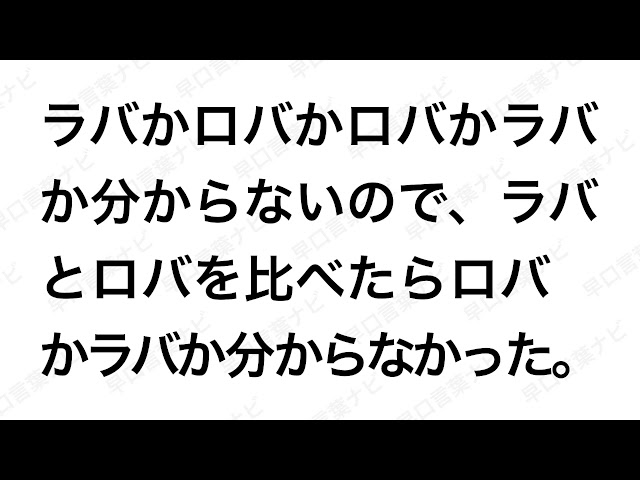
I couldn’t tell if it was a mule or a donkey, so when I compared a mule and a donkey, I still couldn’t tell if it was a donkey or a mule.
A mule is a hybrid born from a male donkey and a female horse.
Since it resembles a donkey more, it may be difficult to judge by comparing photos.
Perhaps this tongue twister was born from that very feeling.
It depicts comparing a mule and a donkey in an extremely confusing sentence.
The hardest part of this tongue twister is probably that “raba” (mule) and “roba” (donkey) keep switching places.
Even in the text, you end up not knowing which is which!