



There are many four-character idioms, like “killing two birds with one stone” and “telepathy,” that we often encounter in everyday life.
Simply knowing how to use them can make your conversations and writing more polished.
However, many people may confuse idioms with similar meanings or not fully understand the correct meanings of some of them.
In this article, we introduce a quiz designed for the general public that helps you deepen your knowledge of four-character idioms while having fun.
Why not learn idioms you can use in conversations with friends and in business settings through a quiz?
- A four-character idiom quiz that elementary schoolers will love! Questions become fun once you understand the meanings
- [Understand with four-character idioms] A psychology test that digs into who you are
- Amusing four-character idioms you’ll want to use right away! A collection of expressions to remember as general knowledge.
- [For Elementary School Students] A Four-Choice Proverb Quiz Recommended for Kids
- Become positive with four-character idioms that resonate with the heart! Common yet deeply meaningful words.
- [Hard-to-Read Quiz] Single-character difficult kanji — including surprisingly simple ones!
- [Challenge] Stimulate your intellectual curiosity with a general knowledge quiz you might not know!
- A quiz of interesting obscure kanji: characters that look easy but are hard to read
- General: Four-character idioms that encourage determination—powerful, heart-stirring words
- [Four-Character Idioms] Impressive and Cool Sound! A Collection of Famous Quotes Worth Knowing as General Knowledge
- Where do you split it? Learn general language knowledge through a quiz.
- Let's take on a four-choice quiz that everyone can enjoy together!
- One-character difficult kanji quiz: a multiple-choice (3 options) game to learn the readings of challenging kanji
Surprisingly tricky! Test your general knowledge with a four-character idiom quiz (1–10)
What is the four-character idiom that means getting two effects from doing one thing?

See the answer
killing two birds with one stone
“Killing two birds with one stone” means achieving two results or benefits through a single action or effort. It comes from a proverb about bringing down two birds with one stone, and it’s a four-character idiom commonly used in Japan as well. Since it makes efficient use of limited time and resources to produce a win-win outcome, it’s a useful concept in both business and everyday life.

What is the four-character idiom that means to become so absorbed in one thing that you forget yourself?
See the answer
being absorbed in something; being frantic; in a daze; wholeheartedly; with all one’s might
“Mugamuchū” is a four-character idiom that describes being so absorbed in something that you forget yourself and lose awareness of your surroundings. To work on something mugamuchū means nothing else catches your eye—you’re extremely focused. It’s a phrase often used in contexts like sports or the arts, when someone is fully devoted to an activity.
What is the four-character idiom that means to share any fate or hardship together?
See the answer
in the same boat; share a common fate (lit. “live and die together as one lotus”)
Originally a Buddhist term meaning to be reborn together on the same lotus flower, “ichiren takushō” has come to signify sharing the same fate. It is most often used for relationships with deep trust, such as between spouses, as in “a bond of ichiren takushō.” It can also be used to express a readiness to accept adverse outcomes together.
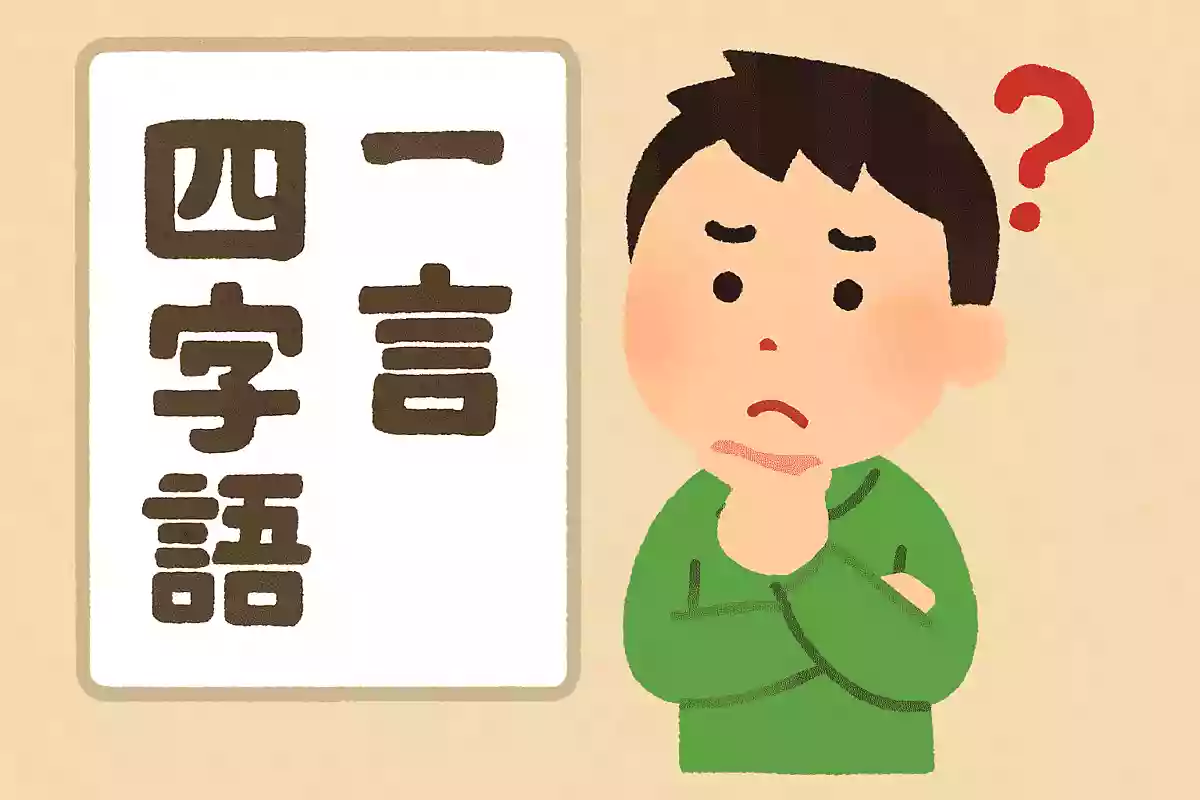
What four-character idiom means a very short amount of time?
See the answer
overnight; in a short time; in a single day
This is a four-character idiom that means a short or brief amount of time. It’s used to emphasize situations where things can’t be resolved quickly and require a long time and a lot of effort. It’s also an effective expression when encouraging someone or conveying empathy.

What is the four-character idiom that means to distinguish between what is necessary and what is unnecessary?

See the answer
selection and elimination
“Shusha Sentaku (Selection and Elimination)” is a four-character idiom that means choosing by taking what is necessary and discarding what is unnecessary. It refers to the act of discerning the essence of things, setting priorities within limited time, and proceeding efficiently to focus on what is most important. It is used in everyday situations.
What four-character idiom means to ignore other people’s opinions?
See the answer
like the east wind to a horse (an admonition goes unheeded; words fall on deaf ears)
This four-character idiom, read as “bajitōfū,” means to pay no heed to other people’s opinions or advice and to let them go in one ear and out the other. It comes from an old anecdote about a horse showing no reaction even when an east wind blows into its ear. It’s often used to describe someone who doesn’t take things seriously and just brushes them off, and you’ll hear it frequently in everyday conversation as well as in business settings.
What is the four-character idiom that means a once-in-a-lifetime encounter?

See the answer
Once-in-a-lifetime encounter
Ichigo ichie is a four-character idiom meaning a once-in-a-lifetime encounter or opportunity. It is also well known as a principle of the tea ceremony, teaching us to cherish each unrepeatable moment and meeting, and to do our best with the awareness that the same time and circumstances will never come again.