

[Intermediate Level] A curated selection of piano masterpieces featuring strikingly brilliant melodies!


When you think of brilliant, showy piano pieces, what comes to mind?
The piano can play melody and accompaniment simultaneously, not only connecting lines smoothly but also creating bold, percussive rhythms—it’s even said to be an instrument capable of recreating an orchestra all on its own.
Piano timbre has many facets—beauty, poignancy, fragility—but this time we’ve selected intermediate-level works that let you fully savor its bright, powerful, and dazzling side!
Even if you prefer gentle or wistful pieces, we hope this will be a chance to discover a new charm of the piano and inspire you to give these works a try.
- [For Intermediate Players] Challenge Yourself! Recommended Masterpieces That Shine at Piano Recitals
- [For Adults] Recommended for Piano Recitals! A Curated Selection of Impressively Sounding Masterpieces
- Piano Masterpieces: Surprisingly Easy Despite Sounding Difficult!? A Curated Selection Perfect for Recitals
- [Piano Recital] Perfect Pieces for Middle Schoolers! A Curated Selection of Impressive, Audience-Pleasing Works
- [Intermediate] Recommended Piano Duets | A Curated Selection of Cool and Dazzling Pieces
- [Intermediate Level] Cool Piano Pieces You Can Play [Great for Recitals Too]
- For Advanced Players: Showstopping Classics to Play at a Piano Recital
- [Latest] Piano Solo Intermediate | Picked Recommended & Popular Sheet Music
- Masterpieces of classical piano that are too beautiful for words. A gathering of delicate tones that cleanse the soul.
- [For Piano Recitals] Simple yet Cool Classical Pieces
- [Classical Music] All pieces under 3 minutes! A collection of short and cool piano pieces
- [For Advanced Players] A Curated Selection of Classical Masterpieces to Tackle at Piano Recitals
- [Low Difficulty] Recommended Tchaikovsky Piano Pieces [Intermediate]
[Intermediate Level] Carefully Selected Piano Masterpieces with Strikingly Brilliant Melodies! (21–30)
Two Rhapsodies, Op. 79 No. 1Johannes Brahms

Johannes Brahms’s masterpiece Two Rhapsodies is frequently performed at piano competitions for junior high and high school students.
This time, we’re introducing the particularly popular No.
1 from Two Rhapsodies, Op.
79.
Because the piece contains many voices, it tends to sound a bit blurred, but it is nonetheless a powerful work.
Since the chordal writing often leads to fortissimo, you can achieve a better performance by playing without overemphasizing contrasts, allowing for a natural sense of shape and balance.

Etude Op. 10, No. 5 “Black Keys”Frederic Chopin

Frédéric Chopin was a Polish-born composer who was active in France.
One of his signature works is No.
5 from the Études Op.
10, which features the black keys as its main focus.
It’s also known as the “Black Key Étude.” Although it was written as a study to develop piano technique, its high musicality has made it a popular piece frequently performed in concerts.
The light, glittering melody in the right hand seems to dance across the black keys.
Just listening to it lifts your spirits, filling you with a bright, positive feeling.
It’s highly recommended for anyone who wants to fully enjoy the piano’s brilliance.
[Intermediate Level] A Curated Selection of Piano Masterpieces with Strikingly Brilliant Melodies (31–40)
Csikos PostHermann Necke

Published in 1895, this work is a piano piece by the German composer Hermann Necke.
Its title comes from the Hungarian horse-herding cowboys known as “csikós” and the horseback acrobatic act called “post.” Characterized by a rhythmic, lively melody, it evokes patterns reminiscent of galloping hooves and a swaying carriage.
The bustling figures in the left hand and the leaps expressed in the right hand impart a vivid sense of speed and exhilaration.
Bright, powerful, and brilliant, this piece lets you fully savor the piano’s appeal.
Give it a try!
Lyric Pieces, Book VIII, Op. 65, No. 6: “Wedding Day at Troldhaugen”Edvard Hagerup Grieg

Grieg’s masterpiece, Lyric Pieces Book VIII, Op.
65 No.
6 “Wedding Day at Troldhaugen.” It’s said to embody Grieg’s characteristic style and is widely beloved among performers.
As for difficulty, it’s roughly on par with the latter half of the sonatina level, or perhaps slightly more challenging.
In the passage where five-note groupings appear in sixteenth notes, the score marks triple forte, so you must produce considerable power and impact.
This section is quite difficult, so I recommend focusing your practice on it.
The Alps at sunsetTheodor Oesten

Theodor Oesten, a composer from Germany, was immersed in music from an early age and later became a popular piano teacher in Berlin.
This work is a delicate and graceful piano piece that depicts the beautiful twilight of the Alps through music.
First published in Leipzig in 1861, it is a standard piece often performed at recitals, alongside Oesten’s signature work, “Doll’s Dream and Awakening.” Evoking the Alps’ magnificent evening scenery in a magical way, this piece is perfect for those who want to fully express their musicality.
If you play it with heart, it will offer listeners a soothing, healing moment.
Give it a try!
Adeline by the SeasideRichard Clayderman
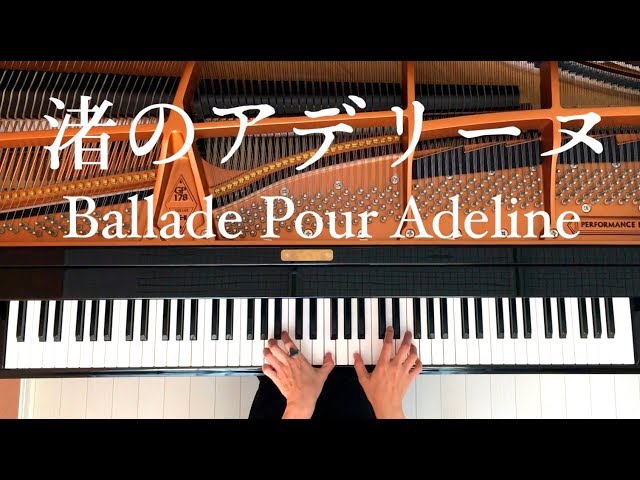
Adeline, by the Sea (Ballade pour Adeline) is the debut piece by French pianist Richard Clayderman.
It’s a famous piano work whose record release in 38 countries became a massive hit, selling 22 million copies.
Because it’s often used as background music on TV and in commercials, and included as an auto-play piece in electronic pianos, many of you have probably heard it somewhere.
Enjoy playing it with a relaxed touch, letting the light, expectation-building introduction and the refreshing melody soothe you.

Promenade from Pictures at an ExhibitionModest Mussorgsky

Pictures at an Exhibition, a piano suite composed by Modest Mussorgsky, one of the Russian Five.
Among its pieces, the one I particularly recommend is Promenade from Pictures at an Exhibition.
Since it is frequently used in Japanese media, many of you may have heard it.
In fact, Mussorgsky composed this work after being deeply shocked by the death of the Russian painter Viktor Hartmann.
Despite that background, the piece has a brilliant, celebratory tone—perhaps reflecting how Mussorgsky, while mourning the painter’s death, was also genuinely enjoying the exhibition.