

[Intermediate Level] A curated selection of piano masterpieces featuring strikingly brilliant melodies!


When you think of brilliant, showy piano pieces, what comes to mind?
The piano can play melody and accompaniment simultaneously, not only connecting lines smoothly but also creating bold, percussive rhythms—it’s even said to be an instrument capable of recreating an orchestra all on its own.
Piano timbre has many facets—beauty, poignancy, fragility—but this time we’ve selected intermediate-level works that let you fully savor its bright, powerful, and dazzling side!
Even if you prefer gentle or wistful pieces, we hope this will be a chance to discover a new charm of the piano and inspire you to give these works a try.
- [For Intermediate Players] Challenge Yourself! Recommended Masterpieces That Shine at Piano Recitals
- [For Adults] Recommended for Piano Recitals! A Curated Selection of Impressively Sounding Masterpieces
- Piano Masterpieces: Surprisingly Easy Despite Sounding Difficult!? A Curated Selection Perfect for Recitals
- [Piano Recital] Perfect Pieces for Middle Schoolers! A Curated Selection of Impressive, Audience-Pleasing Works
- [Intermediate] Recommended Piano Duets | A Curated Selection of Cool and Dazzling Pieces
- [Intermediate Level] Cool Piano Pieces You Can Play [Great for Recitals Too]
- For Advanced Players: Showstopping Classics to Play at a Piano Recital
- [Latest] Piano Solo Intermediate | Picked Recommended & Popular Sheet Music
- Masterpieces of classical piano that are too beautiful for words. A gathering of delicate tones that cleanse the soul.
- [For Piano Recitals] Simple yet Cool Classical Pieces
- [Classical Music] All pieces under 3 minutes! A collection of short and cool piano pieces
- [For Advanced Players] A Curated Selection of Classical Masterpieces to Tackle at Piano Recitals
- [Low Difficulty] Recommended Tchaikovsky Piano Pieces [Intermediate]
[Intermediate Level] A curated selection of iconic piano masterpieces with dazzling melodies! (41–50)
Impromptu FP 176 No. 15 in C minor “In Praise of Édith Piaf”Francis Poulenc
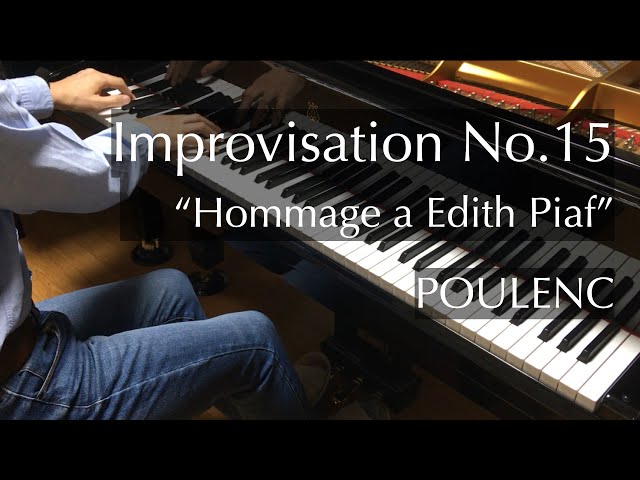
Francis Poulenc’s masterpiece, “Improvisation FP 176 No.
15 in C minor ‘Hommage à Édith Piaf.’” Édith Piaf, the chansonnière who represents France.
This work embodies Poulenc’s deep respect for the beloved Édith Piaf.
In terms of difficulty, it’s somewhere between D and E on the PianoVerse scale.
The quality of the performance changes greatly depending on how cleanly you play the grace notes, so it’s a good idea to practice with particular attention to that aspect.

Piano Sonata No. 11 in A major, K. 331, Third Movement “Turkish March”Wolfgang Amadeus Mozart

The famous piece “Turkish March” is one that everyone has heard at least once.
Many of you may remember classmates who took piano lessons playing it back in elementary or middle school.
The charm of the “Turkish March” lies in its combination of brilliance and strength.
While flashy works often feature gentle melodies centered on waltzes, this piece incorporates the rhythms of the Mehter military band, giving it a pronounced sense of power.
It’s best to express both the crisp, stately atmosphere and the lightness of a waltz to good effect.
Hungarian Dance No. 5Johannes Brahms

Johannes Brahms’s Hungarian Dance No.
5 is a duet practice piece that you often hear at recitals.
It’s a famous work that just about everyone has heard at least once.
Strongly influenced by Romani music, it features melodies throughout that foreshadow later gypsy jazz.
Rather than simply being showy, its themes convey passionate intensity, while the middle section gathers into a bright melody that also feels gentle.
Keeping the brilliance of the duet intact, solo piano arrangements have also been published—so be sure to give it a try!
Six Pieces for Piano, Op. 118 No. 3 “Ballade”Johannes Brahms

Johannes Brahms, one of Germany’s greatest composers.
Brahms wrote many pieces at an intermediate level, but among them I especially recommend “Six Pieces for Piano, Op.
118 No.
3: Ballade.” It’s a piece marked by the weighty, powerful melodies that are quintessential Brahms.
In terms of difficulty, it’s roughly equivalent to Czerny Nos.
40–50.
Although this work is said to be challenging at the beginning and end, the middle section requires legato technique in double notes, so rather than treating it like a piece with relentless, flashy passages, pay careful attention to the details as you perform it.
Love’s GreetingEdward Elgar

Brimming with a romantic atmosphere, this piece was composed in 1888 by Edward Elgar as an engagement gift to his beloved wife, Caroline Alice Roberts.
It is characterized by a graceful, sweet melody and is cherished as music for weddings and anniversaries.
Although written for violin and piano, it can be enjoyed in various arrangements, including solo piano and orchestral versions.
Its syncopated rhythm is striking: it begins gently, modulates in the middle section, then returns to the main theme and ends in a soaring climax.
Overflowing with love, this masterpiece perfectly suits the spring season, a time of new encounters.
Moments Musicaux, Op. 16 No. 6Sergei Vasil’evich Rachmaninov

No.
6 from Moments Musicaux by the Russian composer Sergei Rachmaninoff.
It is characterized by rich harmonies and complex rhythms, with a strikingly powerful melody.
Completed in 1905, the piece captivates with its emotional and dramatic structure.
Alongside its pianistic virtuosity, it fully showcases his expressive depth.
Its brilliant, richly emotive musicality is quintessential Rachmaninoff.
With expansive dynamics and intricate harmonies, it conveys surging waves of emotion—one of the highlights of the work.
Highly recommended for those who want to savor the piano’s bright, powerful, and resplendent side.
ChaconneJ.S.Bach=Busoni

Chaconne appears as the final movement of Johann Sebastian Bach’s Partita for Solo Violin.
While it is highly renowned as a violin piece, Ferruccio Busoni arranged it for piano.
Busoni, an Italian composer with profound insight into Bach’s music, crafted an arrangement that honors the spirit of the original while pursuing the rich expressive possibilities unique to the piano.
Based on a 16th-century Spanish dance, the piece begins with a brief theme and proceeds through a series of variations.
It is technically demanding and structured to draw out the piano’s full potential.
It is a highly recommended work for those who want to experience both the grandeur and the delicacy of classical music.