

Folk songs, children's songs, and nursery rhymes of Hiroshima: the enduring heart of our hometown, passed down through song.
This is a feature on folk songs handed down in Hiroshima Prefecture.
Folk songs arose from the everyday lives of people in their regions and have been passed down to the present day.
What we discovered while preparing this feature is that, compared with other prefectures, Hiroshima has an exceptionally large number of folk songs bearing the name “Ondo,” and you can find many videos of Bon Odori as well.
It may be that people in Hiroshima have long enjoyed their regional traditions through songs and festivals, happily singing and dancing to them.
In this article, we introduce folk songs that have been passed down in Hiroshima since long ago.
It’s also interesting to listen to the folk songs while exploring the meaning embedded in the form known as “Ondo,” which continues to be handed down.
Playlist
| Folk songs, children's songs, and nursery rhymes of Hiroshima: the enduring heart of our hometown, passed down through song. | |||
|---|---|---|---|
| show_chart | Title | Playlist | Review |
| 1east | Please go sleepy-bye. |  play_arrow play_arrow | A lullaby originating in Okayama has been passed down to the present day |
| 2east | Ondo Boat Song |  play_arrow play_arrow | Ondo no Funauta is one of Japan’s three great boat songs. |
| 3east | Rice-Washing Song |  play_arrow play_arrow | The rice-washing song is a work song that helps improve efficiency in sake brewing. |
| 4east | Kure Ondo |  play_arrow play_arrow | The Kure Ondo was created during the postwar reconstruction period and is enjoyed as a Bon Odori dance. |
| 5east | Kiyari song |  play_arrow play_arrow | Kiyari are celebratory festival songs that evolved from work songs into folk songs. |
| 6east | Song of Brush-Making |  play_arrow play_arrow | Passing down the Fude Festival that preserves the tradition of Kumano brushes |
| 7east | Song of the Aogiri |  play_arrow play_arrow | A song that weaves the story of the A-bombed Chinese parasol tree and wishes for peace |
| 8east | Song of Inoko (Boar’s Day Song) |  play_arrow play_arrow | The custom of eating boar rice cakes on the Day of the Boar |
| 9east | Tosa’s ozashiki entertainment |  play_arrow play_arrow | In Tosa’s ozashiki games, drawing the one with a chrysanthemum means a penalty drink. |
| 10east | Mr./Ms. Atsumori |  play_arrow play_arrow | A folk song of Shobara City that sings of the tragic romance of Atsumori and Princess Tamaori |
| 11east | Mibu’s Hanadaue (Rice-Planting Festival) |  play_arrow play_arrow | Mibu no Hanadaue is a folk song that originated from a rice-planting ceremony. |
| 12east | Hi Wagyu Memorial Rice Planting | 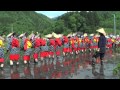 play_arrow play_arrow | The 700-year-old rice-planting ritual for honoring cattle in Hiwa Town |
| 13east | Mihara Yassa Dance |  play_arrow play_arrow | The fun dance of the Mihara Yassa Festival |
| 14east | In the country where Hiroshima is |  play_arrow play_arrow | A song that calls for world peace and opposes war |
| 15east | Soran Bushi |  play_arrow play_arrow | A folk song from Hokkaido wishing for successful herring fishing |
| 16east | Genroku Cherry Blossom Viewing Dance |  play_arrow play_arrow | Genroku Hanami Odori is a nagauta piece from the kabuki repertoire. |
| 17east | Ooyama Memorial Rice-Planting in Shiobara |  play_arrow play_arrow | The Folk Culture of the Ōyama Memorial Rice-Planting in Shiobara |
| 18east | Onomichi Ondo |  play_arrow play_arrow | The Onomichi Ondo was sung at the Port Festival and spread to the public. |
| 19east | The square, us, and the blue sky |  play_arrow play_arrow | An anthem supporting the progressive movement born from the 1971 Tokyo gubernatorial election |
| 20east | Hiroshima Prefecture Folk Song Bay Nagashi |  play_arrow play_arrow | The origins and uses of Hiroshima Prefecture folk song bai-nagashi |
| 21east | Hamakouta (Seashore Maiden’s Song) |  play_arrow play_arrow | Reconstruction of work songs sung by hama-ko (salt field workers) in the irihama-style salt pans |
| 22east | Ai-ya bushi |  play_arrow play_arrow | The Aiya-bushi is danced at festivals and celebrations. |
| 23east | Saka Town Ondo |  play_arrow play_arrow | Town folk song to commemorate the 60th anniversary of Saka Town’s establishment |
| 24east | Hayashida in Shinjo |  play_arrow play_arrow | Traditional performing art of maidens planting rice |
| 25east | one, two, three, four |  play_arrow play_arrow | Hiroshima’s demon game: a game where you form pairs when the song ends. |
| 26east | Hiroshima is a nice place. |  play_arrow play_arrow | A folk song that sings of hope for recovery from the atomic bomb |
| 27east | Millstone Grinding Song |  play_arrow play_arrow | A work song for grinding rice, wheat, and buckwheat into flour with a stone mill |
| 28east | sunset |  play_arrow play_arrow | An upbeat children's song inspired by a sunset view |
| 29east | Hiroshima Peace Song |  play_arrow play_arrow | A choral piece praying for peace, composed by Hideo Yamamoto and commissioned through a public call by the Hiroshima Peace Festival Association. |
| 30east | Fukuyama Tondo Ondo |  play_arrow play_arrow | Fukuyama’s Tondo is a New Year’s event that began when Katsunari Mizuno constructed the castle. |