

2026 is the Year of the Horse! A detailed explanation of four-character idioms related to horses.

How many four-character idioms related to horses can you think of? From familiar ones like “horse’s ear, east wind” (bajitōfū: turning a deaf ear) and “Saiō losing his horse” (saiō shitsu ba: a blessing in disguise) to lesser-known expressions, there’s a wealth of idioms featuring horses.
Horses have long been close to people’s lives, and their form and nature have been etched into many words.
In this article, we highlight common four-character idioms that you can use in everyday conversation and business settings.
Once you learn their meanings and usage, you’ll find yourself nodding in agreement at the depth of the language.
Put them to use to boost your vocabulary!
- [New Year’s Cards for the Year of the Horse] Clever phrases that use “horse” well. Funny one-liners to spark the year’s first laugh.
- A one-line message to add to New Year’s cards! Horse-themed ideas that elementary school kids can write
- Amusing four-character idioms you’ll want to use right away! A collection of expressions to remember as general knowledge.
- Become positive with four-character idioms that resonate with the heart! Common yet deeply meaningful words.
- Interesting four-character idioms for elementary schoolers! Words you'll want to use once you understand their meanings
- [Four-Character Idioms] Impressive and Cool Sound! A Collection of Famous Quotes Worth Knowing as General Knowledge
- [Kakizome] Four-character idioms fit for the New Year: Introducing words that resonate with the heart and their meanings
- Four-character idioms with numbers: clear explanations of meanings and usage
- Four-character idioms that help you achieve goals! Phrases you can use in everyday situations
- General: Four-character idioms that encourage determination—powerful, heart-stirring words
- Enrich your heart with beautiful four-character idioms! A collection of expressions you'll want to use in everyday life.
- Learn the meanings too! Cool four-character idioms that elementary school students will want to remember
- Boost your vocabulary with four-character idioms that include numbers! A collection of four-character idioms for elementary school students to learn.
2026 is the Year of the Horse! A detailed guide to four-character idioms related to horses (1–10)
Saiō loses his horse (a blessing in disguise).
@tanetam33 Saiō-shitsu-ba (The Old Man at the Frontier Loses His Horse). “Saiō-shitsu-ba” means that an event which appears to be misfortune or failure at first may later lead to good fortune. This idiom suggests that, in unpredictable times, effective leadership embraces adversity with flexibility and turns it into opportunity.A blessing in disguise.Turn adversity into opportunitytranslationWisdom of ManagementReverse thinkingLeadershipEra of Change
♪ Original song – Soala – Soala
This four-character idiom expresses that a person’s good fortune and misfortune change with time and that neither can be predicted.
“Saiō” refers to an old man living on the frontier, and the saying originates from a story about him and a horse, in which good and bad fortune repeatedly trade places.
His horse runs away; later, it returns with a better horse; then his son falls off the horse; but because of that injury, the son avoids conscription—good and bad arrive in turn.
Even without such dramatic swings, it’s a phrase that encourages us not to lament misfortune but to believe in future happiness and keep moving forward.

A long whip cannot reach a horse’s belly. (Meaning: Even with great power or skill, there are limits to what one can affect.)

This is a four-character idiom that expresses the fact that there are things that cannot be changed no matter how great one’s power may be.
It can also be used to mean that something too powerful or too long can, conversely, become useless.
The phrase comes from the idea that if a whip is too long, it won’t strike the horse’s belly, and is said to have been a remark by Bokuzō when looking at the relationships among Jin, Chu, and Song during China’s Spring and Autumn period.
It conveys the message that even if one possesses great power, one should not overestimate it and should proceed with caution.
seasoned veteran; someone with vast experience (literally: a thousand armies and ten thousand horses)

It’s a term used to describe someone with extensive combat experience, either as part of a large army or as a person seasoned by life.
The “thousand” and “ten thousand” are not literal figures, but signify a number so large it can’t be readily counted, conveying the vast scale of troops or horses.
While it expresses sheer magnitude, the use of characters related to warfare strongly evokes the idea of experience.
It suggests that countless experiences will be useful in one’s path ahead, and carries the message that it’s good to keep accumulating such experience.
2026 is the Year of the Horse! A detailed explanation of four-character idioms related to horses (11–20)
Always on the move; living a busy, itinerant life (literally: south by ship, north by horse).

It’s an expression that describes someone who is constantly traveling or busily moving around from place to place.
It originates from China’s geography: in the south, with its many rivers and canals, boats are commonly used, while in the north, with its mountains and plains, horses are more common—hence these modes of transport appear in the phrase.
Because it evokes traveling by various means, it also clearly conveys the breadth of the journey.
Since your means of transportation changes depending on where you are, it could be fun to think about what the expression would look like in your own case.
Tiny like a bean, small as a person — extremely small.

A four-character idiom that expresses how distant objects appear small, often used for perspective in painting.
It first appeared in the Chinese painter Jing Hao’s “Treatise on Landscape Painting” (Huà Shānshuǐ Fù) and became established as a term for a visual technique.
The expression describes horses and people in the distance being drawn as tiny as an inch-long horse or a grain-sized dot, using concrete sizes to make the image easy to grasp.
It conveys a mindset and practical guideline for drawing: distant things should be depicted smaller.
Horses and cattle, collars and hems

This is a phrase used to admonish people who lack knowledge or cultivation, or who behave rudely.
The term “collar and hem” literally refers to the neckline and hem of clothing, implying that someone is no better than a cow or horse merely dressed in clothes—lacking human common sense.
While one might picture an animal character wearing clothes, the expression is not cute or whimsical; it carries a strong negative meaning.
It conveys the desire for the person not to be just an animal in clothes, but to become more human and sensible.
Mikemōma
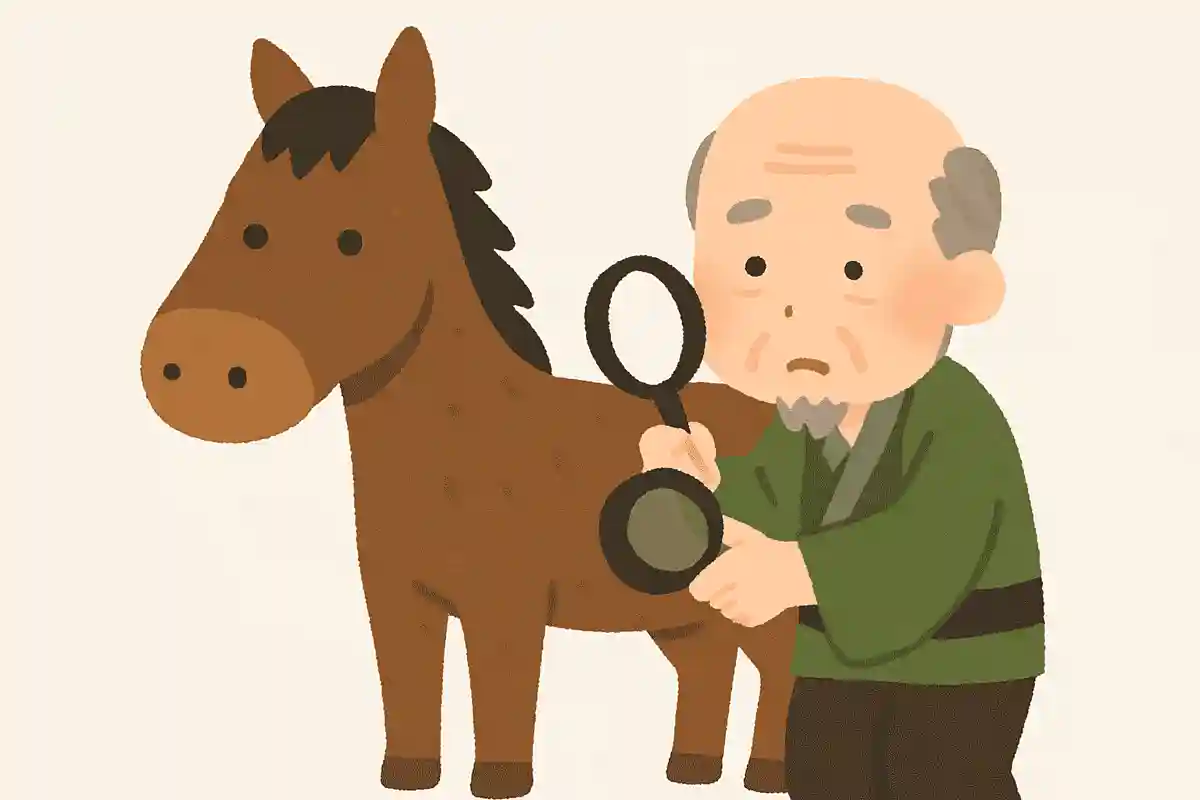
This four-character idiom expresses the idea of trying to judge things only by their surface, and it also serves as a warning that doing so often leads to mistakes.
The term originated in the world of horse racing, where it referred to the skill of discerning a horse’s ability and qualities by examining its coat and build.
From there, it evolved to convey the danger of making judgments based solely on appearances.
It reminds us that looks are only one piece of evidence, and that sound judgment requires considering other aspects as well.
It’s something to recall especially when your thinking leans toward judging by appearances, as it offers a broader perspective.