

[Impressionism] A Curated Selection of Colorful Piano Masterpieces — Debussy & Ravel

The Impressionists were an artistic movement that emerged in Paris, France, in the late 19th century.
The shift from an era that valued realism—faithfully reproducing what was seen—to one that sought freer modes of expression had a profound impact on the history of classical music.
Among those who left their mark for posterity as representative composers of Impressionism were Claude Debussy and Maurice Ravel.
In this feature, we spotlight these two great composers, along with several 19th-century composers said to have been influenced by Impressionism, and introduce masterpieces that embody Impressionism’s emphasis on light and color.
- Lower difficulty: Not as hard as it sounds!? Debussy’s piano pieces
- [Easier Level] Ravel’s Piano Pieces | A curated selection of easier works you can play smoothly!
- For Advanced Players: Showstopping Classics to Play at a Piano Recital
- Piano Pieces by Ibert: Gem-like Masterworks by a 20th-Century French Composer
- Masterpieces of classical piano that are too beautiful for words. A gathering of delicate tones that cleanse the soul.
- [Contemporary Pieces] A curated selection of classical works that captivate with the piano’s mysterious resonance!
- [Poulenc’s Piano Works] A Curated Selection of Masterpieces by a Composer of Esprit
- [Intermediate Level] A curated selection of piano masterpieces featuring strikingly brilliant melodies!
- Séverac’s Piano Pieces: Masterworks by the Genius Composer Recognized by Debussy
- Chabrier’s Piano Pieces: Gemlike Masterworks Forged by the Esprit of French Music
- [Piano] A Lineup of Masterpieces | Piano Pieces That Evoke Spring
- [Franck’s Piano Works] A curated selection of gem-like masterpieces by the Father of Modern Music
- A gem of a masterpiece by the composer of the piano suite Pictures at an Exhibition by Mussorgsky.
[Impressionism] A selection of richly colored piano masterpieces — Debussy & Ravel — (21–30)
Suite ‘Mirrors’ No. 5 – The Valley of the BellsMaurice Ravel

Composed in 1905, the final piece of the suite Miroirs is a fantastical work said to have been inspired by the sound of church bells resonating through the streets of Paris, as heard by Maurice Ravel.
At its premiere in January 1906, its originality and unique sound world were highly praised.
The piece blends the sonorous tolling of bells evoked by the weighty low register with shimmering, delicate high tones, drawing listeners into a dreamlike, meditative realm.
It is an ideal work for those wishing to refine richly colored expression through skillful pedal use and to develop a sense of controlling tone while imagining vivid scenes.
Perform it with an emphasis on the image of sound dissolving into space.
Minuet in C-sharp minorMaurice Ravel

This is a very short piece, about one minute long, said to have been written around 1904 as a practice assignment for a close composer friend.
Within the classical minuet form, it carries Ravel’s characteristic refined sonorities and a subtly introspective mood.
Rather than dazzling display, the piece conveys restrained elegance—melancholy and beautiful, as if translating delicate, hidden emotions directly into sound.
It’s perfect for anyone who wants an easy introduction to Ravel’s unique aesthetic sensibility.
Because its structure is concise and free of unnecessary ornamentation, the key is to play each note with care while picturing the steps of an elegant dance.
Aim to express the nuances of the heart within its soft, subdued atmosphere.
Suite ‘Miroirs’ No. 4 – Alborada del graciosoMaurice Ravel
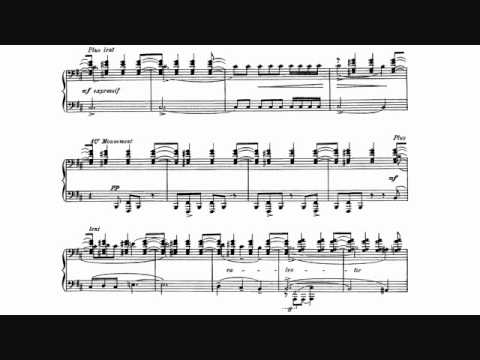
The suite Miroirs, dedicated to the members of the artist group Les Apaches.
Its fourth piece is set in a Spanish morning, a varied work that conjures the image of a jester.
Dry, guitar-like rhythms intersect with passionate melodies, brilliantly portraying the jester’s cheerfulness and the melancholy hidden beneath it.
The piece was later orchestrated and reportedly used in a ballet staged in London in 1919.
Though by no means easy, it is dotted with moments where lyrical singing emerges amid virtuosic passages.
It’s perfect for those who wish to immerse themselves in the richly expressive world of Spanish music or broaden their expressive range through technique.
Emphasize the contrast between the fiery sections and the plaintive middle part, and perform as if telling a story.
Noble and Sentimental Waltzes: Waltz No. 2, Assez lent (fairly slow), G minorMaurice Ravel

A work with an introspective atmosphere that feels like peering into the depths of the heart, it is included in Maurice Ravel’s suite Valses nobles et sentimentales.
There’s an anecdote that it was performed at a private concert in 1911 with the composer’s identity kept secret.
Within the gently flowing time, noble yet sentimental melodies emerge, as if quietly staying close to the listener’s heart.
The traditional waltz rhythm hides some unexpectedly piquant sonorities that seem to express unspoken, complex emotions.
It’s a perfect piece for those who want to learn about subtle changes in tone color and long-breathed phrasing.
The key is to play as if breathing, imbuing each note with intention so as not to break the work’s mysterious atmosphere.
Noble and Sentimental Waltzes: No. 3 Waltz, Modéré in G majorMaurice Ravel

Maurice Ravel’s suite Valses nobles et sentimentales, modeled after Schubert’s waltzes, was introduced to the world in 1911 as a piano work and staged the following year as ballet music.
Of the eight pieces that make up the suite, the third waltz is a beautiful number in which a faintly wistful expression emerges from within a calm and orderly surface.
In this work, the two spirits of “nobility” and “sentiment” are expressed in exquisite balance.
Its slightly intricate, transparent harmonies carried by a flowing triple meter evoke the subtle play of pale light and shadow in the heart.
Rather than flaunting virtuosity, the key is to carefully draw out the fine nuances embedded in the score.
Aim for an elegant atmosphere by playing with a rounded, gentle tone free of harsh edges.
Noble and Sentimental Waltzes, No. 4, Assez animé (fairly lively)Maurice Ravel
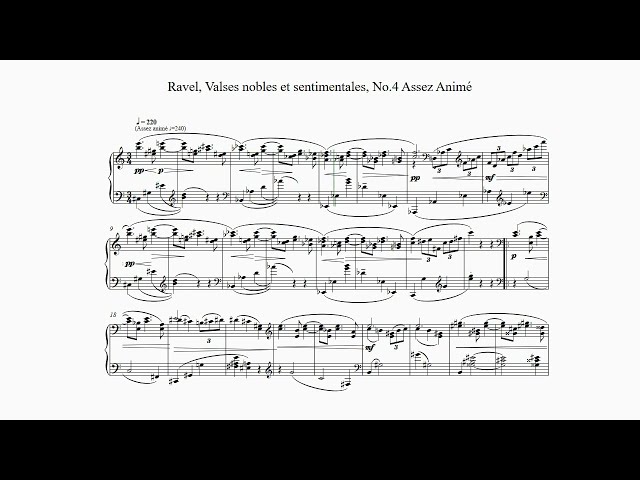
Maurice Ravel’s suite Valses nobles et sentimentales, written in homage to Schubert, contains many captivating pieces that blend traditional waltz idioms with a modern sensibility, and this particular number stands out for its verve and wit.
At the premiere in May 1911, the composer’s name was withheld, and there’s a charming anecdote that the audience tried to guess the author.
The orchestral version was staged as the ballet Adélaïde, ou le langage des fleurs, depicting the romantic intrigues of 1820s Paris.
If you imagine the give-and-take of love conveyed through the language of flowers, you’ll sense that “this sonority is more than merely elegant.” The key is to play the dense chords with lightness through the right hand’s virtuosic motion.
It’s a work that anyone seeking expression beyond classical boundaries should experience.
Gaspard of the Night, M. 55: II. The GallowsMaurice Ravel

One of the pieces from Maurice Ravel’s 1908 piano suite Gaspard de la nuit, it sonically depicts the desolate scene portrayed in the poetry of Aloysius Bertrand.
A defining feature of this work is the relentless repetition of the same note—symbolizing a distant tolling bell—more than 150 times from beginning to end.
Over this monotonous resonance, eerie harmonies accumulate, drawing the listener into a meditative world dominated by the stillness of death.
For performers, maintaining strict tempo and a delicate balance of sonorities is essential; otherwise, the work’s overwhelming gloom may be compromised—making it a formidable challenge.
It is frequently programmed in competitions.
Consider listening to it when you wish to encounter the quiet beauty that lies at the depths of sorrow.