

[For Middle School Students] Also Helpful for Haiku Writing! A Collection of Famous Haiku Using Spring Seasonal Words

A haiku that captures the arrival of spring in the rhythm of 5-7-5.For junior high school students, the experience of distilling the changing seasons and familiar scenery into words enriches their sensibilities.The way cherry blossom petals dance, and the feeling of wanting to go outside, drawn by the gentle, balmy weather.Why not try composing such uniquely springtime scenes in words that are your very own?This time, for junior high school students working on spring haiku, we will introduce some famous haiku related to spring.As you face the words, enjoy a moment of rediscovering the charm of spring.
- For elementary school students! A recommended collection of famous haiku using spring kigo
- [For Elementary School Students] Spring Kigo for Haiku Writing! A Collection of Fun, Easy-to-Memorize Ideas
- Brain training with spring kigo! A collection of ideas for common words you can use in haiku and conversation
- [Winter Haiku] A collection of poems composed by junior high school students: a beautiful and amusing anthology that vividly evokes scenes
- Funny senryu poems composed by junior high school students: introducing outstanding works that will make you burst out laughing
- [Spring Quotes] Glamorous words perfect for adding color to a new beginning
- [Winter Haiku] A collection of poems written by elementary school students. Excellent works that skillfully use seasonal words.
- [For Elementary School Students] Turn Summer Memories into Haiku! A Collection of Fun Summer Haiku Ideas
- [For Elementary School Students] Trivia About April
- Recommended for elementary school students! Ideas for composing summer haiku
- How many can you read? Test your general knowledge with a spring flower kanji quiz
- Let's enjoy learning winter seasonal words! A collection of easy-to-use word ideas for elementary school students
- [Trivia] Challenge! Spring General Knowledge Quiz
For junior high school students: Also useful as a reference for writing haiku! A collection of famous haiku using spring seasonal words (21–30)
Spring Moon

“The spring moon” refers to the moon that gently floats in the spring night sky.
Compared to the winter moon, it appears softer and faintly hazy, and gazing at it brings a calm, unhurried feeling to the heart.
In haiku, it is often used to depict quiet nighttime scenes or the gentle, tranquil mood of spring.
Even just saying, “The spring moon is beautiful tonight,” adds a tender, seasonal touch to a conversation.
Without overthinking it, you can use the phrase naturally by putting into words the feeling you get when you happen to look up at the sky on a spring night.

Spring water

It is a word that refers to the pure, gentle water that flows with snowmelt and spring rain.
The water running through rivers, streams, and fields sheds the cold and stillness of winter, evoking the breath of life in spring.
Its clear, silken flow conveys nature’s awakening and the beginning of a new season.
In haiku, it is often used to depict the arrival of spring, the renewal of life, and serene, pristine scenes.
When used while imagining the light reflected on the river’s surface or the sound of water carrying spring’s hush, a distinctly springlike landscape naturally unfolds.
Spring Mud
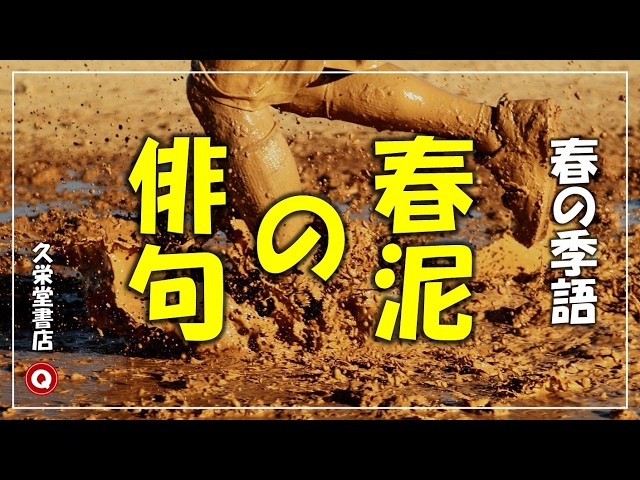
It refers to mud that has become waterlogged and soggy as the ground absorbs meltwater and spring rain.
Soil that was frozen hard through winter softens, and with melted snow and rainwater mixed in, roads and fields turn pliant.
When you walk, mud may stick to your shoes, and it can feel a bit harder to get around, yet that very scene conveys that winter has ended and the season is shifting into spring.
In haiku, it is often used to depict the landscapes around the time of snowmelt and the beginnings of spring in people’s everyday lives.
Spring Snow

The soft snow that falls after spring has begun is called “spring snow.” Unlike the harsh snows of winter, it falls quietly, like a lingering trace of the season.
It often melts right away, evoking a sense of transience and the changing of the seasons.
In haiku, it’s also used to depict the gentle scenes on the way from winter to spring, or to express a slightly wistful feeling.
Just saying, “It’s spring snow today,” in conversation brings a tender sense of the season.
As you watch the snow dance, why not try putting that fleeting beauty into words and using the phrase casually?
Butterfly

It depicts butterflies fluttering lightly in the warmth of spring.
Nature, which spent the winter in quiet, awakens and lets us feel that spring has truly arrived.
Their buoyant flight conveys a sense of calm and brightness, and they are often used in haiku to portray gentle, springlike scenes.
Even just adding a line like “The butterflies are flying” into a conversation can evoke the gentle air of spring.
It’s easy to use if you simply put that springlike scene into words while picturing them dancing around flowers.
spring midday

“Shunchū” (spring noon) refers to a gentle time in early spring days when winter’s chill softens and tender, warm sunlight pours down.
The air carries spring’s uniquely mild brightness; grasses and flowers along the roadside begin to sprout here and there, and stepping outside lets you feel the breath of nature in this seasonal moment.
In haiku, it is often used to depict the gentle spring light, the midday quiet, and the shifts in people’s lives and in nature.
If you use it while envisioning sunlit plants and flowers and a faintly warm breeze, a calm, tender scene of a spring day naturally unfolds.
Spring Dawn

A word that evokes the dawn of spring—especially the gentle light and air of a morning when winter’s chill has softened.
In still towns and open fields, the faint sounds of birdsong and the wind echo softly, conveying the calm of the moment when a new day begins slowly.
In haiku, it is often used to depict the arrival of spring, the awakening of nature, and the fresh yet quiet scenes of morning.
Even in everyday conversation, adding it can convey the season’s tenderness and tranquil presence.
Use it while imagining the morning light streaming through a window and the sounds of nature waking, and feel the gentle time of a spring morning.