

Stand out with your junior high school independent research! A collection of fun experiment and craft ideas


To all middle schoolers who want to wow teachers and friends with a “That’s awesome!” in your independent research project! There are tons of experiments in science and crafts that lead to surprising discoveries—even with simple materials.
Make a train run with copper wire and a battery, pop a balloon with an orange peel…
The real charm is getting to witness strange phenomena you’d never notice in everyday life with your own eyes.
Here, we’ll introduce fun experiments and crafts that can spark ideas for your project.
Whether you love science or not, you’re sure to find discoveries that make you go, “Aha!”
- Recommended for middle school students! A collection of quick science project ideas you can do in a short time.
- [I don't want to be like everyone else!] Recommended independent research topics for high school students
- [Middle School Students] Easy One-Day Science Projects and Crafts Ideas
- Simple and cute summer project crafts! A collection of ideas for girls that will make you want to create
- Recommended for high school students! A collection of easy one-day science project ideas
- For upper-grade boys! Simple yet awesome craft project [Don’t call it lazy]
- Stand out with your junior high school independent research! A collection of fun experiment and craft ideas
- Recommended for elementary school students' independent research! Experiment and observation ideas using everyday materials
- Recommended Independent Research Projects for 5th Graders [Elementary School Students]
- Adults will be hooked! A collection of craft ideas using toilet paper rolls
- [For Elementary School Students] Collection of Science-Related Games and Quizzes
- Amazing discoveries with everyday materials! Fun summer vacation independent research ideas
- [For Upper Elementary Students] Simple but Awesome! A Collection of Summer Vacation Craft Ideas
Stand Out in Your Junior High School Independent Research! A Collection of Fun Experiment and Craft Ideas (11–20)
Rubber band engine

A rubber band engine is a power device that utilizes the property of rubber bands to contract when heated.
Cut cardboard or thick paper into a circle to make a frame, then make small notches around the outer edge and hook multiple rubber bands onto them.
Insert a thin rod through the center where the rubber bands intersect to serve as an axle, and mount it on supports made from metal plates or similar materials.
Next, apply heat only to the right side of the frame using a hair dryer or the like… As the rubber bands contract, the frame’s center of mass shifts and the frame begins to rotate.
Build this device yourself, then analyze its detailed mechanism and consider possible applications, and compile your findings into a report.

Bernoulli’s theorem and lift experiment
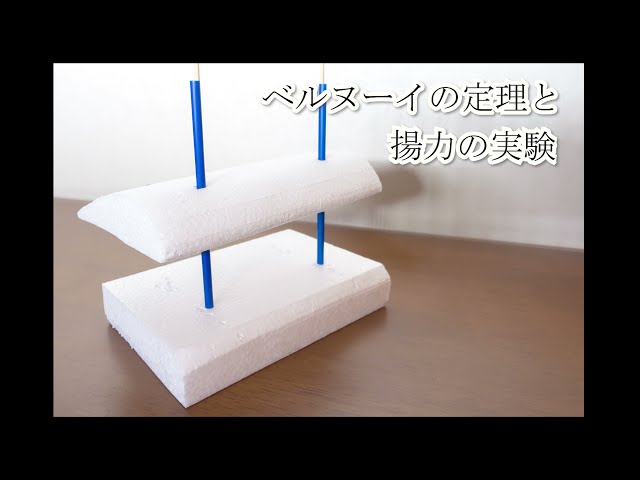
This is an experiment where you explore Bernoulli’s principle—which is also applied in the design of airplanes and cars—and experience it through hands-on crafting.
You use a fan to blow air over a styrofoam wing model mounted on a straw and observe how it moves.
By seeing the mechanism that makes it rise when exposed to wind, you can deepen your understanding of how airplanes fly.
Another key point is that styrofoam is easy to work with, so it’s interesting to test different shapes in the airflow and examine how their movements differ.

milk crown

A “milk crown” refers to the phenomenon where the surface of milk in a cup splashes into a crown-like shape when a single drop of milk is dropped onto it from above.
Many people may have seen this in milk or cornflakes commercials.
If you choose the milk crown as a theme for an independent research project, start by attempting to photograph it.
A DSLR camera that allows you to adjust the shutter speed will help you capture it well.
Next, experiment by changing conditions—such as testing whether liquids other than milk produce a milk crown and what differentiates liquids that do from those that don’t—and then summarize your results.
Making char cloth

If you enjoy camping with your family, making char cloth is highly recommended.
Char cloth is cotton fabric that has been carbonized; it will catch from small sparks—like those from flint and steel or a fire starter—and it holds an ember well, so it’s used for fire making.
Try actually making this char cloth, then research and consider why this method carbonizes the fabric, what carbonization is in the first place, and why char cloth is suitable as tinder.
Compile your findings and reflections into a report.
A battery-powered train running through a coil

This is an experiment often called the simplest train in the world: running a battery through a coil made by winding copper wire.
It uses magnetic force described by the right-hand rule, and it’s fascinating to see the battery move on its own.
Although making the coil by winding copper wire around a tube takes some effort, once that’s done, the experiment is easy—just attach magnets to the battery.
The orientation of the magnets on the battery and the direction you insert it into the coil are crucial for getting it to run.
Let’s also learn what kind of motion occurs if these are set incorrectly.
Investigation of global warming

Global warming, which is constantly cited as a serious problem for the Earth, refers to the rise in atmospheric and ocean temperatures caused by greenhouse gases.
Let’s take a closer look at the detailed causes of this phenomenon, the impacts it is having, and the measures being taken to address it.
Stand out with your junior high school independent research! A collection of fun experiment and craft ideas (21–30)
Virus and Vaccine

There are many diseases in the world that are caused by viruses, including influenza.
While vaccines exist to prevent some of them, in eras before vaccines were developed, countless people lost their lives to viruses.
Let’s explore the past and present of viruses and vaccines by focusing on several specific diseases.