

Recommended for elementary school students! Ideas for composing summer haiku

Haiku are short poems that express nature and the seasons.
It may seem difficult, but even elementary school students can write them.
A haiku consists of 17 syllables in a 5-7-5 pattern, and it must include a “kigo,” a word that evokes a season.
Using this as a guide, think about what you saw and felt during summer vacation, and give it a try.
By simply putting your feelings into words that match the 5-7-5 rhythm, you can create your very own haiku.
It’s fun to freely express what you think!
Use words to capture your wonderful summer memories and experiences, and enjoy writing haiku.
- [For Elementary School Students] Turn Summer Memories into Haiku! A Collection of Fun Summer Haiku Ideas
- [For Elementary School Students] Spring Kigo for Haiku Writing! A Collection of Fun, Easy-to-Memorize Ideas
- [Elementary School Senryu] A Collection of Hilarious Masterpieces about Summer Vacation, Friends, and School Life. Tips and Explanations Learned from Outstanding Works
- [Winter Haiku] A collection of poems written by elementary school students. Excellent works that skillfully use seasonal words.
- Let's enjoy learning winter seasonal words! A collection of easy-to-use word ideas for elementary school students
- For elementary school students! A recommended collection of famous haiku using spring kigo
- [For Middle School Students] Also Helpful for Haiku Writing! A Collection of Famous Haiku Using Spring Seasonal Words
- [Winter Haiku] A collection of poems composed by junior high school students: a beautiful and amusing anthology that vividly evokes scenes
- [For Elementary Students] A Collection of Beautiful Four-Character Idioms to Know
- Recommended for elementary schoolers! A fun collection of craft ideas for 5th graders
- [For General Readers] List of Summer Kigo: Evocative Everyday Words of Summer
- [Elementary School Students] Perfect for Kakizome! A Collection of Four-Character Idiom Ideas
- Perfect for elementary school slogans! A collection of four-character idiom ideas you'll want to use
Recommended for elementary school students! Summer haiku-making ideas (11–20)
The assigned reading with a fan-shaped sticky note fluttering
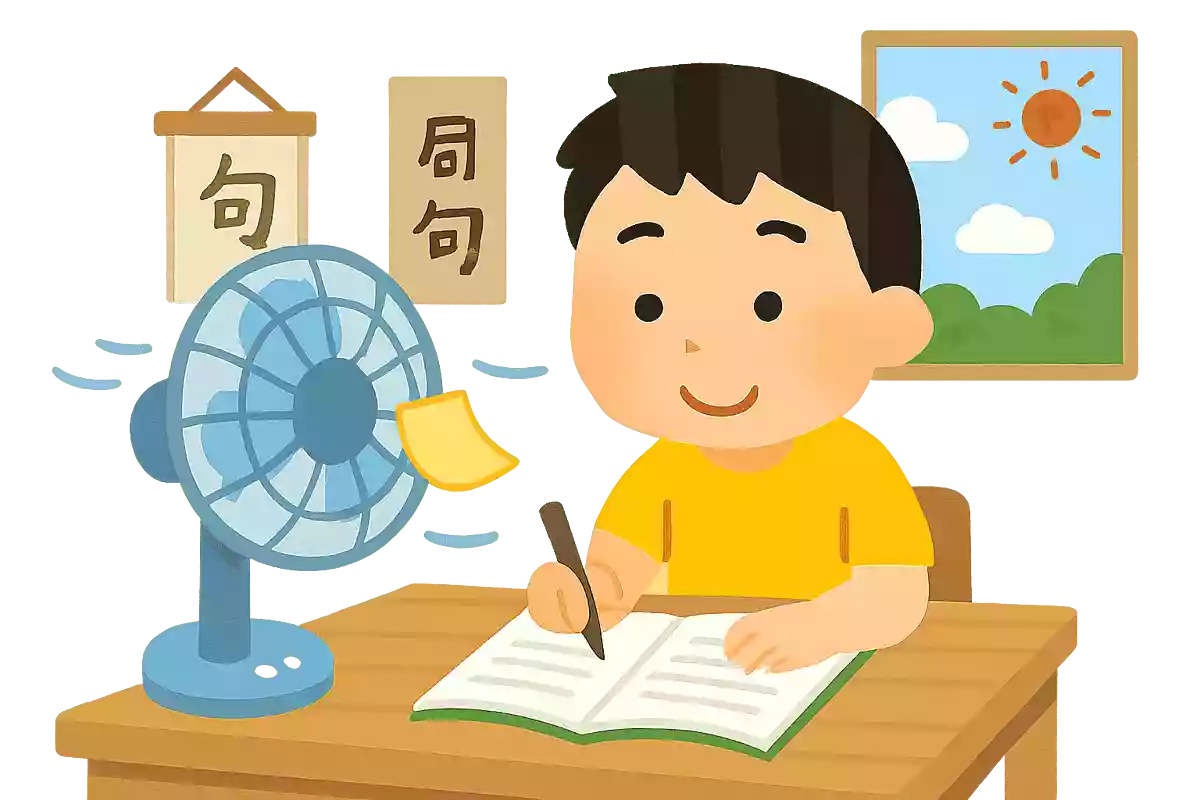
One of the summer vacation assignments is writing a book report, right? A book report involves two steps: reading the book and then writing your thoughts about it.
Some children may feel they’re not good at this kind of assignment.
From the haiku, you can picture a summer scene: reading indoors while the fan spins in the heat.
The sticky notes fluttering in the breeze from the fan convey a sense of coolness.
Or perhaps it shows a book left open mid-reading, with a sticky note still attached.
Either way, it feels like a haiku that conveys the feelings of a child working on homework during summer vacation.

Rereading my diary, smudged, in the morning glow

In some places, summer vacation may last quite a long time, right? For children, it’s a period when they can play a lot and make many memories.
Some elementary schools even assign diary-writing as homework.
Those diaries often end up filled with entries about time spent with family during the summer break, playing with friends, and memories of outings.
By the end of the vacation, the cover and the pages with entries may be smudged or dirty.
From the haiku, we can also sense someone looking back over their diary, reflecting on the summer break and savoring the lingering joy once again.
The whole town is being dyed the color of the evening glow.
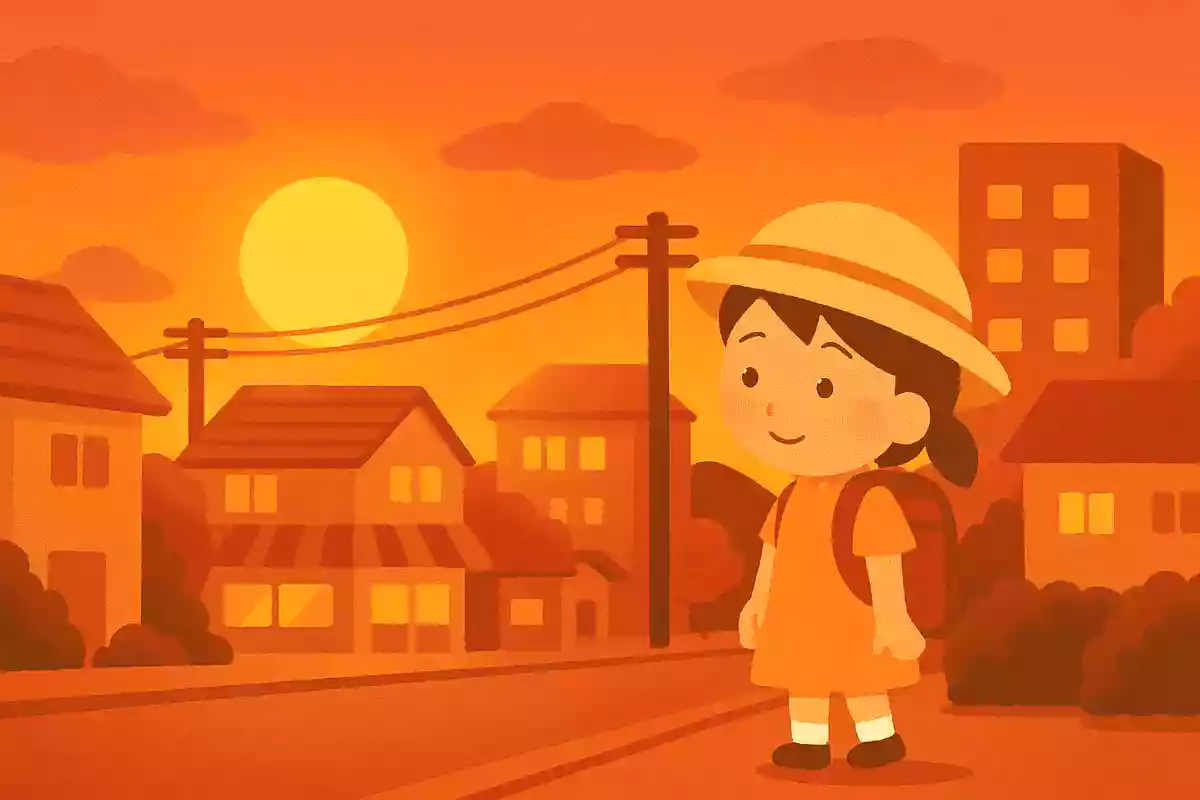
During summer vacation, kids often go out to play, and some may take the feeling of evening approaching as the cue to head home.
This haiku expresses the gradual passage of time toward dusk and the scenery that conveys it.
Since the evening sun differs in color from the midday sun, the description of the town being dyed in that hue evokes a distinctive atmosphere.
Because it portrays the town’s colors changing little by little, it emphasizes the sense of time slowly passing.

Chatty Haiku

Learn with a teacher who is both a haiku poet and an essayist! Let me introduce some ideas for “chatty haiku.” When people hear “haiku,” some may find it intimidating, but calling it “chatty haiku” might make it feel more approachable, don’t you think? In the video, you’ll find haiku that use words a two-year-old might say to their caregiver, as well as haiku that capture the honest feelings of lower-elementary school children.
The unique ideas that make you smile are utterly charming!
Let’s compose haiku and tanka

Something you can even submit as a summer vacation assignment! Here are some ideas for creating haiku and tanka.
Many of you may be thinking, “I want to work on something over the summer!” If so, we recommend trying your hand at haiku or tanka.
The video introduces many tips for composing them! If you’re not sure how to get started, try making haiku or tanka while watching this video.
Be sure to take this opportunity to give it a try.
Haiku Challenge

Learn from haiku masters! Here are some ideas for trying your hand at haiku.
The three great haiku poets of the Edo period include Kobayashi Issa, Matsuo Basho, and Yosa Buson.
A haijin is someone who composes haiku, and many haijin are active today as well! Why not try writing haiku while keeping in mind the key points taught by haiku masters? Everyone starts with no experience.
If you give it a try, you might discover a sense of excitement.
Go ahead and give it a shot!
Recommended for elementary school students! Summer haiku-making ideas (21–30)
A spark to get interested in haiku!

Let’s learn with cute animations.
Here are some ideas to spark your interest in haiku! Haiku is one of Japan’s proud traditional cultures, isn’t it? Some of you may have become interested while learning about haiku’s roots and rules.
This time, let’s try watching animations as an approachable way to get interested, even if you haven’t been before.
They also introduce seasonal words (kigo), so it might be fun to compose a haiku using the kigo that are featured.
Give it a try!