

Quiz about Kinkaku-ji: tidbits to help you understand the Golden Pavilion

Kyoto, also known as the City of a Thousand Years, has a long history and has produced various World Heritage sites over the course of that history.
Kinkaku-ji (the Golden Pavilion) is one of Kyoto’s most iconic World Heritage sites.
With its striking appearance, it’s a popular destination not only in Japan but also among visitors from overseas.
In this article, we’ll introduce various fun facts about Kinkaku-ji in the form of a quiz.
By learning more deeply about the history embedded in the building, you may find yourself more focused when viewing Kinkaku-ji during sightseeing—and enjoy it even more.
- Fun facts quiz about Kiyomizu-dera: a three-choice quiz to learn its history and appeal
- Trivia quiz about Ginkaku-ji: three multiple-choice questions to learn about Kyoto’s history
- Let’s take on the challenge! A multiple-choice history quiz for elementary school students. Review your history lessons.
- [For Elementary School Students] Challenge! Kyoto Local Quiz
- A quiz about the Great Buddha of Nara: fun facts to deepen your understanding of Japan’s iconic Great Buddha.
- [World Heritage] 3-choice quiz to deepen your trivia about Nijo Castle
- [For Kids] November Trivia Quiz & Fun Facts: Let’s Learn While Having Fun!
- [Easy] Quiz for Middle School Students
- What kind of place is Byodoin Phoenix Hall? A quiz to learn about a Japanese architectural masterpiece admired worldwide.
- Trivia quiz about Sanjusangendo: a collection of questions to deepen your knowledge
- [Trivia] A quiz of fun facts about Horyu-ji. Multiple-choice questions (three options) about this historic structure.
- Aim for a perfect score! A three-choice common knowledge quiz that deepens your understanding
- [Trivia] Quiz about Fushimi Inari Taisha
Quiz related to Kinkaku-ji. Trivia to understand Kinkaku-ji (1–10)
What is the name of the spring near Kinkaku-ji from which water used for tea bubbles up?
- Spirit Phoenix Spring
- Galaxy Spring
- Dragon King Spring
See the answer
Galaxy Spring
Kinkaku-ji has a spring called Ginga-sen (“Milky Way Spring”). It is a water source located near Gekkasui, behind Ryūmon Falls at the very back of the temple grounds. The name conveys the meaning of “water as pure as the Milky Way,” and it was originally known as water used for preparing tea.

What is the official name of Kinkaku-ji?
- Jishō-ji (Ginkaku-ji, the Silver Pavilion)
- Rokuon-ji (Kinkaku-ji)
- Kiyomizu-dera (Kiyomizu Temple)
See the answer
Rokuon-ji (Kinkaku-ji)
The official name of Kinkaku-ji is Rokuon-ji. Kinkaku-ji is a temple located in Kyoto’s Kita Ward; its real name is Rokuon-ji and its temple mountain name is Kitayama. “Kinkaku” is also the common name for the Shariden, the main building within Rokuon-ji, and it was given this name because it is covered in gold leaf.
What is the denomination?
- Tendai Buddhism
- Jōdo-shū (Pure Land sect)
- Rinzai school (of Zen Buddhism)
See the answer
Rinzai school (of Zen Buddhism)
Kinkaku-ji is a Rinzai Zen Buddhist temple, belonging to the Rinzai sect’s Shokoku-ji branch, whose head temple is Shokoku-ji in Kamigyo Ward. Rinzai is a school of Zen Buddhism that centers on zazen (seated meditation) as a practice to approach enlightenment. It was a form of Buddhism that was introduced to Japan in the early Kamakura period.
Quiz about Kinkaku-ji: Trivia to understand Kinkaku-ji (11–20)
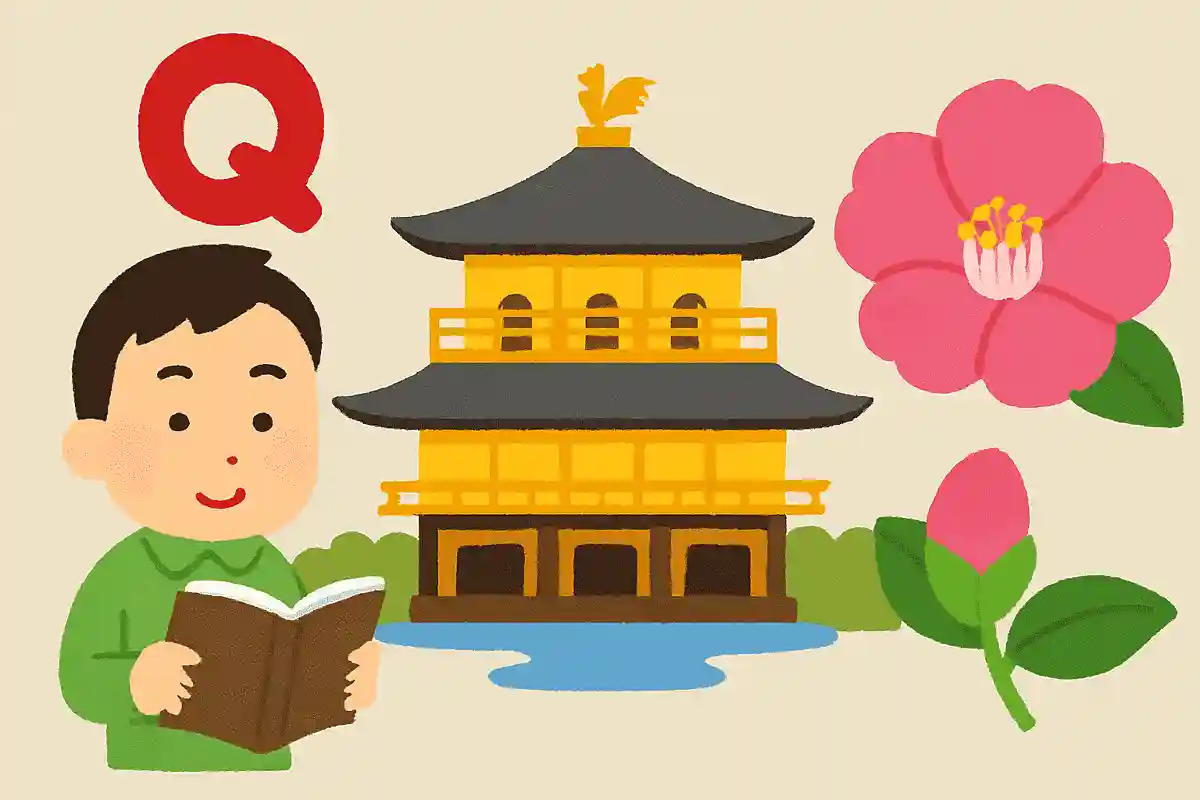
What types of camellias bloom around Kinkaku-ji?
- Kochō Wabisuke
- Golden Camellia
- Ise Taihaku
See the answer
Kochō Wabisuke
The garden of Kinkaku-ji is planted with many kinds of plants, including a type of camellia called “Kocho Wabisuke.” This camellia has a distinctive beauty and plays a role in highlighting the temple’s classical aesthetic. Interestingly, this camellia has no other names and is widely known specifically as “Kocho Wabisuke,” making it a rare variety. When you visit Kinkaku-ji, be sure to look for the blossoms of this beautiful camellia.
Can you see Kinkaku-ji from the Kyoto Tower observation deck?
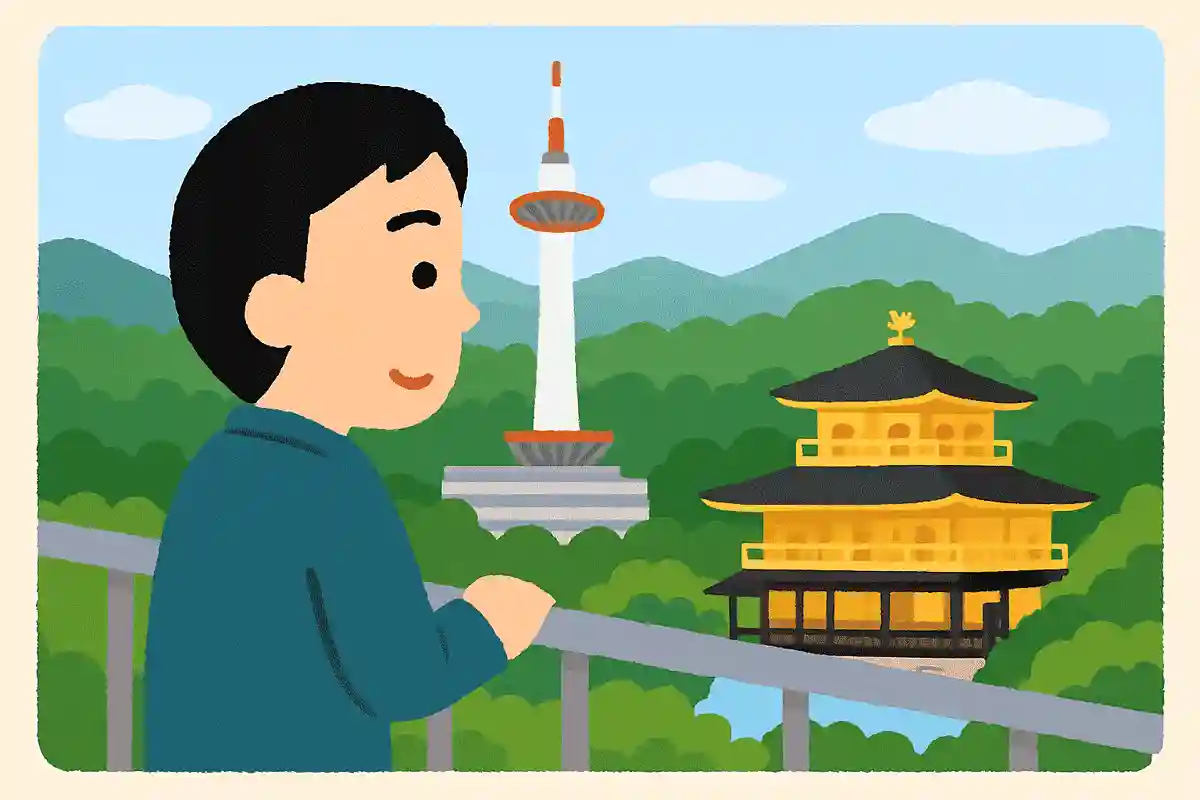
- can see
- can't see
- It depends on the weather.
See the answer
can't see
From the Kyoto Tower observation deck, you can take in a panoramic view of the city. While you might imagine being able to look down on all the famous tourist spots from above, Kinkaku-ji unfortunately isn’t visible because it’s surrounded by nearby mountains and buildings. Perhaps to prevent people from being disappointed when they expect to see it but can’t, there’s a “Not visible” label pointing in the direction of Kinkaku-ji on the observation deck.
What was the Jodo-shu (Pure Land) temple that originally stood on the site where Kinkaku-ji was built?
- Saionji
- Chion-in Temple
- Konkai Kōmyō-ji (Kurodani Temple)
See the answer
Saionji
Before Kinkaku-ji was built, a Jōdo sect temple called Saionji stood on the same site. It was owned by the Saionji family, distant relatives of the Fujiwara clan, but it passed into the hands of Ashikaga Yoshimitsu, who then constructed Kinkaku-ji. Saionji was later relocated to another location.
Which literary giant, inspired by an arson incident, wrote the novel The Temple of the Golden Pavilion?

- Yasunari Kawabata
- Ryūnosuke Akutagawa
- Yukio Mishima
See the answer
Yukio Mishima
In 1950, an actual arson incident occurred at Kinkaku-ji, which had a profound impact on Yukio Mishima. Using this as a motif, he wrote the novel The Temple of the Golden Pavilion, which he published in 1956. In this work, Mishima delves deeply into obsession with beauty and the impulse toward destruction, bringing to light the darkness within the human heart.