

Georg Friedrich Handel Popular Songs Ranking [2026]

Georg Friedrich Handel, a German-born composer known as a major figure of the late Baroque period.
Despite parental opposition, he immersed himself in music, and from a young age his extraordinary talent was evident—he surpassed his teachers in composition, organ, harpsichord, and violin.
In this article, we present a ranking of Georg Friedrich Handel’s most popular works.
Whether you’re a classical music enthusiast or not, be sure to check it out!
- Handel’s Masterpieces | A Comprehensive Introduction to His Popular Works
- George Frideric Handel Popular Songs Ranking [2026]
- Mendelssohn’s Masterpieces | Popular Classical Music
- [Haydn] Pick up famous and representative pieces!
- Jean-Philippe Rameau Popular Songs Ranking [2026]
- [Baroque Music] A Curated Selection of Timeless Masterpieces and Famous Works
- A famous piece by Georg Philipp Telemann. Popular classical music.
- Johann Nepomuk Hummel Popular Song Rankings [2026]
- Carl Maria von Weber Popular Song Rankings [2026]
- César Franck Popular Songs Ranking [2026]
- Niccolò Paganini Popular Song Rankings [2026]
- Gabriel Fauré Popular Songs Ranking [2026]
- François Couperin Popular Songs Ranking [2026]
Georg Friedrich Händel Popular Songs Ranking [2026] (41–50)
Passee piedGeorg Friedrich Händel50rank/position

A passepied is a type of classical dance that means “passing feet,” characterized by a 3/8 meter and a binary form, and it was particularly popular during the Baroque period.
Although the pieces themselves are very short and simple, this is a highly appealing work with a light and elegant melody.
Georg Friedrich Händel Popular Songs Ranking [2026] (51–60)
Passacaglia in G minorGeorg Friedrich Händel51rank/position

Passacaglia is a musical form that originated in an old Spanish dance and was widely used from the 17th to the 18th century.
Set in a gentle triple meter, it features a plaintive melody performed with expressive nuance.
It is a dramatic piece that shines with layered violin timbres.
Fantasia in C majorGeorg Friedrich Händel52rank/position

Fantasia is translated as “fantasy,” and refers to an instrumental work freely created through the composer’s imagination.
From the Baroque era to the present, many composers have produced fantasias, but Handel’s works, in which a bright and lighthearted character is distilled, are especially captivating.
Flute Sonata in G minorGeorg Friedrich Händel53rank/position
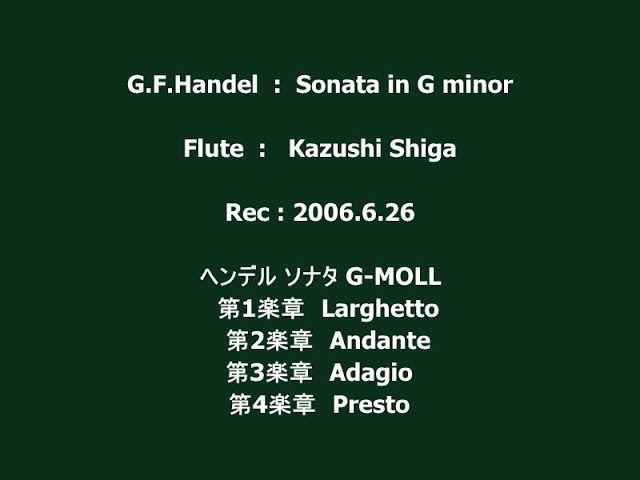
This is the Flute Sonata in G minor by George Frideric Handel, a German-born composer who was active in countries such as Italy and England.
It consists of four movements: a leisurely First Movement, Larghetto; a Second Movement, Andante, which conveys a sense of melancholy even amid motion; a short, roughly one-minute Third Movement, Adagio, that suggests an inner light leading to what follows; and a Fourth Movement, Presto, which bursts forth with a sense of liberation and lightness.
It is a classic masterpiece for flute that embodies the Baroque era.
BourréeGeorg Friedrich Händel54rank/position

The original piece is an Oboe Sonata (in F major, HWV 363a), and there are also arrangements for flute sonata.
This fourth piece is performed on various instruments such as piano and violin.
The bourrée is a dance that originated in France and Spain, and harpsichord pieces by Handel and Bach are well known examples.
MessiahGeorg Friedrich Händel55rank/position

This commercial, memorable for its uniquely styled illustrations, introduces what kind of company SKY Perfect JSAT is.
The answer presented is that it’s a “space business enterprise,” a company that develops businesses leveraging outer space, starting with communications satellites.
The footage of an illustrated woman dancing to a psytrance-style arrangement of “Messiah” leaves a strong impact.
The background music is Handel’s “Messiah,” also known as the “Hallelujah Chorus,” a piece that most people have probably heard somewhere before.

Messiah Pastorale Symphony “Pifa”Georg Friedrich Händel56rank/position
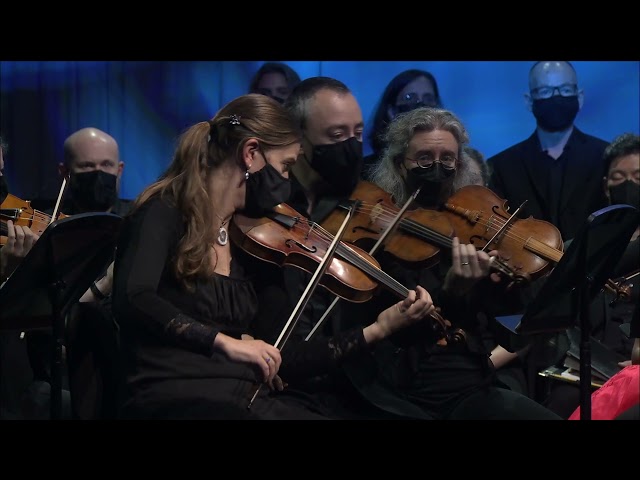
Handel, a master of Baroque music, composed the oratorio Messiah in 1741, and it was premiered in Dublin in April 1742.
The instrumental interlude placed in Part I is a brief pastoral that quietly foreshadows the announcement of the Holy Night to the shepherds.
Over a sustained bass, the strings sing a gentle melody in parallel thirds, and the relaxed swell of the 12/8 meter evokes a Siciliano-like simplicity.
Eschewing brass and percussion entirely, and relying on legato strings alone to depict the stillness of night and a distant prayer without words, the piece crystallizes Handel’s gift for dramatic architecture.
Even within the full Messiah—now a staple of Christmas concert programs—this episode stands out as a scene that conjures particularly serene imagery.