

Introducing Maurice Ravel’s Famous and Representative Works

Maurice Ravel, one of the most important figures in Impressionist music.
His works are meticulously crafted down to the finest details, grounded firmly in classical forms while blending in Impressionist expression.
As a result, his music has a uniquely singular character that only he could create.
He also arranged works by other composers for orchestra, and his outstanding orchestration earned him the nicknames “genius of orchestration” and “magician of the orchestra.”
In this article, we introduce Ravel’s masterpieces and signature works.
Even if you’re not familiar with classical music, there are pieces you have probably heard somewhere at least once.
Enjoy the many wonderful masterpieces of Ravel!
- Masterpieces of the bolero. Recommended popular pieces in bolero form and outstanding performances.
- [Masterpiece Classics] A special showcase of gem-like masterpieces so beautiful they’ll move you to tears
- Timelessly beautiful classical masterpieces. Recommended classical music.
- Gabriel Fauré | Introduction to His Famous and Representative Works
- [Orchestra] Introducing famous and popular pieces
- Debussy’s masterpiece. Popular classical music.
- Masterpieces of Ballet Music: Introducing Classic Favorites
- Impressionist Music: A Comprehensive Introduction to Masterpieces of the Impressionist Movement That Enliven Classical Music History
- [François Couperin] Introducing famous and popular pieces by the composer who loved the harpsichord
- Mendelssohn’s Masterpieces | Popular Classical Music
- Recommended for advanced players: Classical masterpieces to challenge at a piano recital
- [Impressionist Music] A Selection of Classical Works That Evoke the Japanese Spirit
- Mussorgsky’s masterpiece. Popular classical music.
Introducing Maurice Ravel’s Famous and Representative Works (21–30)
Sonatine in F-sharp minor, M. 40: II. MenuetMaurice Ravel

A piece I recommend for times when you want to quietly face your inner self is one from Maurice Ravel’s piano work Sonatine.
While it takes the elegant form of a classical minuet, this movement blends a hidden melancholy with refined sonorities, making it exquisitely beautiful.
As you listen to the melody, you can almost see a scene that maintains dignified grace even amid sorrow.
The work as a whole, including this piece, was choreographed as a ballet in 1975, and its narrative quality stimulates the listener’s imagination.
Rather than stirring intense emotions, it will surely stay close to your heart when you wish to surrender yourself gently to the piano’s delicate timbre.
Gaspard of the Night, M. 55: II. The GallowsMaurice Ravel
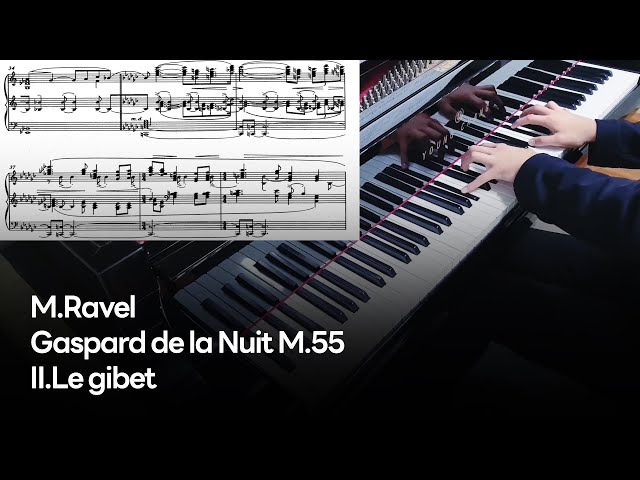
One of the pieces from Maurice Ravel’s 1908 piano suite Gaspard de la nuit, it sonically depicts the desolate scenes evoked by the poetry of Aloysius (Louis) Bertrand.
A striking feature of this work is the relentless repetition of the same note—symbolizing a bell tolling in the distance—more than 150 times from beginning to end.
Over this monotone resonance, eerie harmonies accumulate, drawing the listener into a meditative world dominated by the stillness of death.
For performers, failing to maintain the strict tempo and balance of sonorities risks undermining the work’s harrowing gloom.
This piece is frequently programmed in competitions.
Why not try playing it when you wish to touch the quiet beauty that lies at the bottom of sorrow?
Maurice Ravel: Introducing Famous and Representative Works (31–40)
“Ma mère l’Oye” Scene 3: Dialogue of Beauty and the BeastMaurice Ravel

Maurice Ravel, the French composer renowned for his masterful portrayals of fairy-tale worlds.
A passage from his suite Ma mère l’Oye brilliantly renders the story of Beauty and the Beast in sound.
Set to an elegant waltz, a sweet woodwind melody representing Beauty and the heavy, ominous timbre of the contrabassoon embodying the Beast unfold like a dialogue, drawing listeners into the story’s realm.
Originally premiered in 1910 as a piano four-hands piece and later orchestrated, the work was memorably used in the 2021 film The Worst Person in the World.
Interweaving unease and beauty, it’s perfect for creating a slightly grown-up, mysterious Halloween mood.
If you listen while imagining how the tale concludes, you’ll enjoy it all the more.
Minuet on the Name of HaydnMaurice Ravel

A piano solo piece composed in 1909.
That year marked the 100th anniversary of Haydn’s death, and a Parisian music magazine commissioned Ravel, Debussy, and others to write piano pieces in homage to Haydn, with the condition that they use the motif formed by converting HAYDN into note names—Si, La, Re, Re, Sol.
Strictly speaking, the note-naming system has no Y or N, but according to a substitution table (a kind of cipher), Y is treated like D (Re) and N like G (Sol), thereby establishing the motif’s sequence.
Sonatina Op. 40, Movement II: MinuetMaurice Ravel

Sonatine M.40 was written for a composition competition hosted by a certain magazine.
The work was later dedicated to a pair of Polish brothers whom Maurice Ravel was fond of.
Following the first movement, composed in sonatina form, the second movement is a beautiful piece whose delicate, faintly colored melodies evoke a range of emotions—yearning, loneliness, joy, and more.
The key to performance is to play with ease while avoiding brusqueness, paying close attention to the score’s subtle expressive markings.

Le Tombeau de Couperin, No. 3: ForlaneMaurice Ravel

The third piece from Maurice Ravel’s Le Tombeau de Couperin, composed as a memorial to friends who died in World War I.
Each of the six movements was written in memory of a different person, and this third movement is dedicated to a lieutenant who was a Basque painter.
“Forlane” is a classical dance of North Italian origin, marked “somewhat lively” in tempo, yet the music exudes an elegant atmosphere.
Aim for a spirited performance by clearly articulating the dotted rhythms and grace notes that evoke the character of a dance.
In the style of ChabrierMaurice Ravel

Maurice Ravel composed two pieces titled “in the style of”: À la manière de Borodine (In the Style of Borodin) and this À la manière de Chabrier (In the Style of Chabrier).
Both were written at the request of his friend Alfredo Casella.
Emmanuel Chabrier was a French composer known for his España (Spanish Rhapsody).
While À la manière de Chabrier may not display the same liveliness as España, it conveys Chabrier’s characteristic brightness.
Try to play it so that each note sparkles while making effective use of the pedal!