

Introducing Maurice Ravel’s Famous and Representative Works

Maurice Ravel, one of the most important figures in Impressionist music.
His works are meticulously crafted down to the finest details, grounded firmly in classical forms while blending in Impressionist expression.
As a result, his music has a uniquely singular character that only he could create.
He also arranged works by other composers for orchestra, and his outstanding orchestration earned him the nicknames “genius of orchestration” and “magician of the orchestra.”
In this article, we introduce Ravel’s masterpieces and signature works.
Even if you’re not familiar with classical music, there are pieces you have probably heard somewhere at least once.
Enjoy the many wonderful masterpieces of Ravel!
- Masterpieces of the bolero. Recommended popular pieces in bolero form and outstanding performances.
- [Masterpiece Classics] A special showcase of gem-like masterpieces so beautiful they’ll move you to tears
- Timelessly beautiful classical masterpieces. Recommended classical music.
- Gabriel Fauré | Introduction to His Famous and Representative Works
- [Orchestra] Introducing famous and popular pieces
- Debussy’s masterpiece. Popular classical music.
- Masterpieces of Ballet Music: Introducing Classic Favorites
- Impressionist Music: A Comprehensive Introduction to Masterpieces of the Impressionist Movement That Enliven Classical Music History
- [François Couperin] Introducing famous and popular pieces by the composer who loved the harpsichord
- Mendelssohn’s Masterpieces | Popular Classical Music
- Recommended for advanced players: Classical masterpieces to challenge at a piano recital
- [Impressionist Music] A Selection of Classical Works That Evoke the Japanese Spirit
- Mussorgsky’s masterpiece. Popular classical music.
[Maurice Ravel] Introducing Famous and Representative Works (41–50)
Noble and Sentimental Waltzes, No. 4, Assez animé (fairly lively)Maurice Ravel
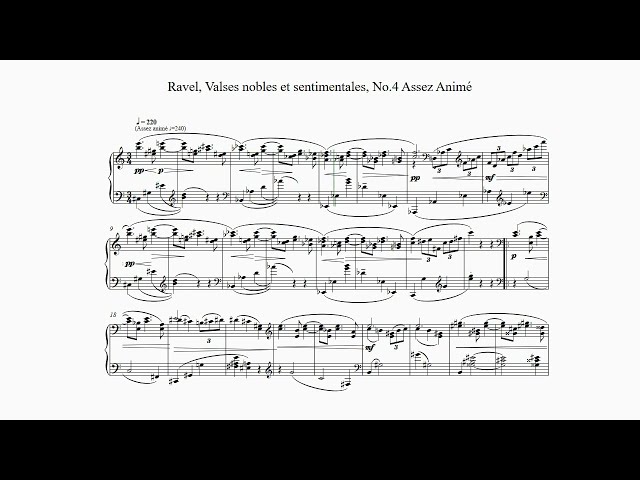
Maurice Ravel’s suite Valses nobles et sentimentales, written in homage to Schubert, contains many captivating pieces that blend traditional waltz idioms with a modern sensibility, and this particular number stands out for its verve and wit.
At the premiere in May 1911, the composer’s name was withheld, and there’s a charming anecdote that the audience tried to guess the author.
The orchestral version was staged as the ballet Adélaïde, ou le langage des fleurs, depicting the romantic intrigues of 1820s Paris.
If you imagine the give-and-take of love conveyed through the language of flowers, you’ll sense that “this sonority is more than merely elegant.” The key is to play the dense chords with lightness through the right hand’s virtuosic motion.
It’s a work that anyone seeking expression beyond classical boundaries should experience.
[Maurice Ravel] Introduction to Famous and Representative Works (51–60)
Noble and Sentimental Waltzes, Waltz No. 5, Presque lent in E majorMaurice Ravel

It is a particularly introspective piece from the suite Valses nobles et sentimentales.
There is an anecdote that at its premiere in May 1911—an anonymous concert of new works—many critics nevertheless recognized the composer as Maurice Ravel.
Marked “avec une émotion intime” (“with intimate feeling”), the music is suffused with a very private atmosphere, like a whispered inner dialogue.
Its melody, ebbing and flowing like waves, feels like a sigh, like a secret longing, quietly drawing close to the listener’s heart.
It is perfect for those who wish to deepen their delicate touch and expressive nuance.
Cherish its sentimental, beautiful world, and play with rounded, gentle tones, carefully and tenderly.
Genteel and Sentimental Waltz: No. 6, Vif (Lively)Maurice Ravel

It’s a piece from a suite composed by Maurice Ravel in the manner of Schubert’s waltzes.
Like a kaleidoscope that constantly shifts its expression, it brims with a lively, slightly mischievous character.
At its premiere in May 1911, the composer’s name was withheld, and its novelty was such that many in the audience could not guess the author.
The work was later used as music for the ballet Adélaïde ou le langage des fleurs.
It feels as though it depicts a somewhat thrilling and humorous ballroom scene.
The key is to bring out the rhythmic intrigue by consciously contrasting light staccato with smooth legato.
Though short, it is rewarding to play and perfect for those who want to broaden their expressive range.
Sonatine in F-sharp minor, M. 40 — I. ModeratoMaurice Ravel

A work by Maurice Ravel in which a delicate, glass-like beauty gleams within the plaintive resonance of F-sharp minor.
Woven with rich harmonies within a classical framework, the piece achieves an exquisite balance between quiet melody and intricate ornamentation, revealing Ravel’s perfectionist side.
Officially published in November 1905, it was later choreographed as a ballet as well, allowing its fragile musical world to be expressed in various forms.
With a character that seems to console a sorrowful heart, it’s recommended for moments when you wish to gaze quietly at your innermost feelings.
You might also find it rewarding to surrender yourself to its architectural beauty.
Little Boat on the Ocean from the Suite ‘Mirrors’Maurice Ravel

How about a cool piece by Maurice Ravel that you’ll want to listen to on a hot day? It’s the third piece from the piano suite Miroirs, published in Paris in 1906 and dedicated to the painter Paul Sordes.
You can picture a small boat gently drifting across a vast sea, and just listening to it feels cleansing for the soul.
The work’s charm lies in its depiction of water through shimmering arpeggios.
They evoke the glinting, rippling surface under light and the deep ocean’s calm, with an expressive range that hardly seems possible from a single piano.
The meter changes 36 times over 140 measures, deftly capturing the ceaseless motion of the waves.
If you’d like to cool off with beautiful sonorities, or if you’re a fan of Impressionist music, you’ll surely enjoy it.
It might also be nice to listen to it alongside the other pieces in the Miroirs suite.
Toccata from Le Tombeau de CouperinMaurice Ravel

This piece, which serves as the finale of a six-movement suite composed in memory of friends who died in World War I, is distinguished by its fast tempo and virtuosic passages—a gem that adds a modern interpretation to a form developed since the Baroque era.
Premiered at the Salle Gaveau in Paris in April 1919, it has continued to captivate performers and audiences alike ever since.
In addition to its brilliant and powerful sonorities, it masterfully fuses Maurice Ravel’s distinctive harmonies and rhythmic sense, overwhelming listeners with its intensity.
Although it demands advanced technical skill, it is a superb work that can enthrall a live audience, making it a perfect choice for those who wish to perform at a piano recital.
Two Hebrew SongsMaurice Ravel

A song cycle composed in 1914 for voice with piano accompaniment.
An orchestral version was also released in 1919.
It consists of Kaddish and The Eternal Enigma.
The lyrics of Kaddish are from an Aramaic liturgical text.
The lyrics of The Eternal Enigma are taken from Jewish folk songs.