

[For Elementary Students] A Collection of Beautiful Four-Character Idioms to Know

When an elementary school child starts learning four-character idioms (yojijukugo) in their Japanese class, there may be a moment when they think, “I want to learn more beautiful words!” Four-character idioms include many expressions that have uniquely Japanese beauty and profound meanings.
Here, we’ve collected beautiful yojijukugo that are easy for elementary students to remember and can be used in essays and more.
The more you learn their meanings, the more you’ll be drawn to the charm of words, which also helps build vocabulary.
Have fun exploring together as a parent and child, and find your favorite yojijukugo!
- [Elementary School Students] Perfect for Kakizome! A Collection of Four-Character Idiom Ideas
- Learn the meanings too! Cool four-character idioms that elementary school students will want to remember
- Recommended for elementary school class goals! A collection of impactful ideas using four-character idioms
- Perfect for elementary school slogans! A collection of four-character idiom ideas you'll want to use
- Interesting four-character idioms for elementary schoolers! Words you'll want to use once you understand their meanings
- Easy-to-remember, positive four-character idioms for elementary school kids! Words that brighten the heart
- Popular even among elementary school students! Stylish and easy-to-remember four-character idioms
- Boost your vocabulary with four-character idioms that include numbers! A collection of four-character idioms for elementary school students to learn.
- For Elementary School Students: Four-Character Idioms You Can Use for New Year’s Resolutions — How to Set Cool Goals!
- Strive toward your goals! Four-character idiom ideas that resonate with elementary school students
- [For Elementary School Students] Four-character idioms you can use in sports! Words that are helpful for cheering and goal setting
- Four-character idioms that wish for happiness! Words that will warm the hearts of elementary school children
- [For Elementary School Students] Inspiring Four-Character Idioms for Shaping the Future at a Glance! Words that Spark Courage
[For Elementary School Students] A Collection of Beautiful Four-Character Idioms You Should Know (11–20)
cherry, plum, peach, and apricot (each flower/thing has its own unique beauty)
@hiroaki946 Oubaitōri Shorts Short video Mini video Set phrase Four-character idioms Proverbs Japanese Meaning of words Wordplay Learning Education Trivia Japanese culture Time-killer Study Knowledge Trivia Everyday life Power of words VOICEVOX: Shikoku Metan A four-character idiom that recognizes differences: “Oubaitōri” Do you know what it means? First, an example sentence: With the arrival of spring, the cherry, plum, peach, and apricot (sour plum) blossoms in the garden were in full bloom, coloring the yard. As the children looked at each flower, they said things like, “I like the pale pink of the cherry blossoms,” “The fragrance of the plum is the best,” “Peach petals are so cute,” and “The white blossoms of the apricot are lovely too.” By noticing the charm each flower possesses and learning the spirit of oubaitōri, the children began to feel that they should also cherish their own individuality. Meaning: Oubaitōri (桜梅桃李) comes from the idea that cherry, plum, peach, and apricot blossoms each have their own unique beauty. It teaches the importance of each person having their own individuality and talents, and expressing their own beauty without comparing themselves to others. It also implies that when people recognize and make use of their strengths and characteristics without comparison, overall harmony can be achieved. That is all.
Original song – hiroaki946 – hiroaki946
This four-character idiom means that just as cherry blossoms, plum blossoms, peach blossoms, and apricot blossoms each bloom with their own unique beauty, it’s okay for every person to be different, too.
It’s easy for elementary school students to understand and carries a message close to “Everyone is different, and that’s okay,” so it’s a good phrase to use in class activities or moral education.
It encourages children to value their own strengths and personalities as they are and to feel positive about themselves.
Beyond memorizing it as study, it can also be a starting point for recognizing differences among friends.
The sound of the phrase is beautiful, and it’s an idiom that lets students enjoy learning while imagining seasonal flowers.

A hundred flowers in full bloom
@hiroaki946 Hyakka Ryouran Shorts Short videos Mini videos Set phrases Four-character idioms Proverbs Japanese The meaning of words Wordplay Learning Education Trivia Japanese culture Pastime Studying Knowledge Trivia Everyday life The power of words VOICEVOX: Shikoku Metan Riotously blooming four-character idiom “Hyakka Ryouran” Do you know what it means? First, an example sentence: With the arrival of spring, the city park was filled with flowers of every color, as if in a state of “hyakka ryouran.” People who saw this beautiful scene were moved by the beauty and vitality of nature and stopped to gaze for a while. In particular, children ran around, their smiles brimming as if they were playing in this paradise of colors. Meaning: “Hyakka Ryouran” literally refers to the scene of countless flowers blooming all at once in riotous profusion, and by extension, it describes a situation where many outstanding people or talents emerge simultaneously. For example, when talents in various fields compete and produce remarkable achievements one after another, it is praised as “hyakka ryouran.” That is all.
Original song – hiroaki946 – hiroaki946
Hyakka ryōran is an expression that describes a profusion of colorful flowers blooming all at once.
It’s used not only for actual flowers, but also to depict many talented or distinctive people flourishing one after another.
When you picture a scene filled with blossoms, it feels dazzling and exciting, doesn’t it? From this phrase, we can say that it’s wonderful when everyone shines by bringing out their own strengths.
People’s talents differ, but when those differences come together, they create great power and a joyful atmosphere.
It can also be a chance to notice the good qualities of your classmates.
To each their own.

It’s a phrase that means “if there are ten people, there are ten different ways of thinking and ten different personalities.” Even if you spend time in the same class, the things you like, what you’re good at, and how you think all differ little by little.
That’s exactly what “jūnin toiro” (ten people, ten colors) expresses.
This saying teaches us that “it’s natural for everyone to be different.” Sometimes we feel down when we compare ourselves with others, but from another perspective, those differences are precious individuality.
If we cherish our own color while respecting others’ colors, the world will become a more comfortable place.
When a friend’s way of thinking differs from yours, try to remember “jūnin toiro.”
innocent and pure

It’s a word that describes being natural and free-spirited, just as your heart dictates.
If you picture a small child laughing innocently or being completely absorbed in something they love, that is exactly “tenshinranman.” The word also carries the nuance that being sincere and straightforward is very appealing.
As we grow older, we become more conscious of others’ eyes and more likely to hide our true feelings.
Remembering this four-character idiom at such times reminds us of the importance of living while cherishing our own hearts.
It is a beautiful and positive idiom that expresses the radiance of a sincere and pure heart.
Add flowers to brocade (to embellish something already beautiful; to make a good situation even better)

This expression is a four-character idiom that originally comes from the image of adding flowers on top of a beautiful brocade.
It describes something already wonderful being enhanced by something even more delightful.
For example, when you work hard and achieve good results, receiving warm words from others makes your joy even greater.
That is exactly what “kinjō tenka” (adding flowers to brocade) conveys.
If we can notice someone’s strengths or achievements and add words that make them even happier, our days might become gentler and more colorful.
It’s a four-character idiom with a beautiful ring that reminds us of that feeling.
with all one’s might

It’s a four-character idiom that means “to try your hardest and never give up until the end.” For example, in a school sports day relay, running with all your might because you want to come in first, or carefully finishing a drawing assignment to the very end—those are both examples of doing your best with all your heart.
Working hard to make up with a friend after a fight also shows the spirit of wholehearted effort.
When you throw yourself into something and give it your all, you gain new abilities and find more enjoyment.
It’s a very uplifting expression you can use whenever you feel, “I’m going to give it my all!” in everyday life.

Stay true to your original intention.
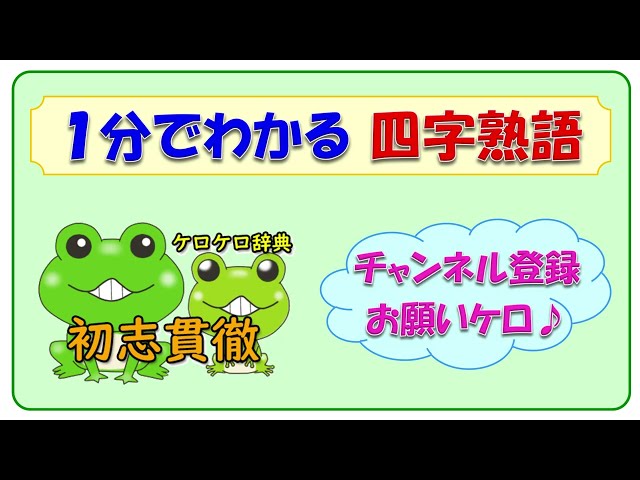
This four-character idiom, read as “shoshikantetsu,” means to carry through with what you started until the very end.
When we begin something, we’re full of motivation, but as soon as things don’t go as planned or we face setbacks, we can quickly lose heart.
That’s when I want you to remember “shoshi-kantetsu.” By adopting this idiom as both a slogan and a goal, we can cultivate a spirit that never gives up.
The ability to see things through to the end is a powerful asset in life, and it’s something we especially want children to develop.

Forge ahead with courage
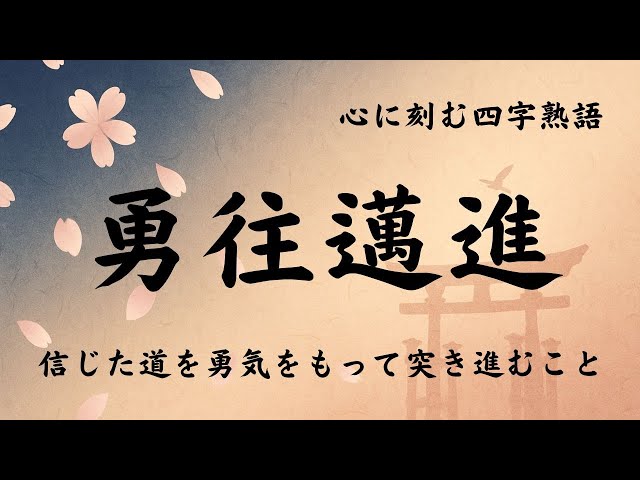
This is a four-character idiom that means “to press forward toward a goal without fear.” For example, when you bravely take on a difficult obstacle relay at a sports day or speak in front of everyone at your first recital, that’s yuō-maishin (fearless, steady advance).
It’s the same when you tackle tough math problems or try a new extracurricular without being afraid.
By moving forward without worrying about failure, your abilities grow and grow.
It’s an energetic, positive phrase that teaches the importance of continuing to challenge yourself without fear.
Say what you mean, do what you say.

Follow through on what you say you’ll do—that’s the essence of keeping your word.
At New Year’s or the start of a new term, many of us set fresh goals, but aren’t we often treating the act of setting goals as the goal itself? It’s easy to say things like “I’ll study hard” or “I’ll throw myself into sports,” but many people never put those words into action.
So why not make this phrase your goal instead? It can prompt you to dig deeper into what you truly want to do, and once you’ve said it, you’ll develop the mindset that you have to follow through.
Learning new things by revisiting the old
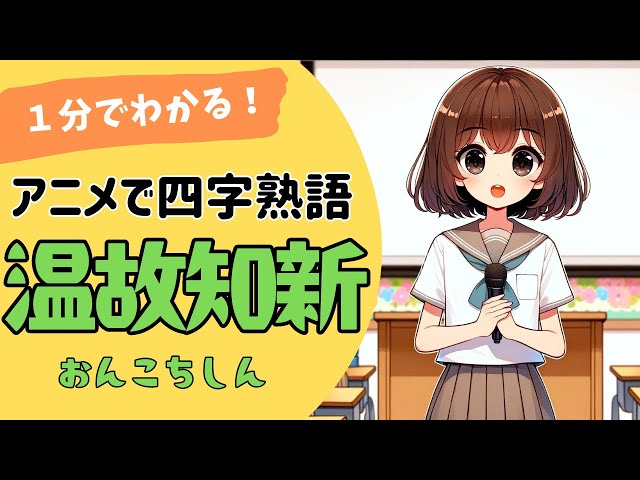
It means learning from the past and putting it to use in new situations.
For example, by reviewing kanji and relearning them, you’ll be able to write more difficult characters, and recalling math problems you studied before can help you tackle new ones—that’s onko chishin.
Studying history to understand past events and applying those lessons to your daily life or school rules is the same idea.
Likewise, remembering the creative tricks from artwork or crafts you made before and using them to create something new is also onko chishin.
When you value the past and skillfully incorporate new things, your abilities will keep growing.