

Strive toward your goals! Four-character idiom ideas that resonate with elementary school students

“I want to express my goals with a four-character idiom!” Many elementary school students and educators probably feel the same way.
Four-character idioms are full of wonderful words that can motivate us in all kinds of situations—studies, daily life, club activities, and more.
In this article, we’ll introduce four-character idioms that are perfect for setting goals, along with clear explanations of their meanings.
Please use this as a reference to help children encounter empowering words that inspire them to strive toward their dreams and goals!
- Recommended for elementary school class goals! A collection of impactful ideas using four-character idioms
- [For Elementary School Students] Four-character idioms you can use in sports! Words that are helpful for cheering and goal setting
- Easy for elementary school students to remember! A four-character idiom that expresses the feeling of trying your best
- For Elementary School Students: Four-Character Idioms You Can Use for New Year’s Resolutions — How to Set Cool Goals!
- Four-character idioms that help elementary schoolers not give up: words that spark the power to keep trying
- Learn the meanings too! Cool four-character idioms that elementary school students will want to remember
- Perfect for elementary school slogans! A collection of four-character idiom ideas you'll want to use
- Easy-to-remember, positive four-character idioms for elementary school kids! Words that brighten the heart
- [Elementary School Students] Perfect for Kakizome! A Collection of Four-Character Idiom Ideas
- [For Elementary School Students] Inspiring Four-Character Idioms for Shaping the Future at a Glance! Words that Spark Courage
- [For Elementary Students] A Collection of Beautiful Four-Character Idioms to Know
- Interesting four-character idioms for elementary schoolers! Words you'll want to use once you understand their meanings
- Four-character idioms that help you achieve goals! Phrases you can use in everyday situations
Striving toward your goals! Four-character idiom ideas that resonate with elementary school students (21–30)
cherry, plum, peach, and apricot (each flower/thing has its own unique beauty)
@hiroaki946 Oubaitōri Shorts Short video Mini video Set phrase Four-character idioms Proverbs Japanese Meaning of words Wordplay Learning Education Trivia Japanese culture Time-killer Study Knowledge Trivia Everyday life Power of words VOICEVOX: Shikoku Metan A four-character idiom that recognizes differences: “Oubaitōri” Do you know what it means? First, an example sentence: With the arrival of spring, the cherry, plum, peach, and apricot (sour plum) blossoms in the garden were in full bloom, coloring the yard. As the children looked at each flower, they said things like, “I like the pale pink of the cherry blossoms,” “The fragrance of the plum is the best,” “Peach petals are so cute,” and “The white blossoms of the apricot are lovely too.” By noticing the charm each flower possesses and learning the spirit of oubaitōri, the children began to feel that they should also cherish their own individuality. Meaning: Oubaitōri (桜梅桃李) comes from the idea that cherry, plum, peach, and apricot blossoms each have their own unique beauty. It teaches the importance of each person having their own individuality and talents, and expressing their own beauty without comparing themselves to others. It also implies that when people recognize and make use of their strengths and characteristics without comparison, overall harmony can be achieved. That is all.
Original song – hiroaki946 – hiroaki946
This four-character idiom means that just as cherry blossoms, plum blossoms, peach blossoms, and apricot blossoms each bloom with their own unique beauty, it’s okay for every person to be different, too.
It’s easy for elementary school students to understand and carries a message close to “Everyone is different, and that’s okay,” so it’s a good phrase to use in class activities or moral education.
It encourages children to value their own strengths and personalities as they are and to feel positive about themselves.
Beyond memorizing it as study, it can also be a starting point for recognizing differences among friends.
The sound of the phrase is beautiful, and it’s an idiom that lets students enjoy learning while imagining seasonal flowers.

Cherry blossoms in full, resplendent bloom
@jeripicho “桜花爛漫” is a Japanese expression meaning “a riot of cherry blossoms.” The idiom “Oka Ranman” refers to the beauty of cherry blossoms and cherry trees in full bloom in Japan, and it also evokes a sense of beauty and tradition. Spring is the season of renewal, growth, and new beginnings. It is the time when the world awakens from its winter slumber and nature comes alive with color, sound, and energy. From the first bloom of a flower to the return of migratory birds, spring is a season of beauty and wonder. Sakura symbolizes both life and death, beauty and violence. Just as the arrival of spring promises new life, the blooming of cherry blossoms brings a sense of vitality and vibrancy. At the same time, their brief lifespan reminds us that life is fleeting.#CherryBlossom Spring #nihongo
♬ snow dream – lmnl
Ouka-ranman is a four-character idiom that describes cherry blossoms bursting into full bloom in a bright, beautiful display.
It’s easy to grasp the meaning if you picture schoolyards and routes to school in spring washed in pink by cherry blossoms.
The sight of blossoms at their peak also conveys the idea that hard work has borne fruit and the feeling of sharing joy together.
In essays or reflections, using it for spring events or scenes like entrance and graduation ceremonies makes your expression much richer.
It’s a word worth remembering that teaches us both the beauty of nature and the brightness of the heart.

To each their own.

It’s a phrase that means “if there are ten people, there are ten different ways of thinking and ten different personalities.” Even if you spend time in the same class, the things you like, what you’re good at, and how you think all differ little by little.
That’s exactly what “jūnin toiro” (ten people, ten colors) expresses.
This saying teaches us that “it’s natural for everyone to be different.” Sometimes we feel down when we compare ourselves with others, but from another perspective, those differences are precious individuality.
If we cherish our own color while respecting others’ colors, the world will become a more comfortable place.
When a friend’s way of thinking differs from yours, try to remember “jūnin toiro.”
triumphant; elated; full of high spirits
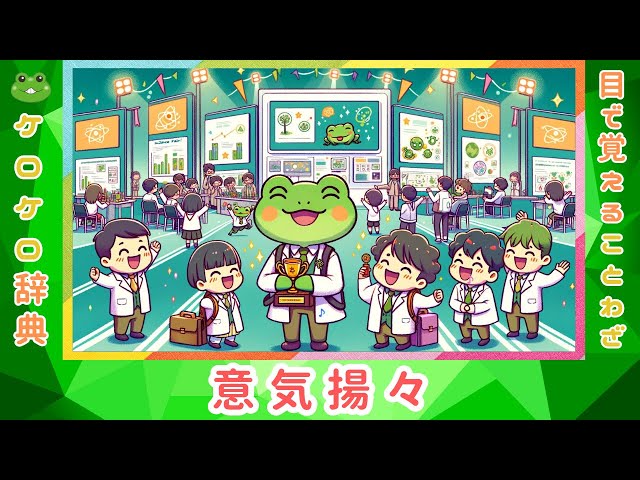
This four-character idiom is often used in positive situations where someone’s expression is radiant because things are going well.
It’s commonly used when someone feels proud after achieving a goal or returns victorious from a competition.
“Iki” refers to one’s frame of mind, while “yōyō” conveys a sense of pride or triumph.
Try using it in moments filled with joy and confidence, such as: “He won the contest and came back in high spirits,” “He was brimming with confidence after being entrusted with a new job,” or “She won the lottery and returned in a triumphant mood.”

a clear and serene mind

It’s not a phrase you hear often in everyday life, but it’s used at decisive moments—whether in a crucial contest or when making a major life decision.
Pronounced “meikyō shisui,” 明鏡 (meikyō) means a “polished mirror without a speck of cloudiness,” and 止水 (shisui) means “still, unmoving water.” For example: “Even against a strong team, his mind was as clear as meikyō shisui,” or “After long deliberation, I’ve made my decision, and my mind is meikyō shisui.” Try using it in situations involving important decisions or pivotal challenges.
The return of the sun; the turning of the tide toward good fortune (often used to mean a revival or a new beginning after adversity).
@hjc.aki Ichi-yō rai-fuku: Winter will surely end and spring will come; tough times will surely end and happiness will arrive.The return of the sun (symbolizing the turning of misfortune to good fortune)translationCalligrapherCalligraphyTranslation
♬ Soranji – Mrs. GREEN APPLE
Like the end of a cold winter and the gentle return of spring, the four-character idiom “Ichiyō Raifuku” means that good fortune comes after a spell of misfortune.
On days when you fail at studying or sports, or when something sad happens, you may worry that things will stay this way forever.
Even so, time moves forward little by little, and a new light begins to shine into your heart.
Even if school life doesn’t go smoothly, by continuing to move forward—even if only in small steps—the situation will surely change.
It is a four-character idiom that gives you the courage to keep hope in your heart.

every move; every action

“Ikkyō-ichidō” (literally, “every single move”) is a four-character idiom that means paying attention to one’s actions and taking responsibility for them.
By being mindful even of small behaviors—such as how you speak and act at school or at home, and how you interact with friends—you can deepen trust with those around you.
In studying or sports, focusing carefully on each individual movement also makes it easier to achieve results.
Another appeal is that by being conscious of the small actions you take every day, you can build good habits and feel your own growth.
Keeping this phrase in mind helps cultivate the ability to live a careful and fulfilling life.
One day, one lifetime

Ichinichi isshō (One day, one lifetime) means treating each day with such care and intention that it becomes as meaningful as a whole life.
It encourages valuing your daily school life, playtime, studying, and lessons.
By keeping this in mind when you wake up in the morning or take on something new, you cultivate the drive to work positively toward your goals.
Including it in your New Year’s resolutions helps you adopt a mindset that makes each day fulfilling rather than wasted—an actionable and cool four-character idiom.
Once-in-a-lifetime encounter

Encounters with people sometimes lead to long-term relationships like friendships, but in most cases they end as a single passing moment.
In Japanese, a once-in-a-lifetime encounter is expressed by the phrase ichigo ichie.
Precisely because most encounters are ichigo ichie, we should cherish the friends we’ve grown close to and the family who always helps us.
It might be nice to reframe your thinking with that sentiment.
Except for the character 期, the other kanji are relatively easy to write, so try your first calligraphy of the year while paying attention to balance.

ingenuity and creativity

When you’re doing crafts, drawing, or organizing an event, adding a little twist can often make things go smoothly.
Creativity and ingenuity refer to the way we generate new ideas to accomplish or build things.
While mastering the basics is important, even a small inventive touch can open the door to a whole new world.
If your child is thinking of working harder in the new year by being more resourceful and adaptable, why not have them choose this phrase for their first calligraphy of the year?