

Strive toward your goals! Four-character idiom ideas that resonate with elementary school students

“I want to express my goals with a four-character idiom!” Many elementary school students and educators probably feel the same way.
Four-character idioms are full of wonderful words that can motivate us in all kinds of situations—studies, daily life, club activities, and more.
In this article, we’ll introduce four-character idioms that are perfect for setting goals, along with clear explanations of their meanings.
Please use this as a reference to help children encounter empowering words that inspire them to strive toward their dreams and goals!
- Recommended for elementary school class goals! A collection of impactful ideas using four-character idioms
- [For Elementary School Students] Four-character idioms you can use in sports! Words that are helpful for cheering and goal setting
- Easy for elementary school students to remember! A four-character idiom that expresses the feeling of trying your best
- For Elementary School Students: Four-Character Idioms You Can Use for New Year’s Resolutions — How to Set Cool Goals!
- Four-character idioms that help elementary schoolers not give up: words that spark the power to keep trying
- Learn the meanings too! Cool four-character idioms that elementary school students will want to remember
- Perfect for elementary school slogans! A collection of four-character idiom ideas you'll want to use
- Easy-to-remember, positive four-character idioms for elementary school kids! Words that brighten the heart
- [Elementary School Students] Perfect for Kakizome! A Collection of Four-Character Idiom Ideas
- [For Elementary School Students] Inspiring Four-Character Idioms for Shaping the Future at a Glance! Words that Spark Courage
- [For Elementary Students] A Collection of Beautiful Four-Character Idioms to Know
- Interesting four-character idioms for elementary schoolers! Words you'll want to use once you understand their meanings
- Four-character idioms that help you achieve goals! Phrases you can use in everyday situations
Work hard toward your goals! Ideas for four-character idioms that resonate with elementary school students (31–40)
flexible; adaptable; responding appropriately to the situation

If you only ever do things in the one way you think is right, it becomes hard to choose a different path when something happens.
At times like this, it’s important to flexibly reconsider your course.
“Rinki-ōhen” (being flexible) means taking actions suited to the situation.
Acting with flexibility can be difficult, too.
By developing your ability to apply what you know, you’ll become better at adapting, so it’s a good idea to put that resolve into your first calligraphy of the year.
The first half, “臨機,” has many intricate components, so take care not to let the characters lose their form when you write them.

A fresh start

You couldn’t study hard last year, you didn’t perform well in sports, and you kept getting into fights with your friends.
If that sounds like your child, write this four-character idiom and make a fresh start—reset your mindset! It’s a waste of time to keep regretting what you couldn’t do in the past.
If studying, sports, and relationships with friends didn’t go well, just work hard from the new year! As a declaration of your determination to do your best in the year ahead, try writing these characters.
Note that the characters “機” and “転” contain small components and require fine spacing, so be careful when doing your first calligraphy of the year.
Good fortune comes to a cheerful home.

A smile is a magical expression that brings happiness not only to yourself but also to those around you.
If your child wants the new year to be filled with laughter, have them try writing this four-character idiom for their first calligraphy of the year.
This phrase is like turning the proverb “Good fortune comes to a smiling household” into a four-character idiom, and, just as the words suggest, it conveys that happiness comes to those who are always smiling.
It can be difficult for elementary school children to smile every day—whether they’ve had a fight with a friend or their studies aren’t going well.
But it’s precisely at such times that they should try to keep smiling and use this phrase with the mindset of drawing in good luck!
with all one’s might

If your child has something they want to work hard at in the new year, how about writing this four-character idiom? Isshōkenmei expresses the idea of tackling things earnestly and with full effort.
It’s a phrase that can encourage children who want to devote themselves to something—whether it’s studying, sports, lessons, or anything they want to try harder at or achieve better results in.
The character “ken” (懸) is a bit tricky, so when writing it for the first calligraphy of the year, be careful not to let the finer details get smudged!
work in the fields on sunny days, read books on rainy days

This phrase means: on sunny days, thoroughly till the rice fields and vegetable patches to prepare the soil, and on rainy days, spend time indoors reading at a relaxed pace.
While such an unhurried lifestyle may differ a bit from that of an elementary school child, try changing the way you think about it.
For example, consider sunny days as important days for challenges and put in your best effort on those days.
See rainy days as days for storing up—sometimes taking a break and taking time to absorb knowledge is important, too.
Try shifting your perspective to your everyday life and incorporating this mindset into the new year through your first calligraphy of the year.
Fall down seven times, get up eight.
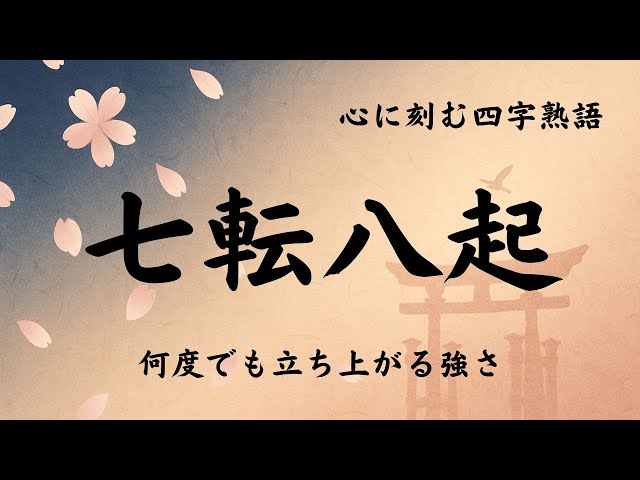
As the saying goes, “fall seven times, stand up eight,” this four-character idiom expresses the spirit of rising again no matter how many times you fail.
It symbolizes the resilience to face difficulties without yielding and to keep challenging oneself time and again.
Life inevitably brings unexpected setbacks and failures, but each time we recover, we grow stronger.
Especially for older adults, it offers the courage to overcome age-related physical limitations and changes in social roles.
By reminding us to step forward again and again instead of standing still, it inspires hope and vitality—a powerful, life-affirming phrase that encourages us to keep going.

march forward bravely
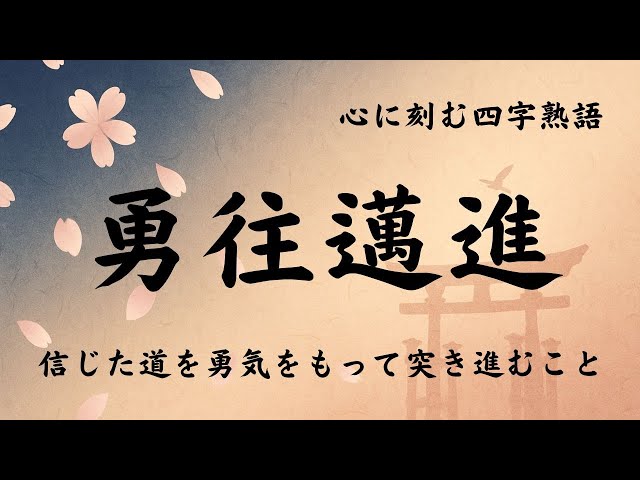
“Yūōmaishin” (勇往邁進) means to press forward boldly and fearlessly toward the goals or path you believe in.
“Yūō” means to advance without hesitation, and “maishin” means to push ahead toward a purpose without fear.
Both words convey the idea of moving forward, and combining them intensifies the meaning.
It’s often used as a very positive expression and is popular as a personal motto or slogan.
It’s a four-character idiom worth remembering as a phrase that stirs your spirit.

Carry out one’s original intention to the end
@az0202za #StickToYourOriginalIntentions #Shoshikantetsu #FourCharacterIdiom #Learning
♬ Original Song – 0202civo – az0202za
Everyone experiences their initial aspirations and enthusiasm fading over time due to the passage of time, changing circumstances, or simple familiarity.
The four-character idiom “shoshi-kantetsu” (初志貫徹) expresses the importance of not giving in to such weakness, but instead holding fast to your original resolve and goals to the very end and seeing them through.
Obstacles and hardships are a part of life.
Even then, we want to keep looking forward and see things through without giving up.
It’s a cool phrase that conveys strong will and an unwavering core, so it makes a great motto when you’re setting off toward a new goal.
Forge ahead with courage
@shi_chan.ikoi_shodo march forward with courageFirst calligraphy of the yearRelaxing CalligraphyCalligraphyhanging scroll (calligraphy scroll)semi-cursive script[Yuō Maishin] Advancing boldly and straight ahead. It means to push forward single-mindedly toward one’s goal without hesitation or fear. “Yūō” = to proceed without hesitation; “Maishin” = to advance rapidly without fear.
♬ Blessings – Rye
It is a phrase that signifies the attitude of boldly pushing forward.
When faced with hardship or adversity, many people feel hesitation and anxiety, but this phrase teaches the importance of continuing to challenge without fear.
Even if the goal is high and the path is steep, the way will open by taking sure steps one by one.
Persistence that refuses to give up until you get there, and the courage to forge ahead without wavering—these are the only real means to overcome difficulties.
For those who keep challenging themselves, it is truly a guiding principle for action.

One good deed a day

This four-character idiom means “do one good deed every day,” and it’s an easy goal for elementary school students to use as a guide for their actions.
There’s no need to accomplish anything big—helping a friend, picking up litter, or greeting others cheerfully all count as admirable good deeds.
By building small actions day by day, students can feel their own growth, and the overall atmosphere of the class will brighten as well.
Good deeds leave a warm impression because they are done without expecting anything in return.
The accumulation of such actions nurtures trust and helps create a classroom filled with kindness.
It’s a practical phrase that encourages a positive approach to each day.