

Perfect for elementary school slogans! A collection of four-character idiom ideas you'll want to use

Elementary school students surprisingly have many occasions to put up slogans, such as at sports days, learning presentations, and class goals.
Why not try incorporating four-character idioms in those moments? These compact expressions carry deep meaning and have the power to unite everyone’s hearts.
Here, we introduce four-character idioms that are easy for elementary school students to remember and that make them want to work hard together with their friends.
Once you learn the meanings, you’re sure to find a favorite phrase!
- Recommended for elementary school class goals! A collection of impactful ideas using four-character idioms
- [For Elementary School Students] Four-character idioms you can use in sports! Words that are helpful for cheering and goal setting
- [Elementary School Students] Perfect for Kakizome! A Collection of Four-Character Idiom Ideas
- Learn the meanings too! Cool four-character idioms that elementary school students will want to remember
- Strive toward your goals! Four-character idiom ideas that resonate with elementary school students
- [For Elementary Students] A Collection of Beautiful Four-Character Idioms to Know
- Easy for elementary school students to remember! A four-character idiom that expresses the feeling of trying your best
- Easy-to-remember, positive four-character idioms for elementary school kids! Words that brighten the heart
- Interesting four-character idioms for elementary schoolers! Words you'll want to use once you understand their meanings
- For Elementary School Students: Four-Character Idioms You Can Use for New Year’s Resolutions — How to Set Cool Goals!
- Popular even among elementary school students! Stylish and easy-to-remember four-character idioms
- Four-character idioms that help elementary schoolers not give up: words that spark the power to keep trying
- Four-character idiom slogans for groups! Words that convey a powerful message
Perfect for elementary school slogans! A collection of catchy four-character idioms you'll want to use (1–10)
steady progress day by day; making rapid strides

“Nisshin-geppo” means making steady progress day by day—like practicing kanji a little every day so you can learn them, or working hard on arithmetic daily so you can do calculations quickly and accurately.
The same applies to sports: if you keep practicing soccer or jump rope every day, you’ll gradually get better.
You can also improve at piano or drawing through daily practice.
It’s a positive, encouraging four-character idiom that means, “If you keep at it steadily every day, you can get a little better.” In anything, by building up your efforts, you can make progress little by little each day.

Indomitable; unyielding (literally: ‘unbent by a hundred setbacks’)

It means to keep trying without giving up, no matter how many times you fail.
For example, even if you mess up many times at jump rope, you practice until you can finish it, or if you get a difficult math problem wrong, you keep challenging it without giving up—that’s “hyakusetsu-futō” (unyielding despite a hundred setbacks).
It’s the same when drawing: even if it doesn’t come out as you imagined, you redo it over and over until it’s complete.
By persevering without losing heart after failures, you gradually improve and become able to do new things.
This upbeat and encouraging four-character idiom teaches the importance of continuing to work hard with a strong will.
A hundred flowers in full bloom

It’s a four-character idiom that means “many beautiful things blooming all at once, creating a lively and joyful scene.” For example, when various flowers in parks or gardens blossom simultaneously in spring, it looks as if the colorful flowers are competing with one another.
You can also use it for a school cultural festival where many works and presentations are on display, or a school performance where lots of friends energetically take the stage—these are all examples of “hyakka ryōran.” When many different things shine together, it creates a very bustling and happy feeling.
It’s an uplifting idiom you can use in everyday life whenever you experience beautiful, joyful moments.
Perfect for elementary school slogans! An idea collection of four-character idioms you'll want to use (11–20)
Stay true to your original intention.
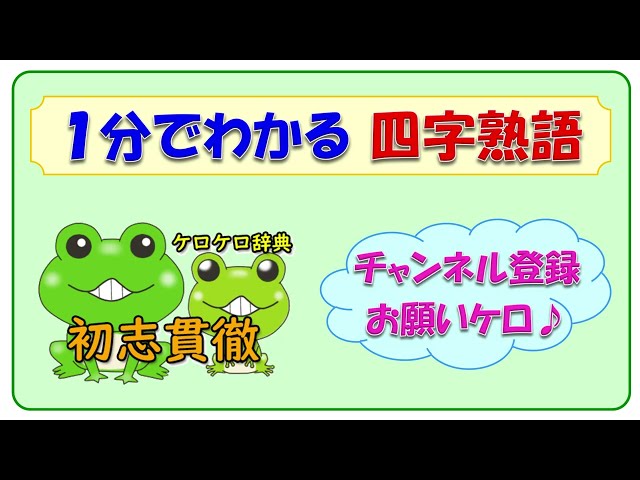
This four-character idiom, read as “shoshikantetsu,” means to carry through with what you started until the very end.
When we begin something, we’re full of motivation, but as soon as things don’t go as planned or we face setbacks, we can quickly lose heart.
That’s when I want you to remember “shoshi-kantetsu.” By adopting this idiom as both a slogan and a goal, we can cultivate a spirit that never gives up.
The ability to see things through to the end is a powerful asset in life, and it’s something we especially want children to develop.

Say what you mean, do what you say.

Follow through on what you say you’ll do—that’s the essence of keeping your word.
At New Year’s or the start of a new term, many of us set fresh goals, but aren’t we often treating the act of setting goals as the goal itself? It’s easy to say things like “I’ll study hard” or “I’ll throw myself into sports,” but many people never put those words into action.
So why not make this phrase your goal instead? It can prompt you to dig deeper into what you truly want to do, and once you’ve said it, you’ll develop the mindset that you have to follow through.
Learning new things by revisiting the old

It means learning from the past and putting it to use in new situations.
For example, by reviewing kanji and relearning them, you’ll be able to write more difficult characters, and recalling math problems you studied before can help you tackle new ones—that’s onko chishin.
Studying history to understand past events and applying those lessons to your daily life or school rules is the same idea.
Likewise, remembering the creative tricks from artwork or crafts you made before and using them to create something new is also onko chishin.
When you value the past and skillfully incorporate new things, your abilities will keep growing.
simplicity and fortitude

This is a four-character idiom that means “to be unadorned and have a solid mind and body.” For example, diligently doing your homework every day and studying, or strengthening your body through exercise and playing outside, are examples of shitsu-jitsu-gō-ken (sobriety and sturdiness).
It means valuing being strong in both mind and body and doing what is right over decorating your appearance.
Also, even if you have a quarrel with a friend, calmly talking things through correctly shows the spirit of shitsu-jitsu-gō-ken.
It is a very important phrase that teaches us, in our daily lives, to make energetic efforts and to nurture our minds and bodies straight and true.