


Elementary school students surprisingly have many occasions to put up slogans, such as at sports days, learning presentations, and class goals.
Why not try incorporating four-character idioms in those moments? These compact expressions carry deep meaning and have the power to unite everyone’s hearts.
Here, we introduce four-character idioms that are easy for elementary school students to remember and that make them want to work hard together with their friends.
Once you learn the meanings, you’re sure to find a favorite phrase!
- Recommended for elementary school class goals! A collection of impactful ideas using four-character idioms
- [For Elementary School Students] Four-character idioms you can use in sports! Words that are helpful for cheering and goal setting
- [Elementary School Students] Perfect for Kakizome! A Collection of Four-Character Idiom Ideas
- Learn the meanings too! Cool four-character idioms that elementary school students will want to remember
- Strive toward your goals! Four-character idiom ideas that resonate with elementary school students
- [For Elementary Students] A Collection of Beautiful Four-Character Idioms to Know
- Easy for elementary school students to remember! A four-character idiom that expresses the feeling of trying your best
- Easy-to-remember, positive four-character idioms for elementary school kids! Words that brighten the heart
- Interesting four-character idioms for elementary schoolers! Words you'll want to use once you understand their meanings
- For Elementary School Students: Four-Character Idioms You Can Use for New Year’s Resolutions — How to Set Cool Goals!
- Popular even among elementary school students! Stylish and easy-to-remember four-character idioms
- Four-character idioms that help elementary schoolers not give up: words that spark the power to keep trying
- Four-character idiom slogans for groups! Words that convey a powerful message
Perfect for elementary school slogans! A collection of catchy four-character idioms you'll want to use (1–10)
single-minded devotion

For example, when you work carefully on a math problem without thinking about anything else, or when you draw a picture by focusing on colors and shapes until you finish it, that’s “devoting yourself single-mindedly.” Likewise, when practicing the piano to memorize a piece, concentrating on the notes and rhythm is another example.
It’s the same when you play a game and tackle the mission in front of you with all your effort.
It describes “focusing your heart and mind on one thing and working on it,” becoming absorbed in something so you can improve or complete it.

with all one’s might

It’s a four-character idiom that means “to try your hardest and never give up until the end.” For example, in a school sports day relay, running with all your might because you want to come in first, or carefully finishing a drawing assignment to the very end—those are both examples of doing your best with all your heart.
Working hard to make up with a friend after a fight also shows the spirit of wholehearted effort.
When you throw yourself into something and give it your all, you gain new abilities and find more enjoyment.
It’s a very uplifting expression you can use whenever you feel, “I’m going to give it my all!” in everyday life.
unity; standing together as one

Recommended for times when everyone wants to join forces and work hard toward the same goal.
For example, during a sports day relay, passing the baton while cheering each other on as a team is also a form of united teamwork.
The same goes for cleaning the classroom together as a class to make it neat.
It’s also important to have this spirit of unity when creating a play for a school festival or coordinating an ensemble for a recital.
This four-character idiom expresses a very uplifting and important mindset: by combining everyone’s strengths, you can succeed at things that one person alone could not accomplish.
giving it your all

It means “to put your full effort into something.” For example, running at full speed until the very end in a relay at a sports day, chasing the ball with all your might in a soccer match, or sticking with your homework or kanji practice without giving up—these are all cases of giving it your all.
Fully enjoying playtime with friends, or creating art and crafts with heartfelt dedication, are also examples.
When you give everything you’ve got to anything you do, you can feel a sense of accomplishment and joy.
This four-character idiom expresses an energetic, positive attitude.
friendly rivalry; mutual improvement through competition

This is a four-character idiom that expresses working together with friends and mutually improving one another.
For example, when studying math, if you and your friends quiz each other and teach one another, both you and your friends will get better and better.
In sports practice, having teammates who strive alongside you helps you run faster or throw a ball more skillfully.
And when practicing the piano, hearing a rival’s performance and feeling motivated to do your best is also the spirit of “sessatakuma.” It’s a wonderful phrase you can use when you grow by helping one another with your friends or teammates.
Forge ahead with courage
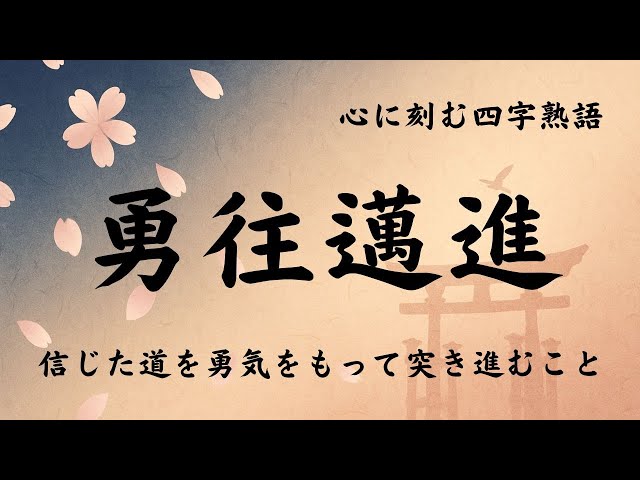
This is a four-character idiom that means “to press forward toward a goal without fear.” For example, when you bravely take on a difficult obstacle relay at a sports day or speak in front of everyone at your first recital, that’s yuō-maishin (fearless, steady advance).
It’s the same when you tackle tough math problems or try a new extracurricular without being afraid.
By moving forward without worrying about failure, your abilities grow and grow.
It’s an energetic, positive phrase that teaches the importance of continuing to challenge yourself without fear.
Excellence in both academics and sports

This is a four-character idiom that means “to work hard at both studies and sports in a well-balanced way.” For example, diligently studying math and Japanese in class while staying active after school with soccer or running is bunbu ryōdō.
It’s the same when you practice piano or drawing thoroughly while also building your body through jump rope or swimming.
By valuing and making an effort in both academics and physical activity—not just one or the other—you can help your mind and body grow healthily.
If you keep the spirit of “bunbu ryōdō” in mind in your school life and daily lessons, it’s a positive and important phrase that helps you become stronger in a well-balanced way, both in heart and body.