



When you feel the arrival of spring, do gentle melodies of children’s spring songs ever come to mind? Wouldn’t it be lovely to share the warmth of the season and the beauty of nature with your child through seasonal songs? Children’s songs are made with gentle words and rhythms that are easy for little ones to enjoy, and they have the power to warmly embrace parent–child communication.
In this article, we’ll introduce a wide range of children’s songs perfect for spring.
While out for a walk or playing at home, try finding a favorite tune and singing it together!
- March nursery rhymes & hand play songs! Spring songs you can enjoy with your kids
- [Spring Songs] Classic and Latest Hit Collections Perfect for a Bright, Gentle Spring
- [For Seniors] Spring Songs You'll Want to Hum: Feel the Season with Nostalgic Classics
- Nursery rhymes perfect for April: A collection of classic spring songs that capture the season
- [Spring Songs] Masterpieces for Mid-Spring to Listen to in March. Spring Tunes
- [Spring Songs] Masterpieces to Listen to in April: Classic Tracks that Color the Month
- Spring songs from the early Showa era: a collection of kayōkyoku and shōka that evoke spring
- Uplifting songs to listen to in spring. Classic spring tunes that warm the heart.
- [For Elementary School Students] Feel the Spring Vibes with Songs! A Collection of Classic Spring Tunes You'll Want to Sing
- [February Songs] Introducing children's songs, folk songs, nursery rhymes, and hand-play songs about Setsubun and winter!
- Spring song medley. The best classic tunes to listen to in spring.
- Nursery rhymes and fingerplay songs to enjoy in May! Songs perfect for the fresh green season
- A spring song with great lyrics. A lovely message that touches the heart.
Children’s songs to sing in spring: a collection of classics you’ll want to sing with your kids (1–10)
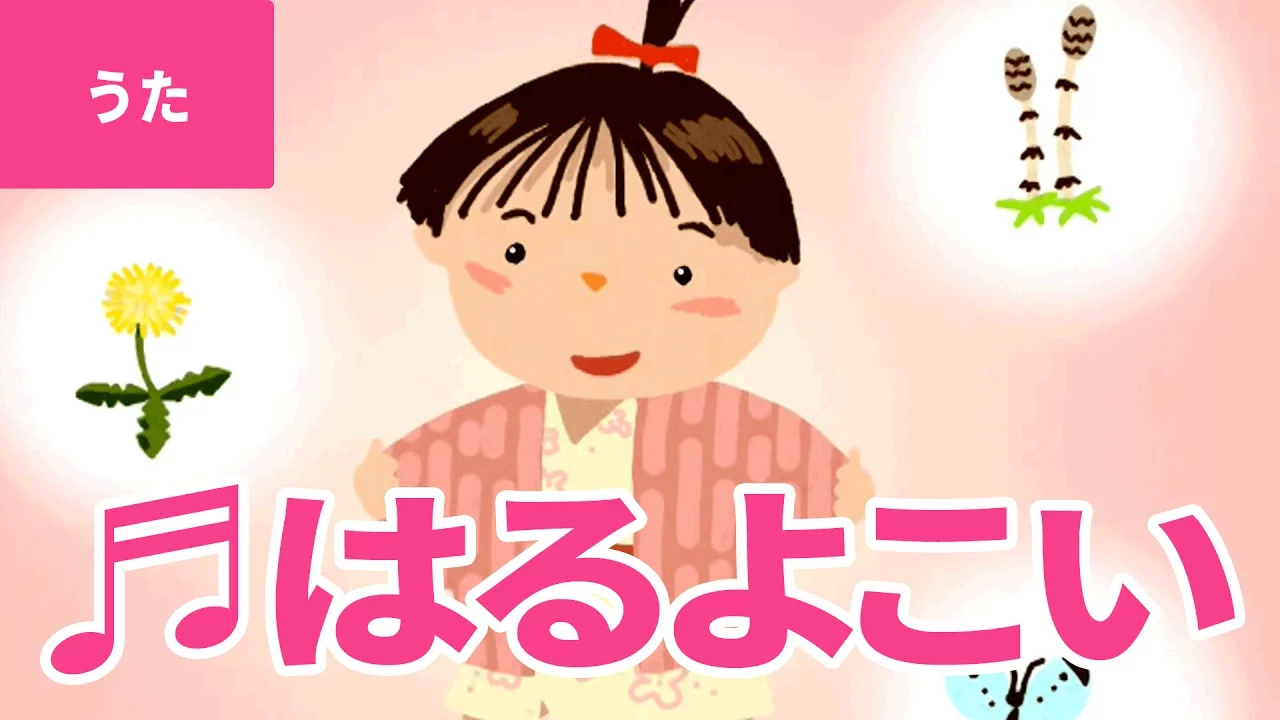
Come, springSakushi: Soma Gyofu / Sakkyoku: Hirota Ryutaro

Warm spring is a season many people eagerly await, isn’t it? Calling out for such a spring to come quickly is this song, “Haruyo Koi” (“Come, Spring”).
In the lyrics, those waiting with bated breath for spring are a baby who has just learned to walk and peach blossoms still in their buds, ready to bloom at any moment.
Beyond the baby and the flower buds, of course, there are many people who long for spring’s arrival for all sorts of reasons.
Why not sing this song—urging spring to hurry along—together with your children, or even as an adult returning to a childlike spirit, and wish for the joyful season to come soon?

FlowerSakushi: Takeshima Hane / Sakkyoku: Taki Rentarō

The spring classic “Hana” was composed by Rentaro Taki.
Its rhythmic melody conveys the buoyant feeling of spring! The lyrics depict the colorful, splendid scenes typical of the season.
Simply listening to the song while taking in the lyrics brings vivid springtime images to mind.
Because the Sumida River appears in the lyrics, Tokyo’s Sumida City has adopted the song as a beloved community anthem.
There is also a monument inscribed with the lyrics in Sumida Park along the Sumida River.
Take a cheerful stroll along a springtime path and sing along!
Spring somewhereSakushi: Momota Sōji / Sakkyoku: Kusakawa Shin

From late February into March, don’t you sometimes catch a fleeting sense of spring even while still feeling the cold? It’s not quite the full arrival of spring yet, but this song expresses the hints of the season you can sense in nature little by little: snow melting and flowing into the river, the calls of spring creatures, flowers budding, and so on.
Those gradual signs of spring can really brighten the heart, can’t they? The “east wind” that appears in the latter half of the lyrics refers to a spring wind blowing from the east, though nowadays it’s sometimes sung as “breeze” instead.
It’s a perfect song for those moments when you notice a small sound of spring somewhere.
School of MedakaSakushi: Chaki Shigeru / Sakkyoku: Nakata Yoshinao

Spring is the season when living creatures become more active.
With that in mind, how about “Medaka no Gakkō” (“The Medaka’s School”)? Many of you probably sang and enjoyed it as children.
First broadcast on an NHK radio program in 1951, it gradually came to be sung across Japan and, within a few years, became firmly established.
In 2007, it was selected as one of Japan’s 100 Best Songs.
Listening to it conjures up images of medaka fish swimming in clear water and puts you in a peaceful mood.
It’s perfect for when you want to spend a laid-back, carefree moment.

Spring StreamSakushi: Takano Tatsuyuki / Sakkyoku: Okano Teiichi

This is a famous Japanese children’s song created by the duo of lyricist Tatsuyuki Takano and composer Teiichi Okano.
It is said to depict the scenery of the Kōhone River, which flowed around present-day Yoyogi in Shibuya Ward, where Takano lived at the time.
It’s a song that inevitably comes to mind when you see a brook in spring.

Spring has come.sakushi: takano tatsuyuki / sakkyoku: okano teiichi

When it comes to spring songs and children’s songs, many people probably think of this one first.
The song “Haru ga Kita” (Spring Has Come) has a long history; it was released in 1910, in the 45th year of the Meiji era, and is widely known and sung by both children and adults as one of the quintessential songs of spring.
It has also been selected for the ‘100 Best Japanese Songs,’ a list featuring songs meant to be enjoyed by parents and children and to be passed down for generations.
The song has three verses, a relaxed tempo, and simple lyrics, making it easy even for young children to sing.
It’s a springtime children’s song that grandparents and grandchildren can enjoy together.

Happy HinamatsuriSakushi: Yamano Saburō (Satō Hachirō) / Sakkyoku: Kawamura Naonori (Kawamura Kōyō)

Speaking of early-spring events, Hinamatsuri (Girls’ Day) comes to mind—so this beloved children’s song is a must! “Ureshii Hinamatsuri,” with lyrics by poet Hachiro Sato and music by composer Naonori Kawamura, was released in 1936 and has been cherished ever since.
When you hear “Hinamatsuri,” this song pops into your head first, doesn’t it? That’s how deeply it’s rooted in the hearts of the Japanese people.
Many artists have covered it, so you might enjoy searching for a version that suits your taste.