

![[Home Run Level] A Compilation of Trivia & Fun Facts About Baseball](https://media.ragnet.co.jp/img/1200__png__https://www.ragnet.co.jp/files/2026/03/7d13a50c4094b7036831816c0bd5bb69.webp)
[Home Run Level] A Compilation of Trivia & Fun Facts About Baseball


In Japan, there’s never a shortage of baseball talk—whether it’s professional baseball, the Major Leagues, or the WBC! Every year, countless baseball fans can’t help but wonder which team will be crowned the best in Japan, who will win the home run title, and which player will pull off a miracle play.
In this article, we’ll introduce fun trivia and tidbits that will make you love baseball even more! We’ve gathered facts from various angles, including the history of baseball and the curiosities behind things you casually see while watching games.
Even if you don’t know much about baseball, you’ll find yourself thinking, “Oh, really? That’s cool!”—so be sure to check it out!
Home Run-Level: A Collection of Trivia & Fun Facts About Baseball (1–10)
The “Cy Young” in the Cy Young Award is not his real name.
The Cy Young Award is the term synonymous with the honor given in Major League Baseball to the pitcher who performed the best that season.
The award is named after Cy Young, who is enshrined in the National Baseball Hall of Fame.
However, “Cy Young” was not actually his real name.
His real name was Denton True Young, and he was nicknamed “Cy” because his fastballs roared like a cyclone—so powerful they were compared to a violent storm.

The tallest player in NPB history is 216 cm tall.

Among players who have been on NPB teams, the tallest is Loek van Mil, standing at an astonishing 216 centimeters.
Considering that the average height of Japanese men in their 30s is around 171 centimeters, the difference compared to Japanese players is certainly striking.
The towering Loek van Mil is also known for being the first player in Japanese professional baseball history to hail from the Netherlands proper.
During his time in Japan, he played for the Tohoku Rakuten Golden Eagles, and afterward he went on to play for the Curaçao Neptunus in his home country of the Netherlands.
The ball’s surface is made of cowhide.
The surface of a baseball is covered with leather, and it’s said that cowhide is the mainstream choice.
This is due to its durability, grip, and appropriate hardness—factors that help standardize the ball and make the game fair and exciting.
In the past, horsehide was used, but it’s said to have been replaced by cowhide because of issues with tautness and durability.
The core is made of cork or rubber, along with wool and cotton thread, and it might be interesting to consider how differences in materials could change the game.

During the war, baseball terminology was converted into Japanese.
When it comes to baseball terminology, English is the standard, and it’s easy to understand because the same terms are used in any country.
However, during the war, even baseball terms were labeled as enemy language, and there were directives to replace them with Japanese.
It’s said that games proceeded using alternative words that reflected each term’s meaning or situation—for example, “strike” became seikyū (correct ball) or yoshi (good), and “out” became mui (futility) or soremade (that’s it).
Changes to the rules may have been difficult for the players, but it was a desperate measure born from the determination to keep baseball alive at all costs.
The minimum guaranteed annual salary for the first team is 16 million yen.
In Nippon Professional Baseball, the minimum guaranteed annual salary for players on the top team (ichi-gun) is 16 million yen.
This is money guaranteed as long as they belong to the team, even if they can’t play in games, and it’s an important system that lets players focus on baseball.
Thanks to this, rookies and young players can concentrate on practice and games without worrying about their livelihood.
It’s similar to how, in a school club, you can participate with peace of mind if paying club fees guarantees equipment and travel expenses.
The minimum guaranteed salary serves as a foundation that helps players keep working hard without being crushed by pressure, and it’s an important system that supports their pursuit of their dreams.

The meaning of “bullpen” is “a place to pen cattle.”
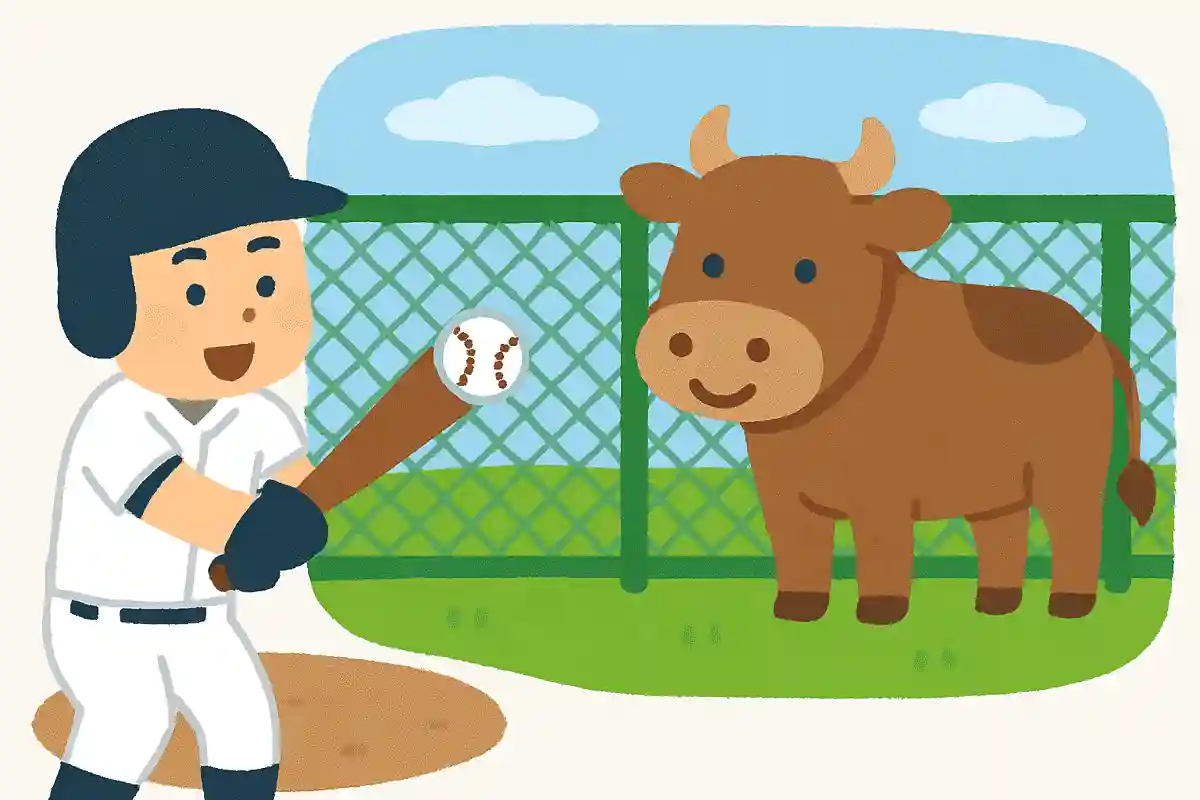
In baseball, the place where pitchers warm up before or during a game is called the “bullpen.” The original meaning of this word in English is “a pen for keeping bulls.” In old ballparks, the area where relief pitchers waited was narrowly enclosed, and because it resembled a pen for cattle, it came to be called the “bullpen.” For example, you can imagine a waiting area surrounded by a fence where pitchers wait for their turn.
It’s a common term in baseball today, but it actually has an interesting origin related to animals.
The catcher’s mask is based on the fencing mask.

It’s said that the catcher’s mask, which catchers wear to protect their faces, was actually based on the mask used in the sport of fencing.
In the old days of baseball, there was no equipment to protect the face, and getting hit by the ball was very dangerous.
Using the fencing mask from swordplay as a hint, a baseball mask was devised.
For example, just as you wear a helmet when riding a bicycle to stay safe, catchers also use equipment to protect their bodies.
It’s standard gear now, but it was born from efforts to prioritize safety.