

![[Diction Training] A Collection of Tongue Twisters to Improve Articulation](https://i.ytimg.com/vi_webp/eh8aRxYoqYA/maxresdefault.webp)

Tongue twisters are phrases that you repeat as fast as you can, even though they’re hard to say.
Many of you may have played with them when you were kids.
Tongue twisters aren’t just a fun pastime—they’re also effective for improving your articulation.
In this article, we’ll introduce tongue twisters that help you speak more clearly!
They’re great not only for articulation practice if you’re aiming to become an announcer or voice actor, but also useful when you’re asked to give a wedding speech or have to present in front of your class.
Practice hard and use them to achieve your dreams and goals!
- A collection of long tongue twisters. Also recommended for practicing announcements and narration.
- Tongue twisters that will make you laugh out loud! Super funny
- Challenging tongue twisters: Introducing high-difficulty phrases and sentences!
- [Recreation] Challenge! A roundup of tongue twisters recommended for elementary school students
- [Diction Training] A Collection of Tongue Twisters to Improve Articulation
- Perfect for pronunciation practice! A collection of English tongue twisters.
- Bursting into laughter! A roundup of Hakata dialect tongue twisters
- Nagoya dialect tongue twisters are exquisite! A fun collection where your tongue gets tied in knots with regional dialects
- “Chau chau, anta” — a Kansai-dialect tongue twister. A phrase only Kansai folks can say.
- [For Seniors] Boost Oral Function with Tongue Twisters! Recommended Picks to Try
- Chinese tongue twisters: A collection of rao kou ling helpful for learning Chinese
- Challenge together! A roundup of word games for adults
- [Rec] Interesting! A roundup of wordplay games
[Diction Training] A Collection of Tongue Twisters to Improve Articulation (1–10)
The mystery of the banana is still a mystery.

There’s a unique tongue twister that goes, “Banana no nazo wa mada nazo na no da zo.” Grammatically, it may feel a bit unnatural.
The hallmark of this tongue twister is how often the sound nazo appears—it shows up five times.
To make matters trickier, there are similar-sounding phrases like nazo and na no da zo.
Plus, na no da zo also closely resembles nazo nazo (riddle), which raises the difficulty.
To avoid getting confused, make sure you’ve got it firmly in your head before you give it a try.

Snowplow in operation

A tongue twister based on a scene often seen in snowy regions: “Snowplow snow removal in progress.” The tricky part of this tongue twister is that the word for “snow removal” appears twice, which makes it easy to lose track of where you are as you repeat it.
It also features several pronunciation challenges: the “jo” sound occurs twice, and the “sha” and “gyo” sounds each occur once.
Try practicing with those four points in mind.
If you master this tongue twister, you might just get better at pronouncing the small kana sounds (ゃ, ゅ, ょ).
When a pig hit a pig, the pig that got hit hit back the pig that hit it, so the pig that hit and the pig that got hit both collapsed.

It’s a comedic tongue twister that depicts a quarrel between pigs.
At first glance it’s hard to follow, so let’s split it into two parts.
In the first half, “When a pig hit another pig, the pig that got hit hit back the pig that hit it,” it shows a pig striking another and getting counterattacked.
The second half, “The pig that hit and the pig that was hit both toppled over,” depicts both of them falling down, ending in a draw.
If you clearly distinguish between “buta” (pig) and “butta” (hit), your success rate will improve.
Tokyo Patent Approval Bureau

One famous tongue twister is “Tokyo Patent Approval Bureau.” The tricky part is that similar-sounding words—tōkyō, tokkyo (patent), and kyoka kyoku (approval bureau)—come one after another.
People especially tend to get mixed up between “Tokyo” and “patent.” And even if you get through “Tokyo patent,” the “approval bureau” that follows is hard to say! By the way, the Tokyo Patent Approval Bureau is a fictional government agency; in reality, patents are filed with the Japan Patent Office.
Keep practicing, and try to master it!
100 passenger aircraft, 100 passengers each

A tongue twister that’s hard even when spoken slowly: “100 passenger planes, 100 passengers each.” Let’s first go over the reading step by step.
"旅客機" is read as "ryokakuki," and the part "客各100人" is read as "kaku-kyaku hyaku-nin." In other words, each of the 100 airplanes has 100 passengers on board.
If you insert a slight pause after “kaku,” you’ll be more likely to succeed.
Incidentally, there’s an even harder version: “In Massachusetts, 100 passenger planes, with 100 persimmon-eating passengers each, are riding a gas-spraying bus and the bus gas explodes.” If you want to raise the difficulty, give that one a try too.
I leaned bamboo against this bamboo fence because I wanted to lean bamboo against it.
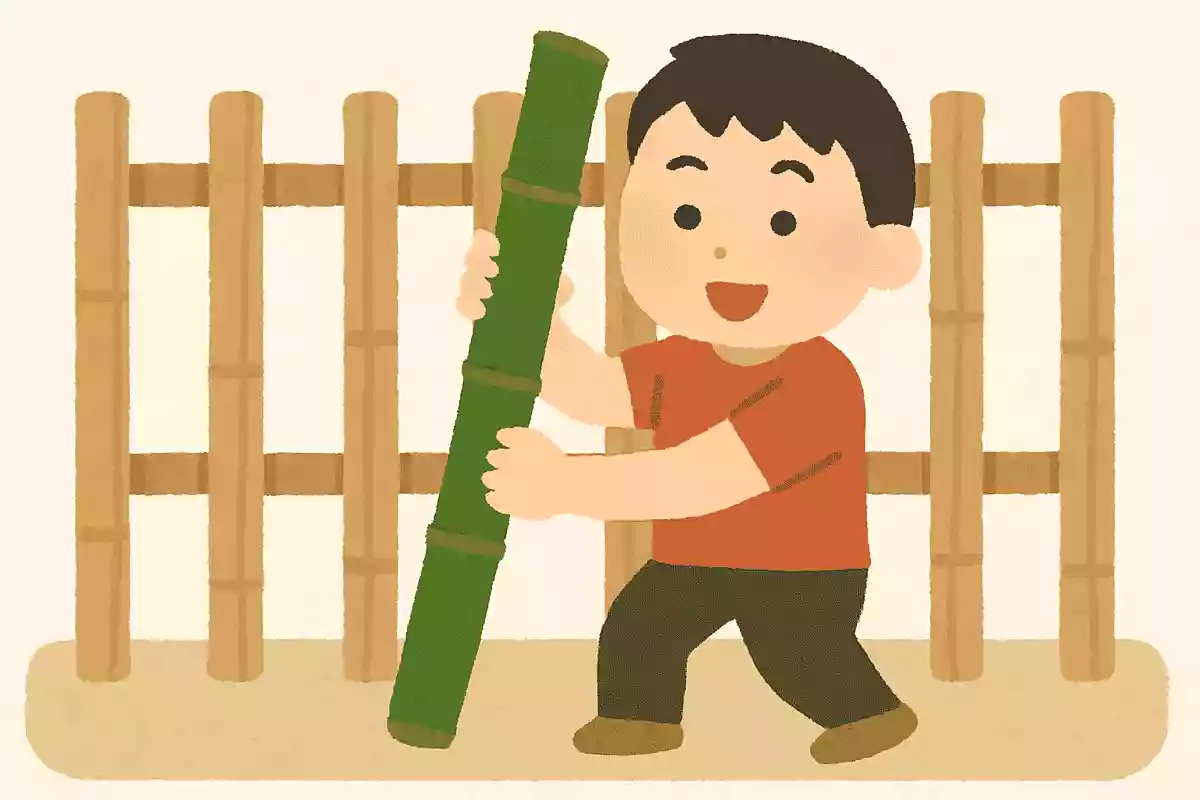
Among the many types of tongue twisters, one that is known to be especially difficult is: “Kono takegaki ni take tatekaketa no wa, take tatekaketakatta kara take tatekaketa.” Put simply, it evokes the image of bamboo being propped against a bamboo fence.
Once you understand what kind of situation it’s describing, you’ll be less likely to get confused.
That said, it’s quite a long tongue twister, so memorizing it is no easy task.
Start by reading it repeatedly to commit it to memory.
If Lady Yodo is who she is, then Lady Nene is who she is too.

There’s a tongue twister related to Japanese history that goes, “If Lady Yodo is the way Lady Yodo is, then Lady Nene is the way Lady Nene is.” In fact, this tongue twister is a line delivered by Jiro Sato in the 2009 NHK Taiga drama Tenchijin.
In other words, “Lady Yodo” refers to Yodo-dono, a concubine of Toyotomi Hideyoshi, and “Lady Nene” refers to Kōdai-in, his principal wife.
The tricky part of this tongue twister is the repeated ‘do’ sound.
Since the same sound comes in quick succession, practice carefully so you don’t get mixed up!