

For Seniors: Effective Recreation for Preventing Care Needs—Have Fun While Staying Healthy


For the physical and mental well-being of older adults, rehabilitation that involves moving the arms and legs is ideal.
However, simply following a set rehabilitation routine doesn’t always lead to motivation.
In this article, we introduce enjoyable recreational activities that contribute to arm and leg rehabilitation for older adults.
From group activities that everyone can get excited about to options you can focus on individually, you’ll surely find fun ways to work on functional improvement.
Choose according to each person’s physical and mental condition.
We hope you find this helpful.
- [For Seniors] Enjoy safely even during the COVID-19 pandemic: Seated activities
- [For Seniors] Refresh Your Mood! Lively, Get-Moving Games
- [For Seniors] Recreational activities and games that let you have fun while strengthening your legs
- [For Seniors] Simple Recreational Activities You Can Enjoy While Seated
- For Seniors: Fun and Lively Exercise Recreation
- [For Seniors] Guaranteed to Liven Things Up! A Collection of Brain Training Activities That Will Spark Laughter
- [For Seniors] Fun Recreational Activities Without Equipment
- [For Seniors] Core Training: Recommended Simple Rehabilitation
- [For Seniors] Easy and fun seated activities you can do in your room
- [For Seniors] Introducing Recreational Activities Anyone Can Enjoy at Geriatric Health Facilities!
- [For Seniors] Leg and lower-back training: Fall prevention
- For seniors: Leg-strengthening exercises you can do without overexertion.
- Recreation Activities Effective for Long-Term Care Prevention for Seniors
[For Seniors] Effective for Preventing the Need for Nursing Care! Fun Recreational Activities (81–90)
Stomp-and-pop balloon launch
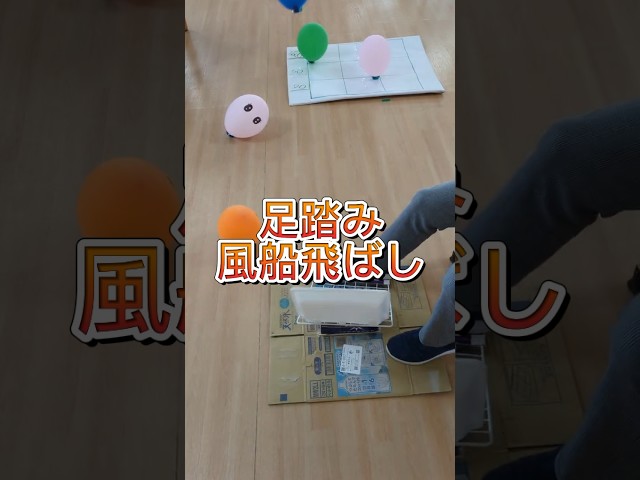
Let’s pop a balloon into the air with a boing! Here’s an idea for a foot-powered balloon-launch game—perfect if you’re looking for a unique activity that uses the feet.
You’ll need items like cardboard, a low platform, a board or mesh, a tray, balloons with weights attached, and a score chart drawn on poster paper.
While seated in a chair, place your feet on the board; using the lever principle, the balloon will launch with a fun “pop!” It’s an easy activity to try and also a good way to move the hip joints.
Give it a go and incorporate it into your sessions!
Shiritori Card Game

Haven’t many older adults played shiritori at least once? Here’s a familiar shiritori-style card game for seniors.
Prepare cards with each of the 50 Japanese syllables written on them, and deal five cards to each player.
Place the remaining cards in the center and draw one card to start.
Think of a word that begins with the syllable of the drawn card, so that the last letter of your chosen word matches one of the cards in your hand.
Adding a rule like “use three-letter words” makes it even more fun and can help stimulate the brain.
The first person to use up all their cards wins.
Let’s all enjoy thinking of words together while we play.

Onigiri Game

Let us introduce the “Onigiri Game,” a fun way to rehabilitate from fingers to arms.
Connect a stick and a plate with a string, placing the stick on your near side and the plate on the opposite side.
Set the rice balls (onigiri) on the plate to start.
Participants use their hands to turn the stick and wind up the string.
The plate will gradually be pulled closer, but don’t let the onigiri fall.
Wind steadily—neither too fast nor too slow—while watching out for obstacles.
The player with more onigiri at the end wins.
You can enjoy it repeatedly by adding more obstacles on the table or making the onigiri lighter, and so on.

Rolling beach ball

It’s a game where you skillfully control a string connected to the chair opposite you to move a beach ball resting on it.
Your ability to judge how moving the string in your hands affects the ball’s motion is put to the test.
You move the ball by changing angles and widening the span, while simultaneously being careful not to let the string slack—this dual task helps stimulate the brain.
The longer the string, the harder it is to control, so once you get used to it, we recommend gradually trying longer setups.

Care prevention exercises to the tune of Kiyoshi’s Zundoko-bushi

These days, Kiyoshi Hikawa has been showcasing new sides of his charm to the public.
I imagine there are fans of Kiyoshi Hikawa among older adults as well.
And when it comes to his hit songs, “Kiyoshi no Zundoko-bushi” comes to mind, doesn’t it? It’s a tune known across many generations.
Let’s move our bodies to “Kiyoshi no Zundoko-bushi.” The key to exercise is consistency.
If the workout uses a song familiar to older adults, it might be easier to keep it up while having fun.
By all means, try singing along as you do the exercises.
Beat the summer heat: chair exercises

When it’s hot, we tend to go outside less, but let’s keep our bodies moving moderately to prevent summer fatigue and maintain our health.
Here, we’ll introduce simple exercises you can do while seated.
After loosening up by rolling your shoulders and twisting your upper body, add in marching in place and lifting your knees to touch your hands.
Finally, move your body while vocalizing to also strengthen the muscles around your mouth.
Do these within a comfortable range in a cool indoor environment, and be sure to stay well hydrated.

[For Seniors] Effective for Preventing Need for Care! Fun Recreational Activities (91–100)
Heatstroke and summer fatigue prevention exercises

As July arrives, the heat really starts to set in.
Building physical stamina becomes important for preventing heatstroke.
With that in mind, here are some exercises you can do while seated.
Try making big circles with your shoulders and arms, and lifting both legs.
It’s also important to keep doing the exercises consistently.
Please make sure to exercise within a comfortable range for older adults.
Doing the exercises while speaking out loud may also help you refresh your mood.
In addition to exercise, remember that staying hydrated and getting enough sleep are also essential, so please keep those in mind.