


How to play dominoes. Domino games that don't involve knocking them down, too!

Speaking of dominoes, they’re the toy you line up and topple over! It’s fun to set up a long line of dominoes and knock them down all at once, and if they all fall perfectly, you get a real sense of accomplishment.
There are many ways to play with dominoes, like creating domino art.
You can also enjoy strategic games using domino tiles, known as dominoes.
In these games, you typically connect tiles with matching numbers and compete for points.
The rules might be a bit hard to learn at first, but once you try, it’s really fun—give it a go! Find the style of domino play you like best.
Dominoes for toppling
Pythagoras Switch-style domino toppling

PythagoraSwitch, a hugely popular NHK E-TV program loved by kids and adults alike, features elaborate domino-style contraptions that use all kinds of clever tricks.
These “Pythagora Devices” are reportedly built in three days and filmed on the fourth day, sometimes requiring as many as 145 takes.
Even though they’re called devices, if you look closely, the mechanisms use everyday stationery and household items you can find in any home, which makes you feel like you could try it yourself.
With the right ideas, you might even create a domino contraption to rival a Pythagora Device.
domino toppling

In a vast space, numerous dominos are lined up—artistically, and without knocking a single one over.
In the end, will they all fall? There used to be a TV show like that, didn’t there? It’s said that the origin of “domino toppling” dates back to the 16th century in Europe, where it began as a pastime among nobles.
Initially, the goal wasn’t to topple them, but to admire the beauty of how they were arranged.
In Japan, there’s a similar game called “shōgi-taoshi.” Why not experience for yourself the sense of accomplishment—now a bit rare—that comes from finishing the setup, and the suspense of wondering whether they’ll all fall at the end?
Domino art

Domino art is where you complete a picture by toppling arranged dominoes.
The CG-made Mario domino display became a huge topic, didn’t it? While it’s tough to stack dominoes like in CG, I think it’s definitely possible to lay them out on a flat surface, knock them over, and create an image.
Why not decide what picture you want to complete and try building it while calculating the color scheme and the placement of each domino? When the image you envisioned appears, you’ll surely feel a great sense of accomplishment.

A game using domino tiles
Mexican Train

In Mexican Train, the basic rules are the same as in other domino games.
Your goal is to play all your tiles, and on your turn you connect a tile from your hand to match the number showing at the end of a chain.
At the end of a round, the total of the pips left in your hand becomes negative points, and after the predetermined number of rounds, the player with the fewest negative points wins.
Unique to this game, each player has their own train, and you can play tiles only on your own train or on any open train.
If you have no playable tile and pass, your train becomes open, allowing other players to play on it.
There are also rules about doubles: a player who plays a double must immediately play a second tile, and when a double is played, all players are required to play on that double until it is satisfied.
It’s a lot of fun—give it a try!
chicken foot

Let me introduce a game called “Chickenfoot.” You use all the domino tiles.
After dealing tiles to each player as their hand, place the remaining tiles face down to form a boneyard.
Decide the play order, then place a single starting tile vertically.
Players connect tiles that have the same number.
If you can’t play, draw one tile from the boneyard; if you still can’t play, you must pass.
Continue taking turns until someone runs out of tiles, or the boneyard is empty and everyone passes.
At the end, add up the pips on the tiles remaining in each player’s hand—this total becomes their negative points.
After the set number of rounds, the player with the lowest negative score wins!
Block Game

This is a “Block Game” played with blocks numbered 1 to 6.
First, turn all the blocks face down and mix them.
Each player then takes 7 blocks.
The remaining blocks are not used.
Decide who goes first with rock-paper-scissors, and the first player plays any one block.
From then on, you may play only one block at a time, and it must match the number at one of the ends.
If you have no playable block, you may pass as many times as you like.
The first player to play all their blocks wins.
The losing player’s remaining block numbers are added up and that total becomes the winner’s points.
The first player to reach 50 points wins!
Board games / card games
Kingdomino
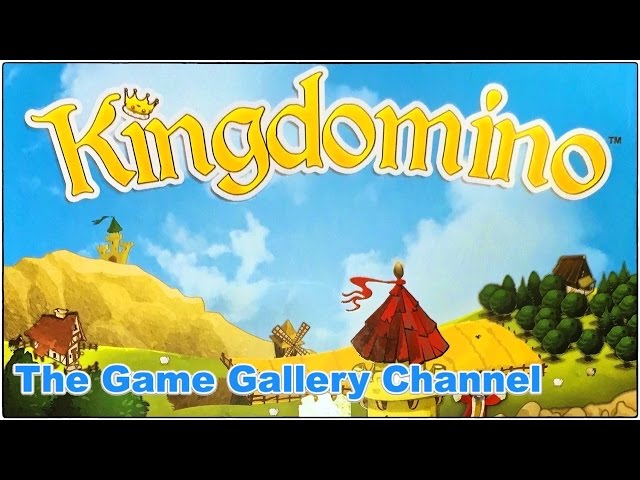
Kingdomino is a game where you build your own kingdom.
Each player is dealt one starting tile, and you connect tiles with matching terrain to it; when you’ve completed a 5×5 grid, your kingdom is finished! Scoring is the number of crowns on a terrain type multiplied by the number of connected squares of that terrain.
The player with the highest score wins! You acquire tiles through a drafting system: the higher the number printed on a tile, the more likely it is to have crowns.
However, players who choose lower-numbered tiles get priority in selecting in the next round, so if you pick a high number, you’ll pick later next turn.
Even if a crowned tile appears, you’ll have to discard it if you can’t place it.
The rules are simple, but the game offers fun strategic choices and bluffing!