

[With Video] Lower-limb strength training for seniors that can be done in bed

As people get older, they tend to have fewer opportunities to move, and some find it difficult to walk due to issues like lower back or knee pain.
You might be wondering, “Are there any simple exercises I can do in bed?”
In this article, we’ll introduce lower-body exercises you can do while lying in bed.
To help you maintain a healthy body for as long as possible, try incorporating them little by little.
Since some exercises may not suit everyone, if you feel pain, please switch to a different one.
- For Seniors: Strength Training You Can Do While Lying Down
- For seniors: Leg-strengthening exercises you can do without overexertion.
- [For Seniors] Strengthen Your Legs! Recommended Training Items
- [Seated] Fun Health Exercises for Older Adults and Seniors
- [For Seniors] Exercises to Walk Again. Fall Prevention
- [For Seniors] Fun Exercises You Can Do While Seated
- [For Seniors] Recommended Easy Strength Training
- Summary of exercises for seniors: introducing preventative care movements by body part.
- [For Seniors] Recreational activities and games that let you have fun while strengthening your legs
- [For Seniors] Leg and lower-back training: Fall prevention
- [For Seniors] Core Training: Recommended Simple Rehabilitation
- [For Seniors] Walking Training: Simple, Easy-to-Do Ideas
- For Seniors: Back-Strengthening Exercises, Calisthenics, and Stretches—Workouts Women Can Do Without Strain
[With Video] Introducing Lower-Limb Strength Training for Seniors That Can Be Done in Bed (1–10)
Pelvic floor muscle training in an all-fours positionNEW!

This is a hands-and-knees (all-fours) exercise that makes it easier to feel the muscles deep in the lower abdomen and pelvis while maintaining a stable position with your hands and knees on the floor.
By supporting your body with your hands and knees, the weight of your internal organs doesn’t press directly on the pelvic floor, making it easier to sense the muscles working.
Bend your knees slightly, engage your lower abdomen as if drawing your groin toward your navel, and hold the gentle “squeeze” for about 10 seconds.
You’ll feel the pelvic floor muscles working gradually.
It’s easy to continue without strain and helps improve stability in your posture and the way you walk, so it’s recommended.

Pelvic floor exercises while lying down (1): supine position, towelNEW!

This is an exercise you can do lying on your back.
First, lie on your back with your knees bent and place a rolled towel between your knees.
In this position your body is stable, you’re less likely to tense unnecessary muscles, and it’s easier to feel your pelvic floor.
As you slowly exhale, tighten your lower abdomen and the area around the anus, gently lift your hips, and notice the light tilting of your pelvis.
As you inhale, slowly release the tension, then lift and lower in the same way, holding each phase for about 5 seconds, repeating around 10 times.
If you feel any low back pain, don’t push yourself—do it only within a comfortable range.
Pelvic floor exercises while lying down (2): Side-lying positionNEW!

This is a training method that makes it easier to stabilize your body and sense your muscles.
First, lie on your side and bend your knees toward your abdomen to create a relaxed position.
While applying gentle resistance with your hand, try consciously tightening your anus and lower abdomen with a firm “squeeze” as you slowly exhale.
The pelvic floor muscles form the base of the pelvis, supporting the internal organs and playing an important role in urination and defecation.
Repeating these intentional contractions can be expected to enhance their function.
As you inhale, relax the effort, and repeat the same movement about 10 times on each side; your inner thighs and deep abdominal muscles will work together, helping to stabilize your core.
[With video] Introducing lower-limb strength training for seniors that can be done in bed (11–20)
Pelvic floor exercises you can do lying down for 5 minutes every dayNEW!
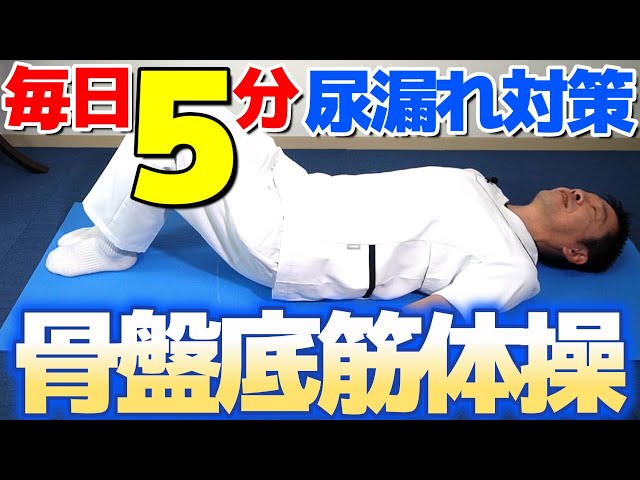
This is a low-impact workout that’s easy to start.
First, lie on your back, bend both knees, and keep them together.
Tighten your anal muscles firmly and hold for 10 seconds.
After 10 seconds, spread your feet to shoulder width, lift your hips, and hold steadily for 5 seconds.
Then, as you inhale, slowly relax and return to the starting position.
Training on your back helps your body relax and makes it easier to understand how to engage your muscles, so you can easily keep it up for short sessions before bed or right after you wake up.
There’s also a method on all fours introduced here, so try incorporating it at your own pace without overexerting yourself.
Yoga to Strengthen the Pelvic Floor MusclesNEW!

Let’s strengthen the pelvic floor with simple yoga.
It can help with urinary leakage, pelvic alignment, and reducing a bloated lower belly.
In the first half, lie on your back, bend your knees and open/close them, and move your extended legs up and down.
In the second half, sit with your knees up and open them wide to each side.
Next, cross both legs and fold your upper body forward.
Finish with Child’s Pose to release the lower back and spine.
Since it’s yoga, be mindful of your breathing throughout.
One set takes about 8 minutes.

Butt lift exercise

The butt-lift exercise is a simple lower-limb workout you can do in bed.
It’s recommended even for people with back or knee pain.
Since you just lift your hips while lying on your back, it’s easy to do without strain.
It strengthens the muscles around your buttocks and lower back, helping your everyday movements feel smoother.
Engage your muscles slowly and lift your hips.
If you feel the tension, try holding that position.
Adjust the number of repetitions and duration to suit your body.
If you feel pain, stop immediately.
If you keep at it little by little, you should start to notice changes in your body.
Ball Squeezing Exercise

“Ball-squeeze exercise” is an easy lower-limb strength training you can do in bed.
Place a soft ball under your knees and press down to squash it.
It helps strengthen the muscles around your lower back and knees, so it’s recommended for people with back or knee pain.
Because you use the ball’s rebound, it improves not only strength but also flexibility and stability.
But don’t overdo it—go at a slow pace and stop immediately if you feel pain.
It can also help improve everyday movements, so try it according to how you’re feeling.