

[For Seniors] Surprisingly Unknown!? Quiz on Various Counters for Everyday Items and Animals

“Rabbits are counted as one ‘wa,’ two ‘wa’; soba noodles as one ‘mai,’ two ‘mai’… In Japanese, the way we count things and living creatures varies depending on what they are.
Even words we use without thinking can make us hesitate—‘Wait, how was that again?’—when asked for the correct counter.
In this article, we’ve gathered quiz-style questions that let you enjoyably learn these uniquely Japanese counting expressions.
They’re full of classic, beautiful turns of phrase and surprising origins, making them perfect for a bit of brain training.
They’ll also spark lively conversation with family and friends—‘Hey, did you know this?’ Give it a try!
- [For Seniors] How many can you read? A kanji quiz of familiar things that look readable but aren’t
- [For Seniors] Difficult-to-Read Kanji for Everyday Items: Take on a quiz full of surprises and discoveries
- [For Seniors] Recommended Brain Training! A Fun Collection of Math Quizzes
- [For Seniors] How many can you read? A comprehensive showcase of difficult food kanji
- [For Seniors] Fun and Exciting! Difficult Kanji Quiz
- [For Seniors] Quiz on Kanji with Many Strokes
- [For Seniors] Multiple-Choice Quiz Collection About Living Creatures
- [For Dementia Prevention!] Brain-Training Math Quiz for Seniors
- [Brain Training] Lively Word Quiz for Seniors
- [For Seniors] Four-character idioms that include numbers. How many do you know?
- [For Seniors] Fun 3-Choice Animal Quiz! Introducing Questions Full of Surprises and Discoveries
- [For Seniors] Fun and Lively! Recommended Quiz Questions
- [For Seniors] Laugh-Out-Loud, Crowd-Pleasing! Fun Quiz
[For Seniors] Surprisingly Unknown!? Quiz on Various Counters for Familiar Objects and Animals (1–10)
Which of the following is the correct counter for a chest of drawers?

- leg; foot; ash of a drink (legs); stand/support (of furniture); stanza/act (theater)
- pole; rod; shaft; bar (e.g., of a balance); neck (of a stringed instrument). Note: reading is 'sao'.
- book
See the answer
pole; rod; shaft; bar (e.g., of a balance); neck (of a stringed instrument). Note: reading is 'sao'.
The correct counter for a tansu (Japanese chest of drawers) is “issao” (one sao). Originally, sao refers to a pole used for rowing a boat, but it is also used for large items and long, slender objects like furniture. In traditional Japanese, sao is used to count furniture such as tansu and nagamochi (long storage chests). While “ichidai” (one unit) is also used in modern times, the formally correct traditional expression is “issao.” It’s not a counter you hear often in daily life, so it’s worth remembering.

Which of the following is the correct way to count chairs that have legs?
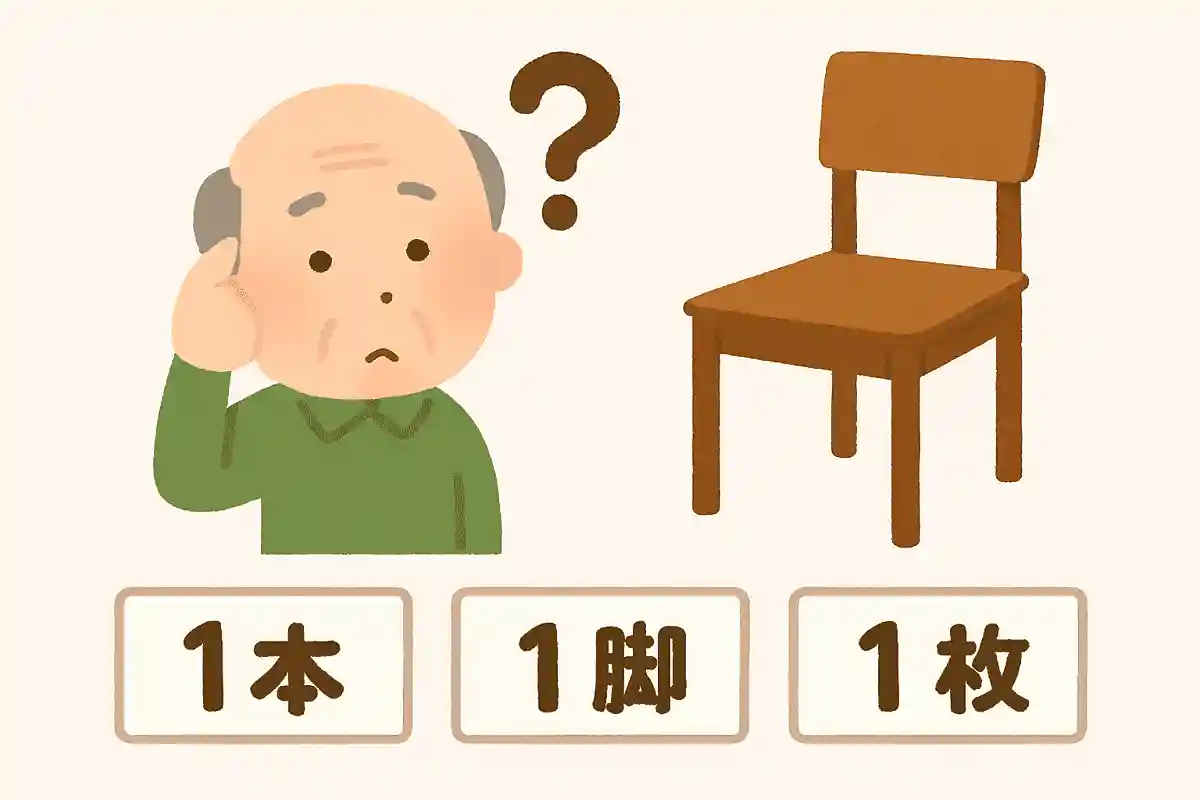
- leg; foot; ash of a drink (legs); stand/support (of furniture); stanza/act (theater)
- stand; platform; table; counter (for counting machines, vehicles, etc.)
- book
See the answer
leg; foot; ash of a drink (legs); stand/support (of furniture); stanza/act (theater)
When counting chairs that have legs, we use the unit kyaku, as in ikkaku (one), nikyaku (two). This kyaku is a traditional counter used for furniture with legs, such as chairs and desks. On the other hand, dai is mainly used for machines, vehicles, electronic devices, or things that function as a stand or platform. Hon is used for long, slender, stick-like objects.
Which of the following is the correct way to count butterflies?
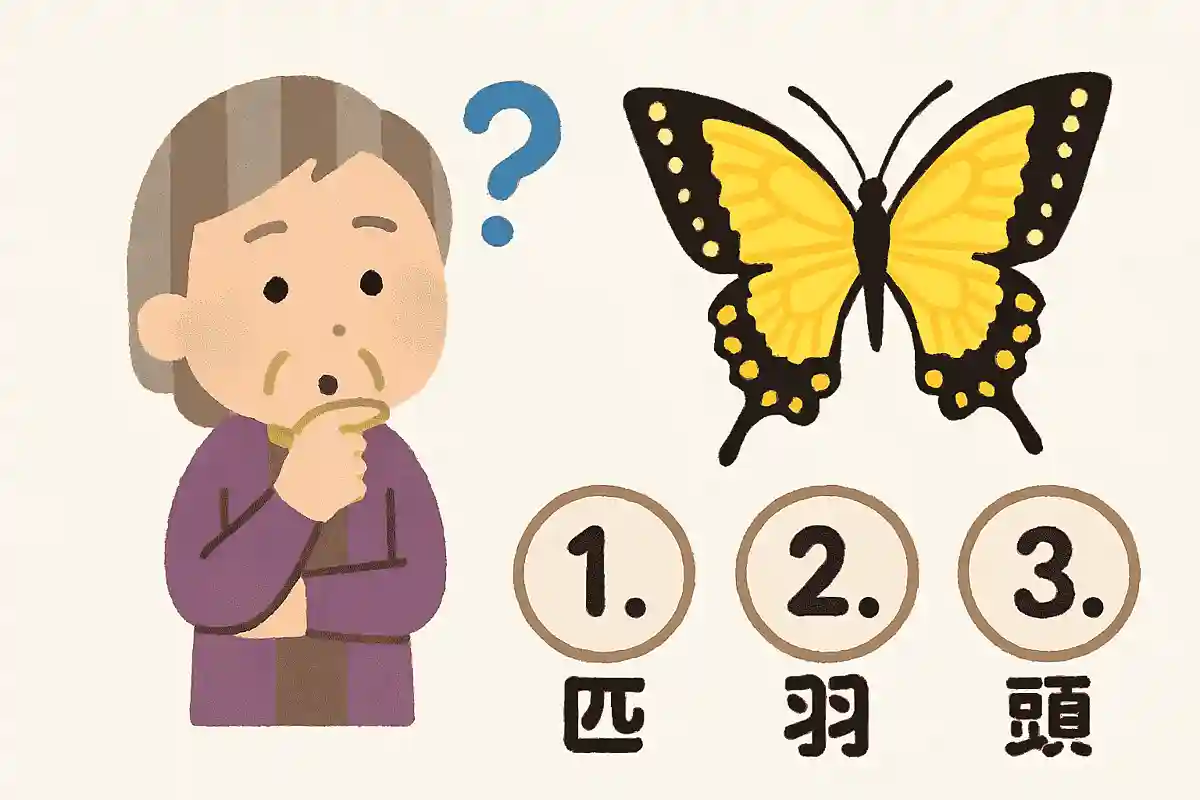
- individual; piece; counter for small objects (ko)
- book
- head
See the answer
head
Insects such as butterflies and dragonflies are generally counted using the counter “頭” (tō). Although “頭” was originally used mainly for counting animals like mammals, this counting method is also applied to relatively large insects. Butterflies can also be counted with “匹” (hiki), but strictly speaking, “頭” is the more formal expression. “個” (ko) and “本” (hon) are not typically used for butterflies.
[For Seniors] Surprisingly Unknown!? Quiz on How to Count Familiar Objects and Animals (11–20)
Which of the following is the correct way to count calendars?
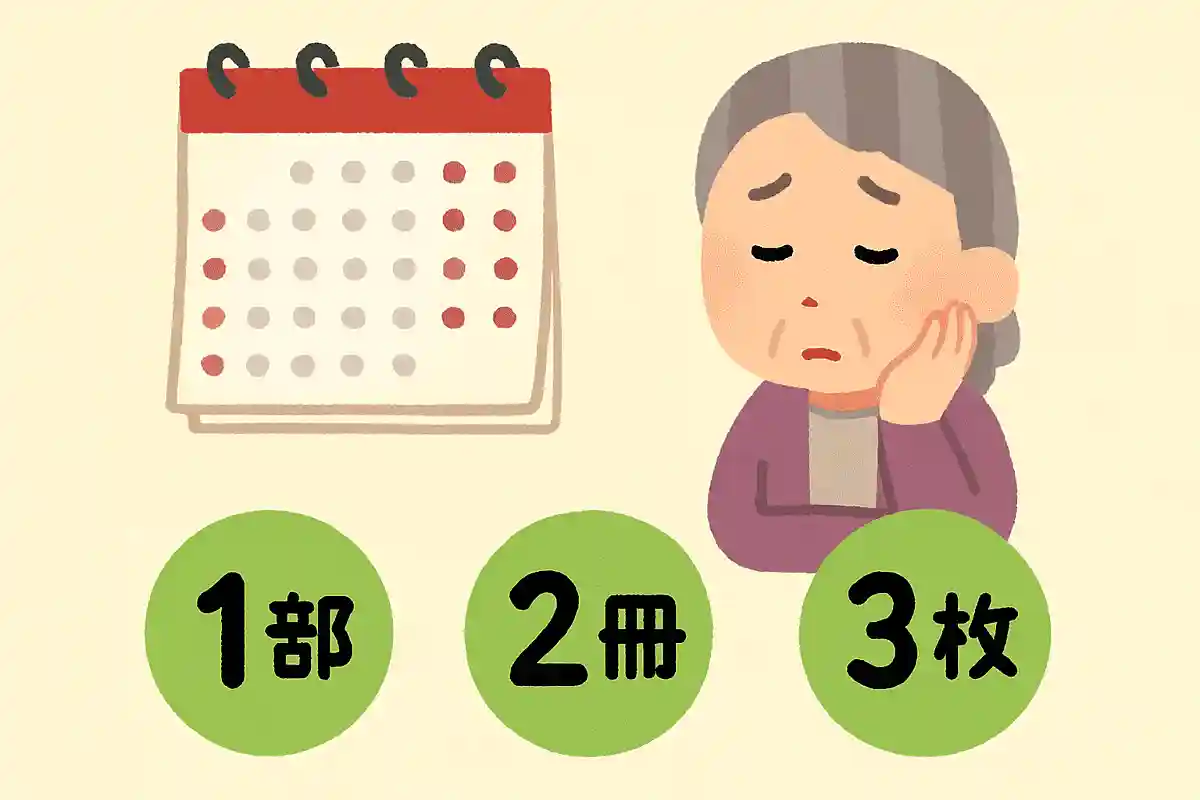
- book
- department; section; part; club (in school); category; counter for copies (e.g., newspapers)
- counter for flat objects (mai)
See the answer
department; section; part; club (in school); category; counter for copies (e.g., newspapers)
It’s common to count calendars using the counter “bu.” For example, saying “Karendā o san-bu kudasai” means you want three calendars. The counter bu is used to count sets of documents or booklets, and while calendars are basically counted with bu, depending on the situation you can also use satsu or ko.
Which of the following is the correct way to count gloves?

- counter for flat objects (mai)
- book
- pair; couple; twin
See the answer
pair; couple; twin
Since gloves come as a pair (two making one set), they are counted as “issō” (one pair) and “nisō” (two pairs). Sō is a counter used for items that come in pairs. For example, shoes and geta (traditional Japanese wooden clogs) are also counted as “issō.” “Mai” is used for thin or flat objects, and “hon” is used for long, slender objects, so they are not suitable for gloves.
Which of the following is the correct way to count pieces of nigiri sushi?
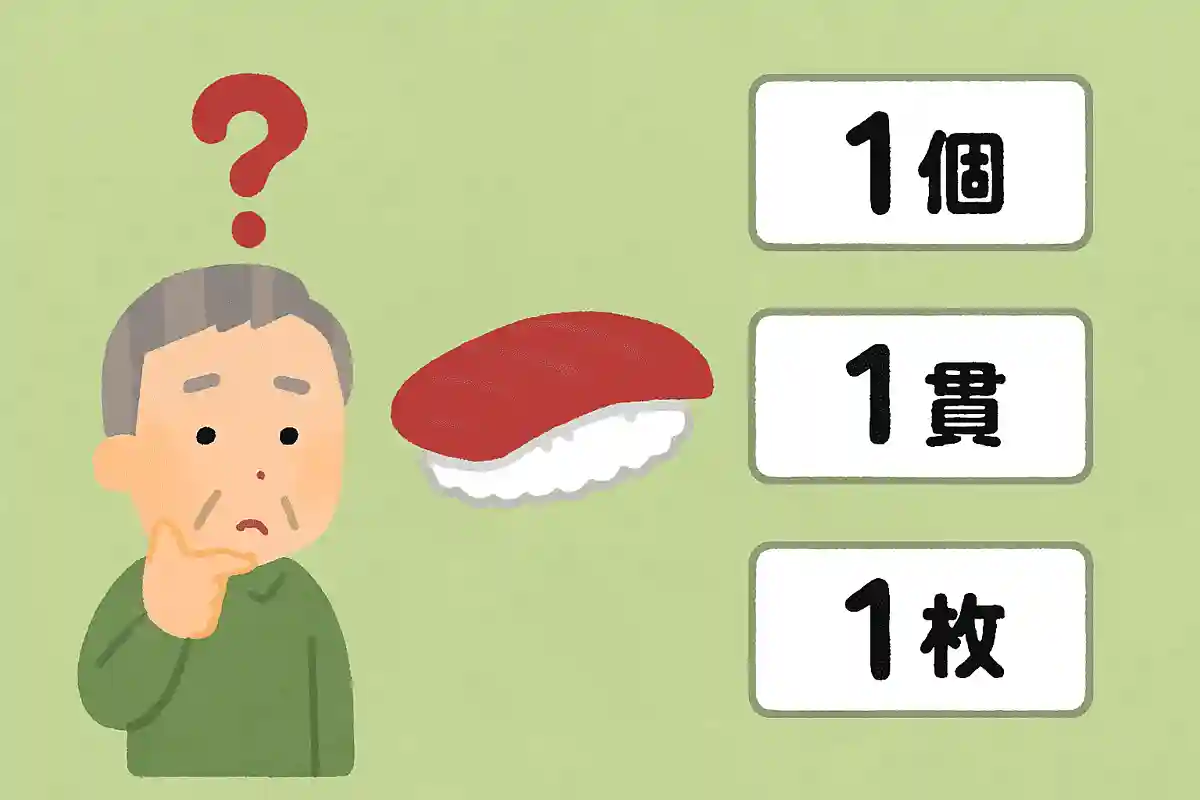
- kan
- cup
- counter for flat objects (mai)
See the answer
kan
Nigiri sushi is counted using the unit kan, as in ikkan (one piece) or nikan (two pieces). Kan was originally a unit of weight, but in sushi restaurants it is used to refer to individual pieces of sushi. In contrast, other foods use different counters: onigiri (rice balls) use ko (pieces), and sashimi uses kire (slices). Therefore, saying something like “Sankan kudasai” (“Three pieces, please”) when ordering sushi is the correct usage.
Which of the following is the correct way to count bundles of dried noodles?
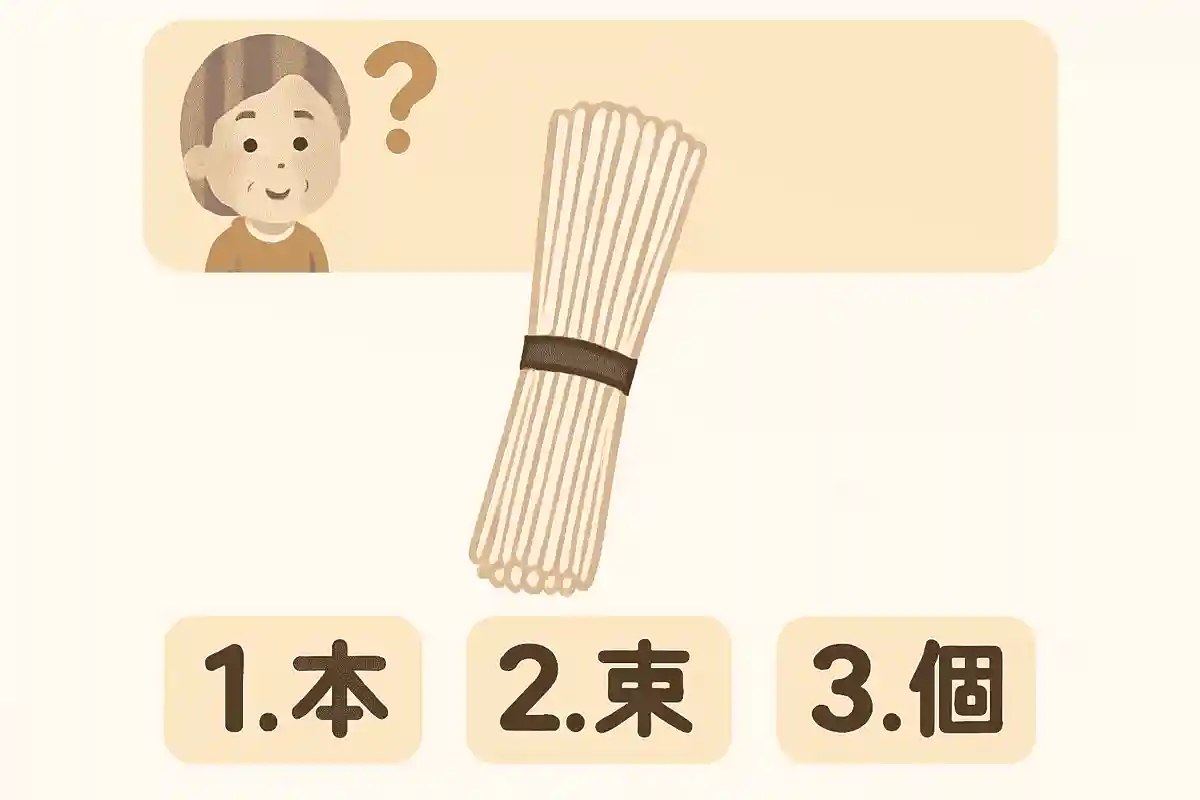
- book
- counter for bundles; handful
- counter for flat objects (mai)
See the answer
counter for bundles; handful
When several dried noodles are tied together into a bundle, the unit used to count that bundle is “wa.” For example, you might say, “Please give me three wa of sōmen.” While the term “taba” (bundle) is also used for banknotes or other bundled items, for dried noodles the unit “wa” is mainly used. It’s a counting unit we don’t usually think about in daily life, but it’s a correct Japanese measure worth remembering.