

![[For Dementia Prevention!] Brain-Training Math Quiz for Seniors](https://i.ytimg.com/vi_webp/phMjHhhZW4Q/maxresdefault.webp)
[For Dementia Prevention!] Brain-Training Math Quiz for Seniors

A recommended activity for preventing dementia in older adults is doing arithmetic problems.
By doing calculations, you train the brain’s cognitive functions, which can help prevent dementia.
In this article, we introduce arithmetic exercises that are great brain training for seniors.
We’ve compiled problems that support dementia prevention, including addition and subtraction, read-aloud calculation exercises, and quick-response calculation tasks.
Since calculation problems really make you use your brain, it’s important to take it slow and keep at it steadily without overexerting yourself.
Try incorporating arithmetic brain-training exercises that can help prevent dementia.
For Dementia Prevention! Brain-Training Math Quiz for Seniors (1–10)
Scattered calculation problems

A mental arithmetic problem where you just keep adding numbers—or so it seems at first.
In reality, there are many numbers, and they’re all facing different directions, making it a jumbled calculation challenge.
You might panic for a moment when you see the screen, but stay calm and add them one by one, in order! If it’s tough, try preparing paper and a pen, rewrite the numbers in the correct orientation, rearrange them, and then do the addition.
Even those who feel uneasy about numbers will likely enjoy this kind of calculation puzzle.
It’s a format you can easily adapt to create many different problems.

Katakana Oral Reading Calculation

Even calculation problems become much harder—and more game-like—when you read them aloud.
This is a type of calculation exercise where you convert numbers into words and enjoy solving them, but with a twist: the questions are presented in katakana.
It might make your brain feel tangled for a moment, but take a close look, think it through carefully, and give it a try.
Of course, it’s good to start with simple problems, and it’s also helpful to do some practice exercises as a warm-up until you get used to it.
For the warm-up, don’t set time limits—just start by getting familiar with the problems.
Discount calculation problem

Let’s try tackling some word problems that involve decimals! This quiz is based on those common “percent off” sale signs you see at stores.
You might have an intuition for discounts like “10%” or “20%,” but what if it’s something like “0.1%”? Suddenly it gets a bit tricky to figure out how to calculate it.
The key is how to convert the “%” notation.
It’s great to challenge yourself on your own, but discussing and solving the problems with friends can be fun too!

Date calculation
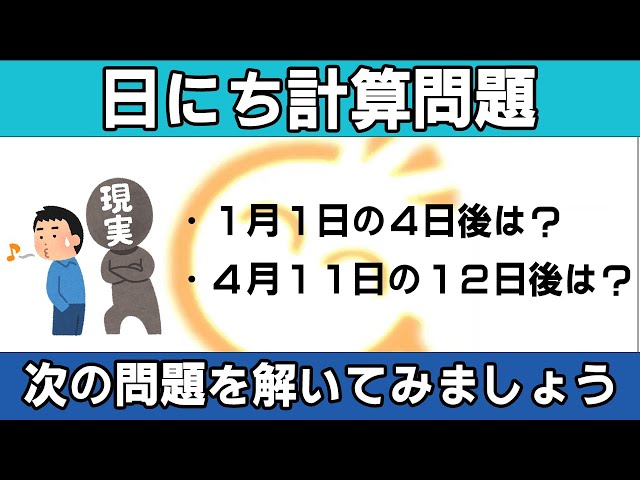
It’s an arithmetic problem where you add, but the answer is a date.
For example, you might be asked, “What is 7 days after March 4?” and you figure out what month and day that is.
It sounds simple, but when the number you add has two digits, you can find yourself thinking, “Huh?” You can present several questions at once and think them through carefully, or set a time limit and answer one by one.
You can also make it harder with questions like “What is 5 days before January 1?” which cross months or involve subtraction.
time calculation

Time and clocks are inseparable from our daily lives, aren’t they? We might think clocks are easy because we’re used to seeing them every day, but there are word problems where you have to answer the time.
For example, a calculation problem where you listen and respond: “What time will it be 30 minutes after 10:15?” Start with simple problems in 10-minute units, then increase the difficulty by adding times like 25 or 45 minutes, and gradually move on to adding less straightforward amounts like 18 or 32 minutes, which makes the problems more challenging.
Change calculation

Calculation problems are perfect for brain training and easy to enjoy, aren’t they? Still, some people may feel put off or think they’re bad at anything involving calculations.
How about trying it in a more relatable way, like change-making problems? That feels less intimidating than “doing calculations” or “mental math” and sounds more fun.
For example, you have 500 yen and you buy a 100-yen tomato, an 80-yen cucumber, and a 150-yen eggplant.
Since you’re buying several items rather than just one, you add them up and subtract the total from the money you have—a problem that makes you use your head.
CrePri calculation problems

Four numbers are arranged in a row.
Add each pair of adjacent numbers, write the one-digit result on the line below, and you’ll now have three numbers.
Again, add each adjacent pair, write the two resulting numbers on the next line, and finally add those to get a single number as the answer.
It’s a reverse-pyramid style calculation problem.
Although it’s just addition, this setup makes for a pretty good brain workout.
You can adjust the difficulty by changing how many numbers you start with.