

[For Dementia Prevention!] Brain-Training Math Quiz for Seniors

A recommended activity for preventing dementia in older adults is doing arithmetic problems.
By doing calculations, you train the brain’s cognitive functions, which can help prevent dementia.
In this article, we introduce arithmetic exercises that are great brain training for seniors.
We’ve compiled problems that support dementia prevention, including addition and subtraction, read-aloud calculation exercises, and quick-response calculation tasks.
Since calculation problems really make you use your brain, it’s important to take it slow and keep at it steadily without overexerting yourself.
Try incorporating arithmetic brain-training exercises that can help prevent dementia.
- Calculation problems that train the brain for seniors
- [For Seniors] Recommended Brain Training! A Fun Collection of Math Quizzes
- [For Seniors] Fun and Lively! Recommended Quiz Questions
- [For Seniors] Find daily brain training. Today’s recommended brain workout.
- [For Seniors] Recommended for Brain Training! Ultra-Difficult Quizzes and Riddles
- [For Seniors] Brain Training with a Whiteboard! Fill-in-the-Blank Exercises & Quizzes
- [For Seniors] Brain Training Recommended for Dementia Prevention
- [For Seniors] Today’s recommended quiz. Daily brain-training quiz!
- [Brain Training] Lively Word Quiz for Seniors
- [For Seniors] Lateral Thinking Game! Brain Training
- [For Seniors] Fun Riddles That Stimulate the Brain
- [For Seniors] Great for Brain Training! Question Card Ideas
- [For Seniors] Popular Brain Training and Recreational Quizzes
For Dementia Prevention! Brain-Training Math Quiz for Seniors (1–10)
Which number is larger?

A series of rapid-fire questions asks you to identify which of two numbers is larger.
You’ll choose whether the right or left number is greater.
Sometimes only plain numbers appear, but occasionally one side is an addition expression, and sometimes both sides are additions.
Seeing an addition problem pop up suddenly might be confusing, but don’t rush—take your time to think it through.
Once you get used to it, you can make it more challenging and fun by turning the addition parts into subtraction or other operations.

instant calculation
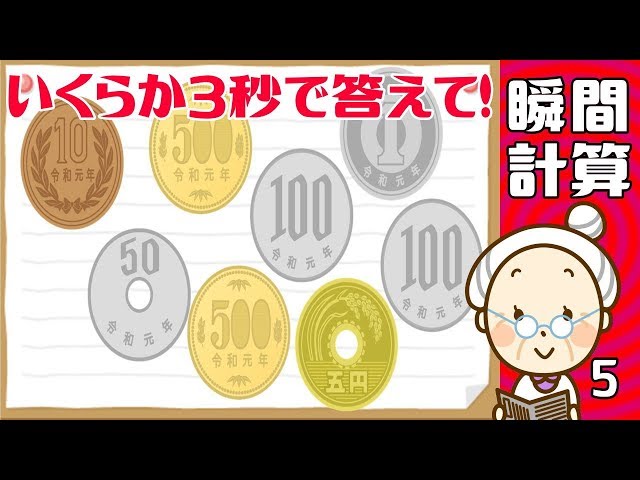
This is a set of exercises where you calculate the total value of several coins displayed on the screen.
The key point is that it’s not just a stream of numbers.
While you’re checking each one—“this is 1 yen, this is 10 yen…”—the display time runs out.
So it’s designed to train quick thinking.
The fact that the arrangement changes each time might also be a pretty important factor.
Imitating the video by actually preparing coins and doing it on your desk seems good too, since it makes randomness and difficulty adjustments easy.

Mix-and-match calculation

This is a mixed-up calculation drill where addition, subtraction, multiplication, and division are combined in the problems.
Since it sometimes uses three numbers or two-digit numbers, they aren’t simple questions—you’ll have to think carefully.
There’s also a time limit for your answers, so speed is key! Those elements—the stimulation—help exercise your brain.
Applying the math rule “do multiplication and division before addition and subtraction” is another important point of this workbook.
With a bit of ingenuity, brain training can be limitless!
For dementia prevention! Brain-training arithmetic quiz for seniors (11–20)
Hiragana oral reading calculation

Many places likely incorporate simple arithmetic problems and mental math into brain training.
However, this set of problems presents addition and subtraction written in hiragana.
Just by introducing this one twist, the difficulty increases—and the fun does too! It turns the task into something that seems to engage different parts of the brain than ordinary addition.
If you find it a bit hard or confusing, feel free to take your time without worrying about the clock, or convert them into numbers and work them out on paper.
Grid Calculation Problems

This is a grid calculation problem where you add the numbers at the intersections of the rows and columns, like in a crossword-style grid.
Similar to those quick-reference charts where birth years are listed vertically and birth months horizontally, with numbers written at their intersections, the vertical and horizontal axes here have numbers, and you answer with the sums at the crossing points.
The more cells you have, the more problems you can create.
To start, you might try something simple with about five cells.
Even if you can’t answer or make mistakes, what matters is thinking—so don’t worry and keep solving!
Brain training math problems

Can you solve this puzzle in 10 seconds? It looks like the kanji “田,” with four divided sections containing numbers.
On the right, one section is missing a number; your task is to fill it so the total matches the sum of the squares on the left.
It may feel overwhelming with all the numbers at first, but don’t worry—the answer is already shown on the left, so if you think it through calmly, the solution will naturally come to you! The 10-second limit is the key, but if that’s tough, try 20 seconds instead.
fill-in-the-blank calculation

Mental arithmetic and calculation problems are popular as brain-training exercises you can enjoy even in small pockets of free time.
How about trying calculation problems where part of an addition or subtraction equation is left blank like a fill-in-the-gap? You look at the answer and one of the numbers in the problem to figure out the missing part.
A good way to keep it enjoyable for a long time is to gradually increase the difficulty: start with simple addition, then subtraction, then two-digit addition and subtraction, and then multiplication.
Whether you get the answer right or wrong doesn’t matter—thinking itself is what trains your brain.
Take your time, think it through, and strengthen your mind!